

Chapter 8· Analysis of Stream Macroinvertebrate Communities
131
N-l
d/t)=L(x;-W;/t))2
(8.1)
;=0
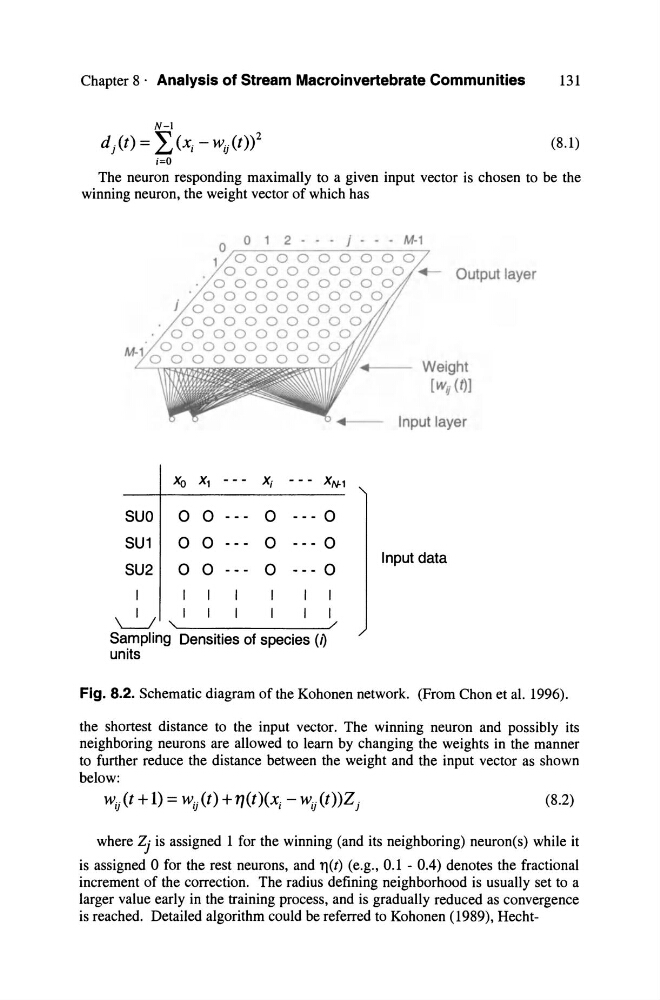
The neuron responding maximally to a given input vector is chosen to be the
winning neuron, the weight vector of which has
SUD
0 0
SU1
SU2
I
o 0
o 0
Xi
- - - XN-1
o
o
o
o
o
o
~"
~
Sampling Densities of species (I)
units
Outpu1 layer
Weight
[wij (t)]
Input layer
Input data
Fig. 8.2. Schematic diagram of the Kohonen network. (From Chon et al. 1996).
the shortest distance to the input vector. The winning neuron and possibly its
neighboring neurons are allowed to leam by changing the weights in the manner
to further reduce the distance between the weight and the input vector as shown
below:
Wij(t + 1) = Wij(t) + f/(t)(x; - Wij(t))Zj
(8.2)
where Zj is assigned 1 for the winning (and its neighboring) neuron(s) while it
is assigned 0 for the rest neurons, and l1(t) (e.g., 0.1 - 0.4) denotes the fractional
increment of the correction. The radius defining neighborhood is usually set to a
larger value early in the training process, and is gradually reduced as convergence
is reached. Detailed algorithm could be referred to Kohonen (1989), Hecht-
131
N-l
d/t)=L(x;-W;/t))2
(8.1)
;=0
The neuron responding maximally to a given input vector is chosen to be the
winning neuron, the weight vector of which has
SUD
0 0
SU1
SU2
I
o 0
o 0
Xi
- - - XN-1
o
o
o
o
o
o
~"
~
Sampling Densities of species (I)
units
Outpu1 layer
Weight
[wij (t)]
Input layer
Input data
Fig. 8.2. Schematic diagram of the Kohonen network. (From Chon et al. 1996).
the shortest distance to the input vector. The winning neuron and possibly its
neighboring neurons are allowed to leam by changing the weights in the manner
to further reduce the distance between the weight and the input vector as shown
below:
Wij(t + 1) = Wij(t) + f/(t)(x; - Wij(t))Zj
(8.2)
where Zj is assigned 1 for the winning (and its neighboring) neuron(s) while it
is assigned 0 for the rest neurons, and l1(t) (e.g., 0.1 - 0.4) denotes the fractional
increment of the correction. The radius defining neighborhood is usually set to a
larger value early in the training process, and is gradually reduced as convergence
is reached. Detailed algorithm could be referred to Kohonen (1989), Hecht-