

86
Sampling Design and Statistical Inference for Ecological Assessment
Ii~l Yihri where the sum is only calculated from
the yis from the rth stratum.
There are a variety of strategies for detennining
the stratum-specific sample sizes. For instance, proportional allocation specifies nr = nNrlN, where Nr
is the number of population units in the rth stratum. Proportional allocation gives each population
unit the same probability of being sampled. Stratum sample sizes can be allocated to minimize the
variance of t if estimates of the within-stratum
variances are available or to minimize the cost of
sampling if stratum-specific costs and variances
can be estimated. Levy and Lemeshow (1991) provide sample size fonnulas for these situations.
6.6.2 Systematic and Cluster Sampling
Systematic and cluster sampling designs are used
when it is more efficient to sample clusters of units
or to sample in regular patterns such as fixed intervals along a transect. Cluster sampling is based
on the idea of choosing one sample unit randomly
to start a cluster and several additional units nearby
to fill out the cluster. Systematic sampling selects
the sample units so that they occur in systematic
patterns. In contrast to strata, which are comprised
of population units close together with respect to
the Y variable, clusters are sets of sample units that
are close together with respect to a different measure of distance, such as time or space. Cluster sampling is most efficient when the distance variable
affects the logistics or cost of sampling, such as
distance between plot locations when sampling
vegetation. An important advantage of systematic
sampling is that, when sampling an area, it is possible to distribute the sampling locations more unifonnly than would be accomplished by simple random sampling.
Systematic and cluster sampling designs are connected by the property that only a few sample units
are selected randomly, and the remainder of the
sample is selected detenninistically. The transects
and the clusters are called primary sampling units
and the cells within transect or within cluster are
called secondary units. The primary units completely detennine the secondary units, because once
the primary units are selected no further randomization is involved in selecting sample units. The
principal advantage of these designs is that the cost
may be substantially less than the cost of an SRS
of the same sample size. In contrast to stratified
random sampling, there is little or no interest in the
transects or clusters as distinct entities. In contrast,
stratified random sampling is usually motivated by
an interest in describing the strata individually. To
maximize the efficiency of transect and cluster
sampling designs, primary units should be defined
in such a way that the variation of secondary units
within transect, or within cluster, is as large as possible. Consequently, when sampling vegetation, it
is preferable to orient the transects across, rather
than along, important environmental gradients,
such as elevation. Cluster sampling is inefficient in
this regard for sampling vegetation, because adjacent plots tend to be similar.
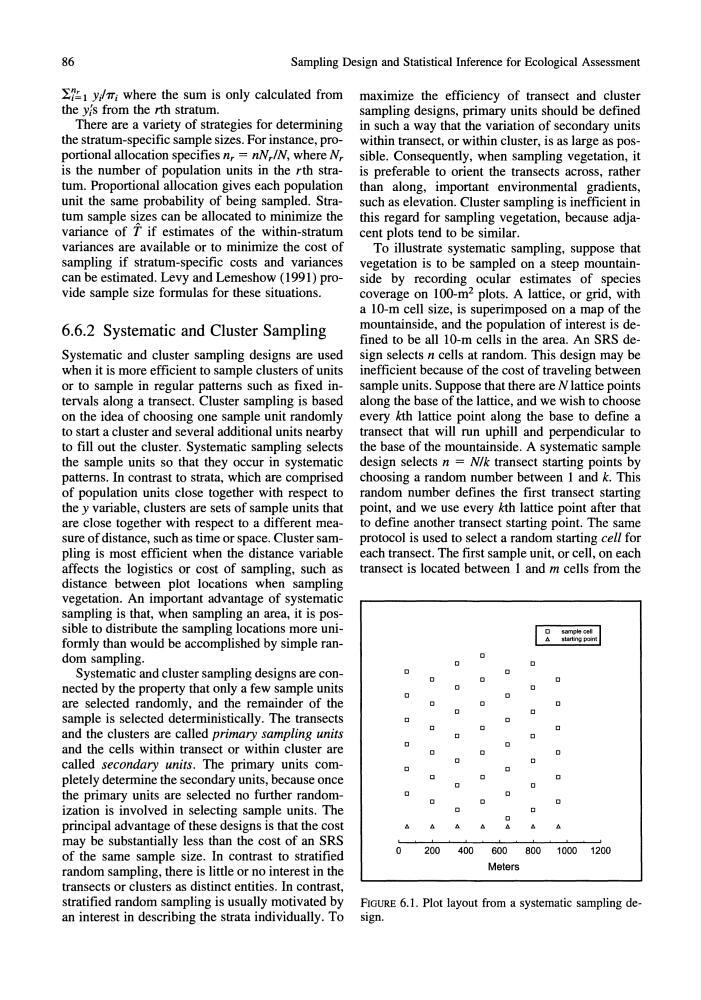
To illustrate systematic sampling, suppose that
vegetation is to be sampled on a steep mountainside by recording ocular estimates of species
coverage on lOO-m2 plots. A lattice, or grid, with
a lO-m cell size, is superimposed on a map of the
mountainside, and the population of interest is defined to be all lO-m cells in the area. An SRS design selects n cells at random. This design may be
inefficient because of the cost of traveling between
sample units. Suppose that there are Nlattice points
along the base of the lattice, and we wish to choose
every kth lattice point along the base to define a
transect that will rnn uphill and perpendicular to
the base of the mountainside. A systematic sample
design selects n = Nlk transect starting points by
choosing a random number between I and k. This
random number defines the first transect starting
point, and we use every kth lattice point after that
to define another transect starting point. The same
protocol is used to select a random starting cell for
each transect. The first sample unit, or cell, on each
transect is located between I and m cells from the
0
0
0
0
0
0
0
0
0
0
0
0
0
0
0
0
0
0
0
0
0
0
0
0
0
0
0
0
0
0
0
0
0
0
0
0
0
0
0
0
0
0
0
0
0
0
. . .. . . .. . . .. ..
0
200
400
600
800 1000 1200
Meters
FIGURE 6.1. Plot layout from a systematic sampling design.
Sampling Design and Statistical Inference for Ecological Assessment
Ii~l Yihri where the sum is only calculated from
the yis from the rth stratum.
There are a variety of strategies for detennining
the stratum-specific sample sizes. For instance, proportional allocation specifies nr = nNrlN, where Nr
is the number of population units in the rth stratum. Proportional allocation gives each population
unit the same probability of being sampled. Stratum sample sizes can be allocated to minimize the
variance of t if estimates of the within-stratum
variances are available or to minimize the cost of
sampling if stratum-specific costs and variances
can be estimated. Levy and Lemeshow (1991) provide sample size fonnulas for these situations.
6.6.2 Systematic and Cluster Sampling
Systematic and cluster sampling designs are used
when it is more efficient to sample clusters of units
or to sample in regular patterns such as fixed intervals along a transect. Cluster sampling is based
on the idea of choosing one sample unit randomly
to start a cluster and several additional units nearby
to fill out the cluster. Systematic sampling selects
the sample units so that they occur in systematic
patterns. In contrast to strata, which are comprised
of population units close together with respect to
the Y variable, clusters are sets of sample units that
are close together with respect to a different measure of distance, such as time or space. Cluster sampling is most efficient when the distance variable
affects the logistics or cost of sampling, such as
distance between plot locations when sampling
vegetation. An important advantage of systematic
sampling is that, when sampling an area, it is possible to distribute the sampling locations more unifonnly than would be accomplished by simple random sampling.
Systematic and cluster sampling designs are connected by the property that only a few sample units
are selected randomly, and the remainder of the
sample is selected detenninistically. The transects
and the clusters are called primary sampling units
and the cells within transect or within cluster are
called secondary units. The primary units completely detennine the secondary units, because once
the primary units are selected no further randomization is involved in selecting sample units. The
principal advantage of these designs is that the cost
may be substantially less than the cost of an SRS
of the same sample size. In contrast to stratified
random sampling, there is little or no interest in the
transects or clusters as distinct entities. In contrast,
stratified random sampling is usually motivated by
an interest in describing the strata individually. To
maximize the efficiency of transect and cluster
sampling designs, primary units should be defined
in such a way that the variation of secondary units
within transect, or within cluster, is as large as possible. Consequently, when sampling vegetation, it
is preferable to orient the transects across, rather
than along, important environmental gradients,
such as elevation. Cluster sampling is inefficient in
this regard for sampling vegetation, because adjacent plots tend to be similar.
To illustrate systematic sampling, suppose that
vegetation is to be sampled on a steep mountainside by recording ocular estimates of species
coverage on lOO-m2 plots. A lattice, or grid, with
a lO-m cell size, is superimposed on a map of the
mountainside, and the population of interest is defined to be all lO-m cells in the area. An SRS design selects n cells at random. This design may be
inefficient because of the cost of traveling between
sample units. Suppose that there are Nlattice points
along the base of the lattice, and we wish to choose
every kth lattice point along the base to define a
transect that will rnn uphill and perpendicular to
the base of the mountainside. A systematic sample
design selects n = Nlk transect starting points by
choosing a random number between I and k. This
random number defines the first transect starting
point, and we use every kth lattice point after that
to define another transect starting point. The same
protocol is used to select a random starting cell for
each transect. The first sample unit, or cell, on each
transect is located between I and m cells from the
0
0
0
0
0
0
0
0
0
0
0
0
0
0
0
0
0
0
0
0
0
0
0
0
0
0
0
0
0
0
0
0
0
0
0
0
0
0
0
0
0
0
0
0
0
0
. . .. . . .. . . .. ..
0
200
400
600
800 1000 1200
Meters
FIGURE 6.1. Plot layout from a systematic sampling design.