

4.3 Management Pathology
59
Levels of Analysis
Events
-C@-'EcologY'
Issues
o What is the nature and
intensity of the event?
o How do we respond to
the situation?
F st
IQ)
.~.---- ...........
/..
'"
./
.
Trend Analysis
o What is changing and
in which direction?
> o
C
/
IPatterns
of
Behavior
\
\
\
!
\
'\
o What can we predict? ~
-
"- i
\
. -------------------~-----o
'C
Q)
Q)
0W
Structure
of
System
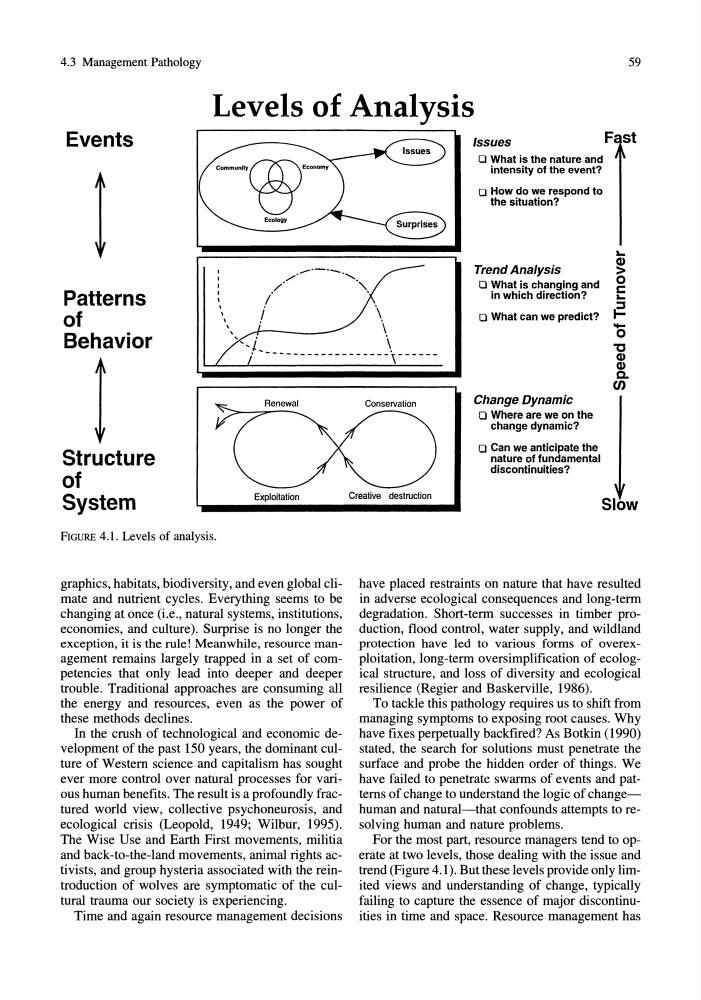
FIGURE 4.1. Levels of analysis.
Renewal
Exploitation
graphics, habitats, biodiversity, and even global climate and nutrient cycles. Everything seems to be
changing at once (i.e., natural systems, institutions,
economies, and culture). Surprise is no longer the
exception, it is the rule! Meanwhile, resource management remains largely trapped in a set of competencies that only lead into deeper and deeper
trouble. Traditional approaches are consuming all
the energy and resources, even as the power of
these methods declines.
In the crush of technological and economic development of the past 150 years, the dominant culture of Western science and capitalism has sought
ever more control over natural processes for various human benefits. The result is a profoundly fractured world view, collective psychoneurosis, and
ecological crisis (Leopold, 1949; Wilbur, 1995).
The Wise Use and Earth First movements, militia
and back-to-the-land movements, animal rights activists, and group hysteria associated with the reintroduction of wolves are symptomatic of the cultural trauma our society is experiencing.
Time and again resource management decisions
Conservation
Creative destruction
Change Dynamic
o Where are we on the
change dynamic?
o Can we anticipate the
nature of fundamental
discontinuities?
Slow
have placed restraints on nature that have resulted
in adverse ecological consequences and long-term
degradation. Short-term successes in timber production, flood control, water supply, and wildland
protection have led to various forms of overexploitation, long-term oversimplification of ecological structure, and loss of diversity and ecological
resilience (Regier and Baskerville, 1986).
To tackle this pathology requires us to shift from
managing symptoms to exposing root causes. Why
have fixes perpetually backfired? As Botkin (1990)
stated, the search for solutions must penetrate the
surface and probe the hidden order of things. We
have failed to penetrate swarms of events and patterns of change to understand the logic of changehuman and natural-that confounds attempts to resolving human and nature problems.
For the most part, resource managers tend to operate at two levels, those dealing with the issue and
trend (Figure 4.1). But these levels provide only limited views and understanding of change, typically
failing to capture the essence of major discontinuities in time and space. Resource management has
59
Levels of Analysis
Events
-C@-'EcologY'
Issues
o What is the nature and
intensity of the event?
o How do we respond to
the situation?
F st
IQ)
.~.---- ...........
/..
'"
./
.
Trend Analysis
o What is changing and
in which direction?
> o
C
/
IPatterns
of
Behavior
\
\
\
!
\
'\
o What can we predict? ~
-
"- i
\
. -------------------~-----o
'C
Q)
Q)
0W
Structure
of
System
FIGURE 4.1. Levels of analysis.
Renewal
Exploitation
graphics, habitats, biodiversity, and even global climate and nutrient cycles. Everything seems to be
changing at once (i.e., natural systems, institutions,
economies, and culture). Surprise is no longer the
exception, it is the rule! Meanwhile, resource management remains largely trapped in a set of competencies that only lead into deeper and deeper
trouble. Traditional approaches are consuming all
the energy and resources, even as the power of
these methods declines.
In the crush of technological and economic development of the past 150 years, the dominant culture of Western science and capitalism has sought
ever more control over natural processes for various human benefits. The result is a profoundly fractured world view, collective psychoneurosis, and
ecological crisis (Leopold, 1949; Wilbur, 1995).
The Wise Use and Earth First movements, militia
and back-to-the-land movements, animal rights activists, and group hysteria associated with the reintroduction of wolves are symptomatic of the cultural trauma our society is experiencing.
Time and again resource management decisions
Conservation
Creative destruction
Change Dynamic
o Where are we on the
change dynamic?
o Can we anticipate the
nature of fundamental
discontinuities?
Slow
have placed restraints on nature that have resulted
in adverse ecological consequences and long-term
degradation. Short-term successes in timber production, flood control, water supply, and wildland
protection have led to various forms of overexploitation, long-term oversimplification of ecological structure, and loss of diversity and ecological
resilience (Regier and Baskerville, 1986).
To tackle this pathology requires us to shift from
managing symptoms to exposing root causes. Why
have fixes perpetually backfired? As Botkin (1990)
stated, the search for solutions must penetrate the
surface and probe the hidden order of things. We
have failed to penetrate swarms of events and patterns of change to understand the logic of changehuman and natural-that confounds attempts to resolving human and nature problems.
For the most part, resource managers tend to operate at two levels, those dealing with the issue and
trend (Figure 4.1). But these levels provide only limited views and understanding of change, typically
failing to capture the essence of major discontinuities in time and space. Resource management has