

482
Southern Appalachian Case Study
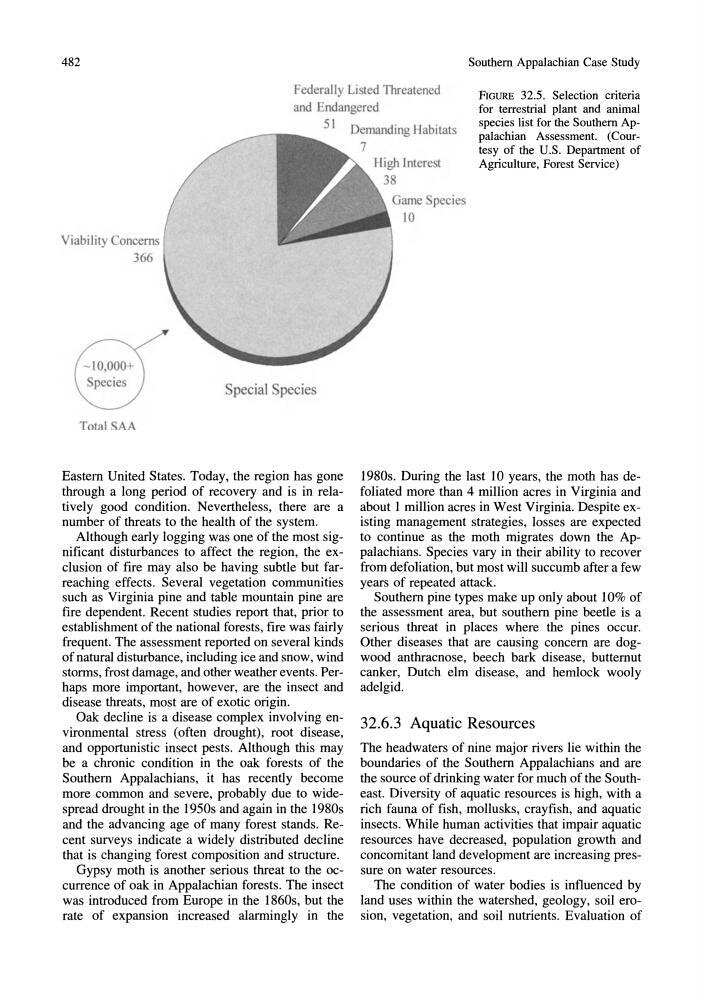
Federally Listed Threatened
and Endangered
FIGURE 32.5. Selection criteria
for terrestrial plant and animal
species list for the Southern Appalachian Assessment. (Courtesy of the U.S. Department of
Agriculture, Forest Service)
51 Demanding Habitats
Viability Concerns
366
Total SAA
Special Species
Eastern United States. Today, the region has gone
through a long period of recovery and is in relatively good condition. Nevertheless, there are a
number of threats to the health of the system.
Although early logging was one of the most significant disturbances to affect the region, the exclusion of fire may also be having subtle but farreaching effects. Several vegetation communities
such as Virginia pine and table mountain pine are
fire dependent. Recent studies report that, prior to
establishment of the national forests, fire was fairly
frequent. The assessment reported on several kinds
of natural disturbance, including ice and snow, wind
storms, frost damage, and other weather events. Perhaps more important, however, are the insect and
disease threats, most are of exotic origin.
Oak decline is a disease complex involving environmental stress (often drought), root disease,
and opportunistic insect pests. Although this may
be a chronic condition in the oak forests of the
Southern Appalachians, it has recently become
more common and severe, probably due to widespread drought in the 1950s and again in the 1980s
and the advancing age of many forest stands. Recent surveys indicate a widely distributed decline
that is changing forest composition and structure.
Gypsy moth is another serious threat to the occurrence of oak in Appalachian forests. The insect
was introduced from Europe in the l860s, but the
rate of expansion increased alarmingly in the
7
pecles
1980s. During the last 10 years, the moth has defoliated more than 4 million acres in Virginia and
about 1 million acres in West Virginia. Despite existing management strategies, losses are expected
to continue as the moth migrates down the Appalachians. Species vary in their ability to recover
from defoliation, but most will succumb after a few
years of repeated attack.
Southern pine types make up only about 10% of
the assessment area, but southern pine beetle is a
serious threat in places where the pines occur.
Other diseases that are causing concern are dogwood anthracnose, beech bark disease, butternut
canker, Dutch elm disease, and hemlock wooly
adelgid.
32.6.3 Aquatic Resources
The headwaters of nine major rivers lie within the
boundaries of the Southern Appalachians and are
the source of drinking water for much of the Southeast. Diversity of aquatic resources is high, with a
rich fauna of fish, mollusks, crayfish, and aquatic
insects. While human activities that impair aquatic
resources have decreased, population growth and
concomitant land development are increasing pressure on water resources.
The condition of water bodies is influenced by
land uses within the watershed, geology, soil erosion, vegetation, and soil nutrients. Evaluation of
Southern Appalachian Case Study
Federally Listed Threatened
and Endangered
FIGURE 32.5. Selection criteria
for terrestrial plant and animal
species list for the Southern Appalachian Assessment. (Courtesy of the U.S. Department of
Agriculture, Forest Service)
51 Demanding Habitats
Viability Concerns
366
Total SAA
Special Species
Eastern United States. Today, the region has gone
through a long period of recovery and is in relatively good condition. Nevertheless, there are a
number of threats to the health of the system.
Although early logging was one of the most significant disturbances to affect the region, the exclusion of fire may also be having subtle but farreaching effects. Several vegetation communities
such as Virginia pine and table mountain pine are
fire dependent. Recent studies report that, prior to
establishment of the national forests, fire was fairly
frequent. The assessment reported on several kinds
of natural disturbance, including ice and snow, wind
storms, frost damage, and other weather events. Perhaps more important, however, are the insect and
disease threats, most are of exotic origin.
Oak decline is a disease complex involving environmental stress (often drought), root disease,
and opportunistic insect pests. Although this may
be a chronic condition in the oak forests of the
Southern Appalachians, it has recently become
more common and severe, probably due to widespread drought in the 1950s and again in the 1980s
and the advancing age of many forest stands. Recent surveys indicate a widely distributed decline
that is changing forest composition and structure.
Gypsy moth is another serious threat to the occurrence of oak in Appalachian forests. The insect
was introduced from Europe in the l860s, but the
rate of expansion increased alarmingly in the
7
pecles
1980s. During the last 10 years, the moth has defoliated more than 4 million acres in Virginia and
about 1 million acres in West Virginia. Despite existing management strategies, losses are expected
to continue as the moth migrates down the Appalachians. Species vary in their ability to recover
from defoliation, but most will succumb after a few
years of repeated attack.
Southern pine types make up only about 10% of
the assessment area, but southern pine beetle is a
serious threat in places where the pines occur.
Other diseases that are causing concern are dogwood anthracnose, beech bark disease, butternut
canker, Dutch elm disease, and hemlock wooly
adelgid.
32.6.3 Aquatic Resources
The headwaters of nine major rivers lie within the
boundaries of the Southern Appalachians and are
the source of drinking water for much of the Southeast. Diversity of aquatic resources is high, with a
rich fauna of fish, mollusks, crayfish, and aquatic
insects. While human activities that impair aquatic
resources have decreased, population growth and
concomitant land development are increasing pressure on water resources.
The condition of water bodies is influenced by
land uses within the watershed, geology, soil erosion, vegetation, and soil nutrients. Evaluation of