

2.6 Conclusions
Time and Space Scale
Fast and Small
Cell
Water use
Photosynthesis
37
Slow and Large
..
~ anism Growth of m irnIividuru
g ~
Spatial cover and biomass production
~
Intraspecific competition
Population Genetic diversity
~
Spatial cover and biomass production
~
Interspecific competition
Community
Species diversity
~S"'tim oovtt wd bi_, prod.,", ••
Ecosystem;
Biotic and abiotic history
Landscape
Nutrient cycles
Fractal dimension
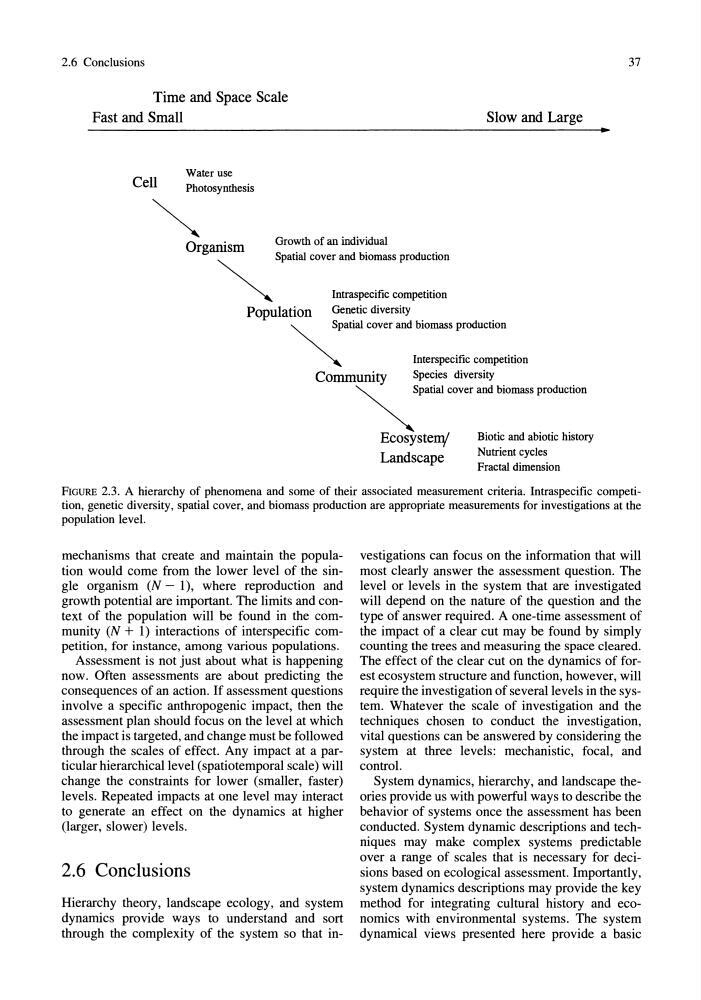
FIGURE 2.3. A hierarchy of phenomena and some of their associated measurement criteria. Intraspecific competition, genetic diversity, spatial cover, and biomass production are appropriate measurements for investigations at the
population level.
mechanisms that create and maintain the population would come from the lower level of the single organism (N - 1), where reproduction and
growth potential are important. The limits and context of the population will be found in the community (N + 1) interactions of interspecific competition, for instance, among various populations.
Assessment is not just about what is happening
now. Often assessments are about predicting the
consequences of an action. If assessment questions
involve a specific anthropogenic impact, then the
assessment plan should focus on the level at which
the impact is targeted, and change must be followed
through the scales of effect. Any impact at a particular hierarchical level ( spatiotemporal scale) will
change the constraints for lower (smaller, faster)
levels. Repeated impacts at one level may interact
to generate an effect on the dynamics at higher
(larger, slower) levels.
2.6 Conclusions
Hierarchy theory, landscape ecology, and system
dynamics provide ways to understand and sort
through the complexity of the system so that investigations can focus on the information that will
most clearly answer the assessment question. The
level or levels in the system that are investigated
will depend on the nature of the question and the
type of answer required. A one-time assessment of
the impact of a clear cut may be found by simply
counting the trees and measuring the space cleared.
The effect of the clear cut on the dynamics of forest ecosystem structure and function, however, will
require the investigation of several levels in the system. Whatever the scale of investigation and the
techniques chosen to conduct the investigation,
vital questions can be answered by considering the
system at three levels: mechanistic, focal, and
control.
System dynamics, hierarchy, and landscape theories provide us with powerful ways to describe the
behavior of systems once the assessment has been
conducted. System dynamic descriptions and techniques may make complex systems predictable
over a range of scales that is necessary for decisions based on ecological assessment. Importantly,
system dynamics descriptions may provide the key
method for integrating cultural history and economics with environmental systems. The system
dynamical views presented here provide a basic
Time and Space Scale
Fast and Small
Cell
Water use
Photosynthesis
37
Slow and Large
..
~ anism Growth of m irnIividuru
g ~
Spatial cover and biomass production
~
Intraspecific competition
Population Genetic diversity
~
Spatial cover and biomass production
~
Interspecific competition
Community
Species diversity
~S"'tim oovtt wd bi_, prod.,", ••
Ecosystem;
Biotic and abiotic history
Landscape
Nutrient cycles
Fractal dimension
FIGURE 2.3. A hierarchy of phenomena and some of their associated measurement criteria. Intraspecific competition, genetic diversity, spatial cover, and biomass production are appropriate measurements for investigations at the
population level.
mechanisms that create and maintain the population would come from the lower level of the single organism (N - 1), where reproduction and
growth potential are important. The limits and context of the population will be found in the community (N + 1) interactions of interspecific competition, for instance, among various populations.
Assessment is not just about what is happening
now. Often assessments are about predicting the
consequences of an action. If assessment questions
involve a specific anthropogenic impact, then the
assessment plan should focus on the level at which
the impact is targeted, and change must be followed
through the scales of effect. Any impact at a particular hierarchical level ( spatiotemporal scale) will
change the constraints for lower (smaller, faster)
levels. Repeated impacts at one level may interact
to generate an effect on the dynamics at higher
(larger, slower) levels.
2.6 Conclusions
Hierarchy theory, landscape ecology, and system
dynamics provide ways to understand and sort
through the complexity of the system so that investigations can focus on the information that will
most clearly answer the assessment question. The
level or levels in the system that are investigated
will depend on the nature of the question and the
type of answer required. A one-time assessment of
the impact of a clear cut may be found by simply
counting the trees and measuring the space cleared.
The effect of the clear cut on the dynamics of forest ecosystem structure and function, however, will
require the investigation of several levels in the system. Whatever the scale of investigation and the
techniques chosen to conduct the investigation,
vital questions can be answered by considering the
system at three levels: mechanistic, focal, and
control.
System dynamics, hierarchy, and landscape theories provide us with powerful ways to describe the
behavior of systems once the assessment has been
conducted. System dynamic descriptions and techniques may make complex systems predictable
over a range of scales that is necessary for decisions based on ecological assessment. Importantly,
system dynamics descriptions may provide the key
method for integrating cultural history and economics with environmental systems. The system
dynamical views presented here provide a basic