

392
populations expanded in response to competitive
release in years and at sites where Glossosoma declined. The most important point to emerge from
the work of Wiley et aI. (1997) is that, in the absence of an extended time series of biological data
across the study sites (at least 20 years for trout
populations and 5 years for insect populations),
much of the variation observed among stream biota
could have been ascribed mistakenly to geographic
structuring of populations, not interannual population fluctuations at particular sites. This same point
has been made for lakes (Magnuson et aI., 1990).
The need for appropriate temporal dimensionality
is often overlooked in spatial studies based on onetime samples, when all observed variation among
sites is commonly assumed to be associated with
spatial processes.
For many years, stream ecologists have focused
on local conditions within the channel and its adjacent riparian zone as the factors primarily controlling biotic responses to land use. Even the River
Continuum Concept of Vannote et aI. (1980), a
notable attempt to synthesize many aspects of
stream ecosystem structure and function in a landor riverscape perspective, appeared to presume that
land use and other habitat-altering impacts had
significance only as site-specific deviations from
the larger-scale norm dictated by stream order.
Regulatory mechanisms (e.g., Best Management
Practices) have similarly focused on site-specific
application of procedures or technologies to ameliorate local consequences of human activity (Frissell and Bayles, 1996; Allan et aI., 1997). However, Warren (1979) and Frissell et aI. (1986)
suggested that watershed- or catchment-scale
processes and conditions interact hierarchically
with local processes and conditions to regulate
stream habitat and biotic conditions. Aspects of this
approach were later folded into revisions of the
River Continuum Concept (Minshall, 1988), elaborated in the form of patch-mosaic theory by
Pringle et aI. (1988) and integrated into comprehensive theoretical views of stream community organization by Townsend and Hildrew (1994) and
Poff (1997) and of riverine floodplain landscapes
by Ward (1997).
Underlying these theoretical developments is the
generalization that the physical dynamics of stream
ecosystems can be viewed as a hierarchy of nested
processes and habitats that vary from large-scale
systems that vary slowly and are disrupted infrequently down to smaller habitat patches that change
more rapidly and are more frequently disrupted (see
Figure 24.2). A second tenet is that different kinds
of organisms, with different life histories, biologiAssessment of Biotic Patterns in Freshwater Ecosystems
cal requirements, interactions with other biota, and
spatial distributions, will vary differently in response to different scales and processes of habitat
change. Thus biotic responses to any environmental event will not be uniform and synchronous;
rather, they will be complex and will often appear
taxon- or guild-specific (Townsend and Hildrew,
1994; Lewis et aI., 1996; Frissell et aI., 1997; Poff,
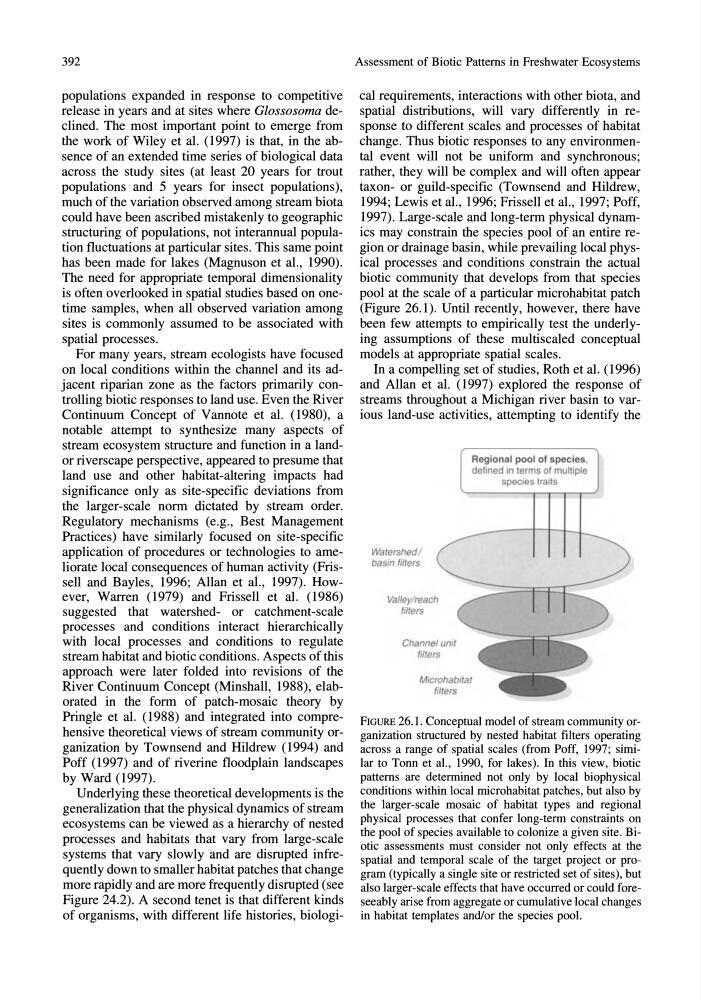
1997). Large-scale and long-term physical dynamics may constrain the species pool of an entire region or drainage basin, while prevailing local physical processes and conditions constrain the actual
biotic community that develops from that species
pool at the scale of a particular microhabitat patch
(Figure 26.1). Until recently, however, there have
been few attempts to empirically test the underlying assumptions of these multiscaled conceptual
models at appropriate spatial scales.
In a compelling set of studies, Roth et aI. (1996)
and Allan et aI. (1997) explored the response of
streams throughout a Michigan river basin to various land-use activities, attempting to identify the
Watershed/
basin filters
Valley/reach
fillers
Channa/unit
fillers
Regional pool of species.
defined in terms of multiple
species traits
Microhabitat
fillers
FIGURE 26.1. Conceptual model of stream community organization structured by nested habitat filters operating
across a range of spatial scales (from Poff, 1997; similar to Tonn et aI., 1990, for lakes). In this view, biotic
patterns are determined not only by local biophysical
conditions within local microhabitat patches, but also by
the larger-scale mosaic of habitat types and regional
physical processes that confer long-term constraints on
the pool of species available to colonize a given site. Biotic assessments must consider not only effects at the
spatial and temporal scale of the target project or program (typically a single site or restricted set of sites), but
also larger-scale effects that have occurred or could foreseeably arise from aggregate or cumulative local changes
in habitat templates and/or the species pool.
populations expanded in response to competitive
release in years and at sites where Glossosoma declined. The most important point to emerge from
the work of Wiley et aI. (1997) is that, in the absence of an extended time series of biological data
across the study sites (at least 20 years for trout
populations and 5 years for insect populations),
much of the variation observed among stream biota
could have been ascribed mistakenly to geographic
structuring of populations, not interannual population fluctuations at particular sites. This same point
has been made for lakes (Magnuson et aI., 1990).
The need for appropriate temporal dimensionality
is often overlooked in spatial studies based on onetime samples, when all observed variation among
sites is commonly assumed to be associated with
spatial processes.
For many years, stream ecologists have focused
on local conditions within the channel and its adjacent riparian zone as the factors primarily controlling biotic responses to land use. Even the River
Continuum Concept of Vannote et aI. (1980), a
notable attempt to synthesize many aspects of
stream ecosystem structure and function in a landor riverscape perspective, appeared to presume that
land use and other habitat-altering impacts had
significance only as site-specific deviations from
the larger-scale norm dictated by stream order.
Regulatory mechanisms (e.g., Best Management
Practices) have similarly focused on site-specific
application of procedures or technologies to ameliorate local consequences of human activity (Frissell and Bayles, 1996; Allan et aI., 1997). However, Warren (1979) and Frissell et aI. (1986)
suggested that watershed- or catchment-scale
processes and conditions interact hierarchically
with local processes and conditions to regulate
stream habitat and biotic conditions. Aspects of this
approach were later folded into revisions of the
River Continuum Concept (Minshall, 1988), elaborated in the form of patch-mosaic theory by
Pringle et aI. (1988) and integrated into comprehensive theoretical views of stream community organization by Townsend and Hildrew (1994) and
Poff (1997) and of riverine floodplain landscapes
by Ward (1997).
Underlying these theoretical developments is the
generalization that the physical dynamics of stream
ecosystems can be viewed as a hierarchy of nested
processes and habitats that vary from large-scale
systems that vary slowly and are disrupted infrequently down to smaller habitat patches that change
more rapidly and are more frequently disrupted (see
Figure 24.2). A second tenet is that different kinds
of organisms, with different life histories, biologiAssessment of Biotic Patterns in Freshwater Ecosystems
cal requirements, interactions with other biota, and
spatial distributions, will vary differently in response to different scales and processes of habitat
change. Thus biotic responses to any environmental event will not be uniform and synchronous;
rather, they will be complex and will often appear
taxon- or guild-specific (Townsend and Hildrew,
1994; Lewis et aI., 1996; Frissell et aI., 1997; Poff,
1997). Large-scale and long-term physical dynamics may constrain the species pool of an entire region or drainage basin, while prevailing local physical processes and conditions constrain the actual
biotic community that develops from that species
pool at the scale of a particular microhabitat patch
(Figure 26.1). Until recently, however, there have
been few attempts to empirically test the underlying assumptions of these multiscaled conceptual
models at appropriate spatial scales.
In a compelling set of studies, Roth et aI. (1996)
and Allan et aI. (1997) explored the response of
streams throughout a Michigan river basin to various land-use activities, attempting to identify the
Watershed/
basin filters
Valley/reach
fillers
Channa/unit
fillers
Regional pool of species.
defined in terms of multiple
species traits
Microhabitat
fillers
FIGURE 26.1. Conceptual model of stream community organization structured by nested habitat filters operating
across a range of spatial scales (from Poff, 1997; similar to Tonn et aI., 1990, for lakes). In this view, biotic
patterns are determined not only by local biophysical
conditions within local microhabitat patches, but also by
the larger-scale mosaic of habitat types and regional
physical processes that confer long-term constraints on
the pool of species available to colonize a given site. Biotic assessments must consider not only effects at the
spatial and temporal scale of the target project or program (typically a single site or restricted set of sites), but
also larger-scale effects that have occurred or could foreseeably arise from aggregate or cumulative local changes
in habitat templates and/or the species pool.