

24.3 Review of Classification Systems for Aquatic Biophysical Environments
357
Leaf and Stick
Detritus in
Morgin
STREAM SYSTEM
SEGMENT SYSTEM
REACH SYSTEM
POOL - RIFFLE
SYSTEM
MICROHABITAT
SYSTEM
10 1 m
1 00 m
10-1 m
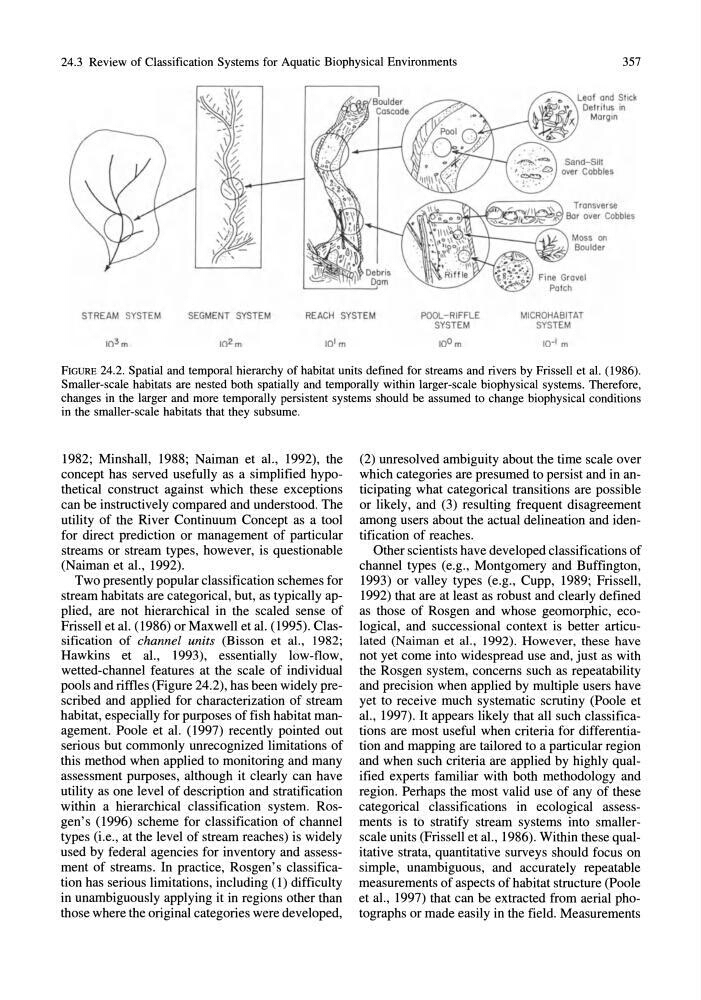
FIGURE 24.2. Spatial and temporal hierarchy of habitat units defined for streams and rivers by Frissell et al. (1986).
Smaller-scale habitats are nested both spatially and temporally within larger-scale biophysical systems. Therefore,
changes in the larger and more temporally persistent systems should be assumed to change biophysical conditions
in the smaller-scale habitats that they subsume.
1982; Minshall, 1988; Naiman et aI., 1992), the
concept has served usefully as a simplified hypothetical construct against which these exceptions
can be instructively compared and understood. The
utility of the River Continuum Concept as a tool
for direct prediction or management of particular
streams or stream types, however, is questionable
(Naiman et aI., 1992).
Two presently popular classification schemes for
stream habitats are categorical, but, as typically applied, are not hierarchical in the scaled sense of
Frissell et aI. (1986) or Maxwell et aI. (1995). Classification of channel units (Bisson et aI., 1982;
Hawkins et aI., 1993), essentially low-flow,
wetted-channel features at the scale of individual
pools and riffles (Figure 24.2), has been widely prescribed and applied for characterization of stream
habitat, especially for purposes of fish habitat management. Poole et aI. (1997) recently pointed out
serious but commonly unrecognized limitations of
this method when applied to monitoring and many
assessment purposes, although it clearly can have
utility as one level of description and stratification
within a hierarchical classification system. Rosgen's (1996) scheme for classification of channel
types (i.e., at the level of stream reaches) is widely
used by federal agencies for inventory and assessment of streams. In practice, Rosgen's classification has serious limitations, including (1) difficulty
in unambiguously applying it in regions other than
those where the original categories were developed,
(2) unresolved ambiguity about the time scale over
which categories are presumed to persist and in anticipating what categorical transitions are possible
or likely, and (3) resulting frequent disagreement
among users about the actual delineation and identification of reaches.
Other scientists have developed classifications of
channel types (e.g., Montgomery and Buffington,
1993) or valley types (e.g., Cupp, 1989; Frissell,
1992) that are at least as robust and clearly defined
as those of Rosgen and whose geomorphic, ecological, and successional context is better articulated (Naiman et aI., 1992). However, these have
not yet come into widespread use and, just as with
the Rosgen system, concerns such as repeatability
and precision when applied by multiple users have
yet to receive much systematic scrutiny (Poole et
aI., 1997). It appears likely that all such classifications are most useful when criteria for differentiation and mapping are tailored to a particular region
and when such criteria are applied by highly qualified experts familiar with both methodology and
region. Perhaps the most valid use of any of these
categorical classifications in ecological assessments is to stratify stream systems into smallerscale units (Frissell et aI., 1986). Within these qualitative strata, quantitative surveys should focus on
simple, unambiguous, and accurately repeatable
measurements of aspects of habitat structure (Poole
et aI., 1997) that can be extracted from aerial photographs or made easily in the field. Measurements
357
Leaf and Stick
Detritus in
Morgin
STREAM SYSTEM
SEGMENT SYSTEM
REACH SYSTEM
POOL - RIFFLE
SYSTEM
MICROHABITAT
SYSTEM
10 1 m
1 00 m
10-1 m
FIGURE 24.2. Spatial and temporal hierarchy of habitat units defined for streams and rivers by Frissell et al. (1986).
Smaller-scale habitats are nested both spatially and temporally within larger-scale biophysical systems. Therefore,
changes in the larger and more temporally persistent systems should be assumed to change biophysical conditions
in the smaller-scale habitats that they subsume.
1982; Minshall, 1988; Naiman et aI., 1992), the
concept has served usefully as a simplified hypothetical construct against which these exceptions
can be instructively compared and understood. The
utility of the River Continuum Concept as a tool
for direct prediction or management of particular
streams or stream types, however, is questionable
(Naiman et aI., 1992).
Two presently popular classification schemes for
stream habitats are categorical, but, as typically applied, are not hierarchical in the scaled sense of
Frissell et aI. (1986) or Maxwell et aI. (1995). Classification of channel units (Bisson et aI., 1982;
Hawkins et aI., 1993), essentially low-flow,
wetted-channel features at the scale of individual
pools and riffles (Figure 24.2), has been widely prescribed and applied for characterization of stream
habitat, especially for purposes of fish habitat management. Poole et aI. (1997) recently pointed out
serious but commonly unrecognized limitations of
this method when applied to monitoring and many
assessment purposes, although it clearly can have
utility as one level of description and stratification
within a hierarchical classification system. Rosgen's (1996) scheme for classification of channel
types (i.e., at the level of stream reaches) is widely
used by federal agencies for inventory and assessment of streams. In practice, Rosgen's classification has serious limitations, including (1) difficulty
in unambiguously applying it in regions other than
those where the original categories were developed,
(2) unresolved ambiguity about the time scale over
which categories are presumed to persist and in anticipating what categorical transitions are possible
or likely, and (3) resulting frequent disagreement
among users about the actual delineation and identification of reaches.
Other scientists have developed classifications of
channel types (e.g., Montgomery and Buffington,
1993) or valley types (e.g., Cupp, 1989; Frissell,
1992) that are at least as robust and clearly defined
as those of Rosgen and whose geomorphic, ecological, and successional context is better articulated (Naiman et aI., 1992). However, these have
not yet come into widespread use and, just as with
the Rosgen system, concerns such as repeatability
and precision when applied by multiple users have
yet to receive much systematic scrutiny (Poole et
aI., 1997). It appears likely that all such classifications are most useful when criteria for differentiation and mapping are tailored to a particular region
and when such criteria are applied by highly qualified experts familiar with both methodology and
region. Perhaps the most valid use of any of these
categorical classifications in ecological assessments is to stratify stream systems into smallerscale units (Frissell et aI., 1986). Within these qualitative strata, quantitative surveys should focus on
simple, unambiguous, and accurately repeatable
measurements of aspects of habitat structure (Poole
et aI., 1997) that can be extracted from aerial photographs or made easily in the field. Measurements