

23.6 Conclusion: The Value of a Multiscale Approach and Adaptive Management
349
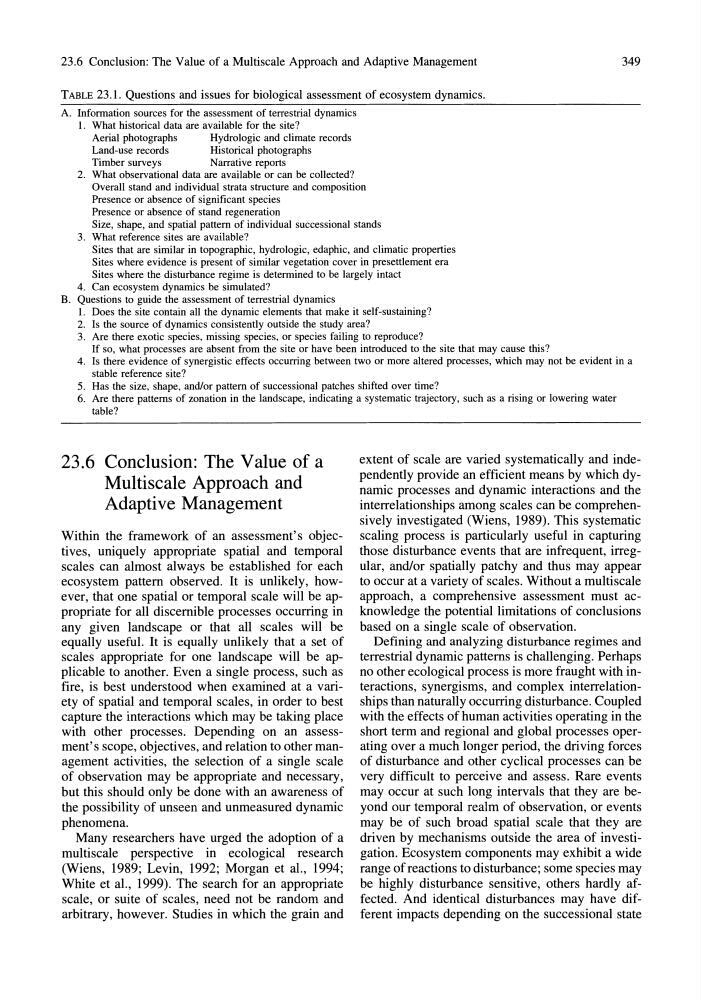
TABLE 23.1. Questions and issues for biological assessment of ecosystem dynamics.
A. Infonnation sources for the assessment of terrestrial dynamics
I. What historical data are available for the site?
Aerial photographs
Hydrologic and climate records
Land-use records
Historical photographs
Timber surveys
Narrative reports
2. What observational data are available or can be collected?
Overall stand and individual strata structure and composition
Presence or absence of significant species
Presence or absence of stand regeneration
Size, shape, and spatial pattern of individual successional stands
3. What reference sites are available?
Sites that are similar in topographic, hydrologic, edaphic, and climatic properties
Sites where evidence is present of similar vegetation cover in pre settlement era
Sites where the disturbance regime is detennined to be largely intact
4. Can ecosystem dynamics be simulated?
B. Questions to guide the assessment of terrestrial dynamics
I. Does the site contain all the dynamic elements that make it self-sustaining?
2. Is the source of dynamics consistently outside the study area?
3. Are there exotic species, missing species, or species failing to reproduce?
If so, what processes are absent from the site or have been introduced to the site that may cause this?
4. Is there evidence of synergistic effects occurring between two or more altered processes, which may not be evident in a
stable reference site?
5. Has the size, shape, and/or pattern of successional patches shifted over time?
6. Are there patterns of zonation in the landscape, indicating a systematic trajectory, such as a rising or lowering water
table?
23.6 Conclusion: The Value of a
Multiscale Approach and
Adaptive Management
Within the framework of an assessment's objectives, uniquely appropriate spatial and temporal
scales can almost always be established for each
ecosystem pattern observed. It is unlikely, however, that one spatial or temporal scale will be appropriate for all discernible processes occurring in
any given landscape or that all scales will be
equally useful. It is equally unlikely that a set of
scales appropriate for one landscape will be applicable to another. Even a single process, such as
fire, is best understood when examined at a variety of spatial and temporal scales, in order to best
capture the interactions which may be taking place
with other processes. Depending on an assessment's scope, objectives, and relation to other management activities, the selection of a single scale
of observation may be appropriate and necessary,
but this should only be done with an awareness of
the possibility of unseen and unmeasured dynamic
phenomena.
Many researchers have urged the adoption of a
multiscale perspective in ecological research
(Wiens, 1989; Levin, 1992; Morgan et aI., 1994;
White et aI., 1999). The search for an appropriate
scale, or suite of scales, need not be random and
arbitrary, however. Studies in which the grain and
extent of scale are varied systematically and independently provide an efficient means by which dynamic processes and dynamic interactions and the
interrelationships among scales can be comprehensively investigated (Wiens, 1989). This systematic
scaling process is particularly useful in capturing
those disturbance events that are infrequent, irregular, and/or spatially patchy and thus may appear
to occur at a variety of scales. Without a multiscale
approach, a comprehensive assessment must acknowledge the potential limitations of conclusions
based on a single scale of observation.
Defining and analyzing disturbance regimes and
terrestrial dynamic patterns is challenging. Perhaps
no other ecological process is more fraught with interactions, synergisms, and complex interrelationships than naturally occurring disturbance. Coupled
with the effects of human activities operating in the
short term and regional and global processes operating over a much longer period, the driving forces
of disturbance and other cyclical processes can be
very difficult to perceive and assess. Rare events
may occur at such long intervals that they are beyond our temporal realm of observation, or events
may be of such broad spatial scale that they are
driven by mechanisms outside the area of investigation. Ecosystem components may exhibit a wide
range of reactions to disturbance; some species may
be highly disturbance sensitive, others hardly affected. And identical disturbances may have different impacts depending on the successional state
349
TABLE 23.1. Questions and issues for biological assessment of ecosystem dynamics.
A. Infonnation sources for the assessment of terrestrial dynamics
I. What historical data are available for the site?
Aerial photographs
Hydrologic and climate records
Land-use records
Historical photographs
Timber surveys
Narrative reports
2. What observational data are available or can be collected?
Overall stand and individual strata structure and composition
Presence or absence of significant species
Presence or absence of stand regeneration
Size, shape, and spatial pattern of individual successional stands
3. What reference sites are available?
Sites that are similar in topographic, hydrologic, edaphic, and climatic properties
Sites where evidence is present of similar vegetation cover in pre settlement era
Sites where the disturbance regime is detennined to be largely intact
4. Can ecosystem dynamics be simulated?
B. Questions to guide the assessment of terrestrial dynamics
I. Does the site contain all the dynamic elements that make it self-sustaining?
2. Is the source of dynamics consistently outside the study area?
3. Are there exotic species, missing species, or species failing to reproduce?
If so, what processes are absent from the site or have been introduced to the site that may cause this?
4. Is there evidence of synergistic effects occurring between two or more altered processes, which may not be evident in a
stable reference site?
5. Has the size, shape, and/or pattern of successional patches shifted over time?
6. Are there patterns of zonation in the landscape, indicating a systematic trajectory, such as a rising or lowering water
table?
23.6 Conclusion: The Value of a
Multiscale Approach and
Adaptive Management
Within the framework of an assessment's objectives, uniquely appropriate spatial and temporal
scales can almost always be established for each
ecosystem pattern observed. It is unlikely, however, that one spatial or temporal scale will be appropriate for all discernible processes occurring in
any given landscape or that all scales will be
equally useful. It is equally unlikely that a set of
scales appropriate for one landscape will be applicable to another. Even a single process, such as
fire, is best understood when examined at a variety of spatial and temporal scales, in order to best
capture the interactions which may be taking place
with other processes. Depending on an assessment's scope, objectives, and relation to other management activities, the selection of a single scale
of observation may be appropriate and necessary,
but this should only be done with an awareness of
the possibility of unseen and unmeasured dynamic
phenomena.
Many researchers have urged the adoption of a
multiscale perspective in ecological research
(Wiens, 1989; Levin, 1992; Morgan et aI., 1994;
White et aI., 1999). The search for an appropriate
scale, or suite of scales, need not be random and
arbitrary, however. Studies in which the grain and
extent of scale are varied systematically and independently provide an efficient means by which dynamic processes and dynamic interactions and the
interrelationships among scales can be comprehensively investigated (Wiens, 1989). This systematic
scaling process is particularly useful in capturing
those disturbance events that are infrequent, irregular, and/or spatially patchy and thus may appear
to occur at a variety of scales. Without a multiscale
approach, a comprehensive assessment must acknowledge the potential limitations of conclusions
based on a single scale of observation.
Defining and analyzing disturbance regimes and
terrestrial dynamic patterns is challenging. Perhaps
no other ecological process is more fraught with interactions, synergisms, and complex interrelationships than naturally occurring disturbance. Coupled
with the effects of human activities operating in the
short term and regional and global processes operating over a much longer period, the driving forces
of disturbance and other cyclical processes can be
very difficult to perceive and assess. Rare events
may occur at such long intervals that they are beyond our temporal realm of observation, or events
may be of such broad spatial scale that they are
driven by mechanisms outside the area of investigation. Ecosystem components may exhibit a wide
range of reactions to disturbance; some species may
be highly disturbance sensitive, others hardly affected. And identical disturbances may have different impacts depending on the successional state