

23.5 Characterization of Dynamics and Evidence Used in Assessment
345
1900
E:3 Pine
o Bottomland Hardwood
o Cleared (fields)
~ Upland Hardwood
[I] PinelUpland Hardwood
• Town
-H+ Railroad
1960
.................
. . . . . . . . . . . . . . . . . . . . . . . . "" . . . "" . . . . . . ~..;...;~~*
1930
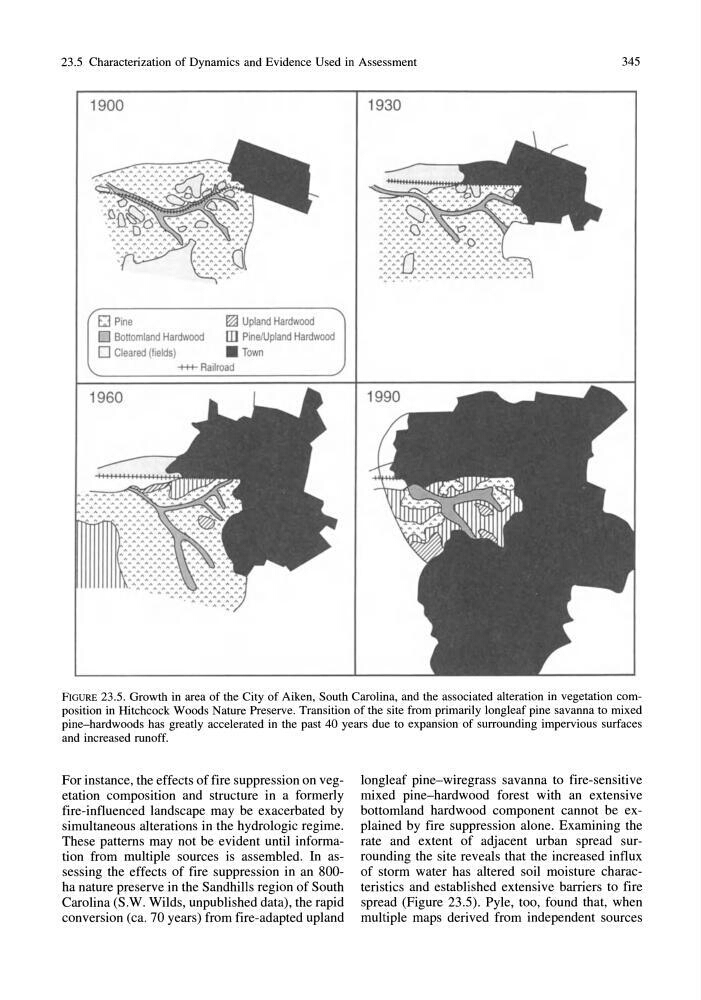
FIGURE 23.5. Growth in area of the City of Aiken, South Carolina, and the associated alteration in vegetation composition in Hitchcock Woods Nature Preserve. Transition of the site from primarily longleaf pine savanna to mixed
pine-hardwoods has greatly accelerated in the past 40 years due to expansion of surrounding impervious surfaces
and increased runoff.
For instance, the effects of fire suppression on vegetation composition and structure in a formerly
fire-influenced landscape may be exacerbated by
simultaneous alterations in the hydrologic regime.
These patterns may not be evident until information from multiple sources is assembled. In assessing the effects of fire suppression in an 800ha nature preserve in the Sandhills region of South
Carolina (S.W. Wilds, unpublished data), the rapid
conversion (ca. 70 years) from fire-adapted upland
longleaf pine-wiregrass savanna to fire-sensitive
mixed pine-hardwood forest with an extensive
bottomland hardwood component cannot be explained by fire suppression alone. Examining the
rate and extent of adjacent urban spread surrounding the site reveals that the increased influx
of storm water has altered soil moisture characteristics and established extensive barriers to fire
spread (Figure 23.5). Pyle, too, found that, when
multiple maps derived from independent sources
345
1900
E:3 Pine
o Bottomland Hardwood
o Cleared (fields)
~ Upland Hardwood
[I] PinelUpland Hardwood
• Town
-H+ Railroad
1960
.................
. . . . . . . . . . . . . . . . . . . . . . . . "" . . . "" . . . . . . ~..;...;~~*
1930
FIGURE 23.5. Growth in area of the City of Aiken, South Carolina, and the associated alteration in vegetation composition in Hitchcock Woods Nature Preserve. Transition of the site from primarily longleaf pine savanna to mixed
pine-hardwoods has greatly accelerated in the past 40 years due to expansion of surrounding impervious surfaces
and increased runoff.
For instance, the effects of fire suppression on vegetation composition and structure in a formerly
fire-influenced landscape may be exacerbated by
simultaneous alterations in the hydrologic regime.
These patterns may not be evident until information from multiple sources is assembled. In assessing the effects of fire suppression in an 800ha nature preserve in the Sandhills region of South
Carolina (S.W. Wilds, unpublished data), the rapid
conversion (ca. 70 years) from fire-adapted upland
longleaf pine-wiregrass savanna to fire-sensitive
mixed pine-hardwood forest with an extensive
bottomland hardwood component cannot be explained by fire suppression alone. Examining the
rate and extent of adjacent urban spread surrounding the site reveals that the increased influx
of storm water has altered soil moisture characteristics and established extensive barriers to fire
spread (Figure 23.5). Pyle, too, found that, when
multiple maps derived from independent sources