

326
Elements of Ecological Land Classifications for Ecological Assessments
o 50
200
400 km
WI Assessment area
~ Characterization area
~ Reporting units
IZ:iZI Analysis area
(4th-code hydrologic unit)
IZSZJ Basic characterization unit
(6th-code hydrologic unit)
D Integrated response unit
(biophysical polygon)
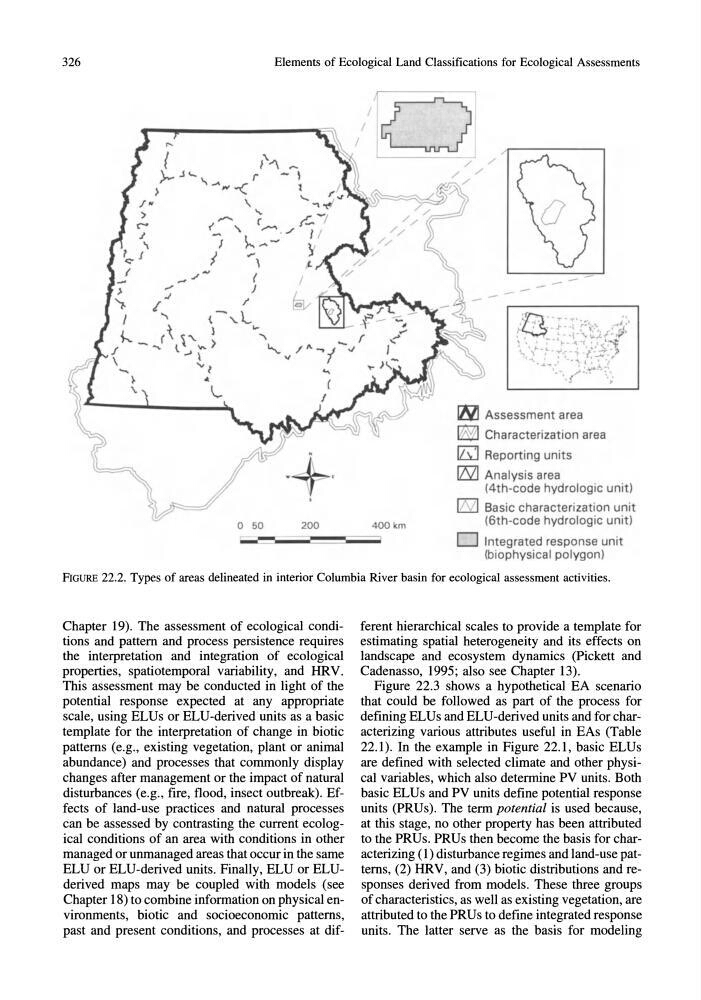
FIGURE 22.2. Types of areas delineated in interior Columbia River basin for ecological assessment activities.
Chapter 19). The assessment of ecological conditions and pattern and process persistence requires
the interpretation and integration of ecological
properties, spatiotemporal variability, and HRV.
This assessment may be conducted in light of the
potential response expected at any appropriate
scale, using ELUs or ELU-derived units as a basic
template for the interpretation of change in biotic
patterns (e.g., existing vegetation, plant or animal
abundance) and processes that commonly display
changes after management or the impact of natural
disturbances (e.g., fire, flood, insect outbreak). Effects of land-use practices and natural processes
can be assessed by contrasting the current ecological conditions of an area with conditions in other
managed or unmanaged areas that occur in the same
ELU or ELU-derived units. Finally, ELU or ELUderived maps may be coupled with models (see
Chapter 18) to combine information on physical environments, biotic and socioeconomic patterns,
past and present conditions, and processes at different hierarchical scales to provide a template for
estimating spatial heterogeneity and its effects on
landscape and ecosystem dynamics (Pickett and
Cadenasso, 1995; also see Chapter 13).
Figure 22.3 shows a hypothetical EA scenario
that could be followed as part of the process for
defining ELUs and ELU-derived units and for characterizing various attributes useful in EAs (Table
22.1). In the example in Figure 22.1, basic ELUs
are defined with selected climate and other physical variables, which also determine PV units. Both
basic ELUs and PV units define potential response
units (PRUs). The term potential is used because,
at this stage, no other property has been attributed
to the PRUs. PRUs then become the basis for characterizing (1) disturbance regimes and land-use patterns, (2) HRV, and (3) biotic distributions and responses derived from models. These three groups
of characteristics, as well as existing vegetation, are
attributed to the PRUs to define integrated response
units. The latter serve as the basis for modeling
Elements of Ecological Land Classifications for Ecological Assessments
o 50
200
400 km
WI Assessment area
~ Characterization area
~ Reporting units
IZ:iZI Analysis area
(4th-code hydrologic unit)
IZSZJ Basic characterization unit
(6th-code hydrologic unit)
D Integrated response unit
(biophysical polygon)
FIGURE 22.2. Types of areas delineated in interior Columbia River basin for ecological assessment activities.
Chapter 19). The assessment of ecological conditions and pattern and process persistence requires
the interpretation and integration of ecological
properties, spatiotemporal variability, and HRV.
This assessment may be conducted in light of the
potential response expected at any appropriate
scale, using ELUs or ELU-derived units as a basic
template for the interpretation of change in biotic
patterns (e.g., existing vegetation, plant or animal
abundance) and processes that commonly display
changes after management or the impact of natural
disturbances (e.g., fire, flood, insect outbreak). Effects of land-use practices and natural processes
can be assessed by contrasting the current ecological conditions of an area with conditions in other
managed or unmanaged areas that occur in the same
ELU or ELU-derived units. Finally, ELU or ELUderived maps may be coupled with models (see
Chapter 18) to combine information on physical environments, biotic and socioeconomic patterns,
past and present conditions, and processes at different hierarchical scales to provide a template for
estimating spatial heterogeneity and its effects on
landscape and ecosystem dynamics (Pickett and
Cadenasso, 1995; also see Chapter 13).
Figure 22.3 shows a hypothetical EA scenario
that could be followed as part of the process for
defining ELUs and ELU-derived units and for characterizing various attributes useful in EAs (Table
22.1). In the example in Figure 22.1, basic ELUs
are defined with selected climate and other physical variables, which also determine PV units. Both
basic ELUs and PV units define potential response
units (PRUs). The term potential is used because,
at this stage, no other property has been attributed
to the PRUs. PRUs then become the basis for characterizing (1) disturbance regimes and land-use patterns, (2) HRV, and (3) biotic distributions and responses derived from models. These three groups
of characteristics, as well as existing vegetation, are
attributed to the PRUs to define integrated response
units. The latter serve as the basis for modeling