

310
multiple of the amount initially spent by the final
demand sectors. (p. 4)
The inverted Leontief matrix [(/- A)-I)] provides a precise calculation of the stream of respendings that occur in the regional economy. This
matrix is a multiplier matrix, in that it provides information on the amount of sales generated by all
sectors of the regional economy when final demand
is increased by one dollar for each sector. It is possible to use this matrix to forecast production required to satisfy expected final demand because the
following relation holds:
X=(/-A)-Iy,
where X is a vector of output levels and Y is a vector of final demands. (p. 4)
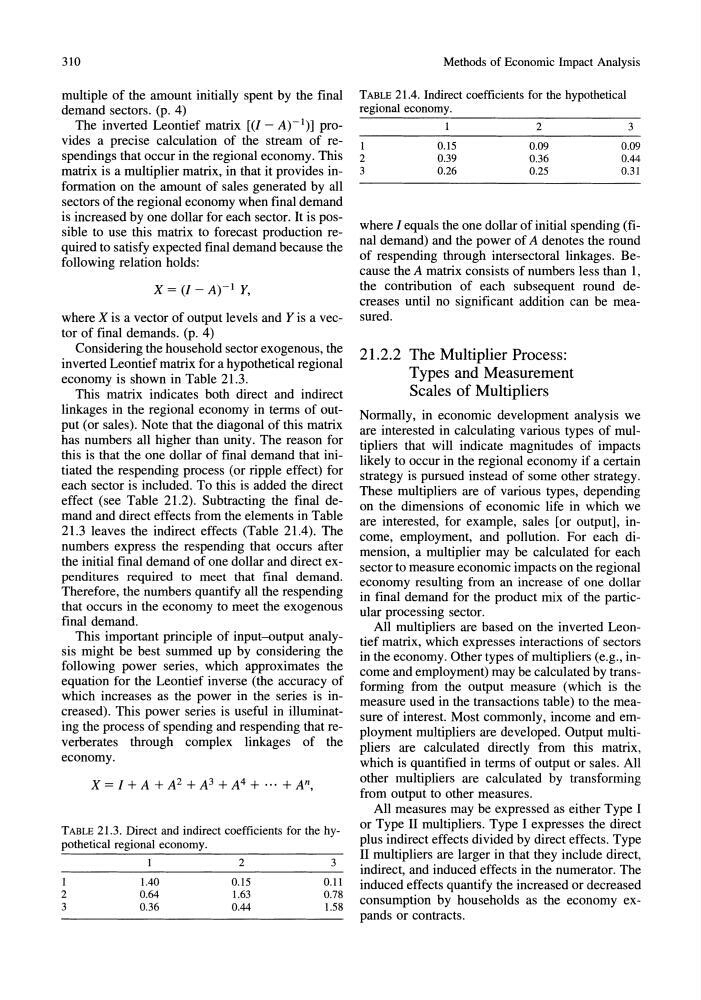
Considering the household sector exogenous, the
inverted Leontief matrix for a hypothetical regional
economy is shown in Table 21.3.
This matrix indicates both direct and indirect
linkages in the regional economy in terms of output (or sales). Note that the diagonal of this matrix
has numbers all higher than unity. The reason for
this is that the one dollar of final demand that initiated the respending process (or ripple effect) for
each sector is included. To this is added the direct
effect (see Table 21.2). Subtracting the final demand and direct effects from the elements in Table
21.3 leaves the indirect effects (Table 21.4). The
numbers express the respending that occurs after
the initial final demand of one dollar and direct expenditures required to meet that final demand.
Therefore, the numbers quantify all the respending
that occurs in the economy to meet the exogenous
final demand.
This important principle of input-output analysis might be best summed up by considering the
following power series, which approximates the
equation for the Leontief inverse (the accuracy of
which increases as the power in the series is increased). This power series is useful in illuminating the process of spending and respending that reverberates through complex linkages of the
economy.
X = I + A + A2 + A3 + A4 + ... + An,
TABLE 21.3. Direct and indirect coefficients for the hypothetical regional economy.
1
2
3
1
2
3
1.40
0.64
0.36
0.15
1.63
0.44
0.11
0.78
1.58
Methods of Economic Impact Analysis
TABLE 21.4. Indirect coefficients for the hypothetical
regional economy.
1
2
3
1
0.15
0.09
0.09
2
0.39
0.36
0.44
3
0.26
0.25
0.31
where I equals the one dollar of initial spending (final demand) and the power of A denotes the round
of respending through intersectoral linkages. Because the A matrix consists of numbers less than 1,
the contribution of each subsequent round decreases until no significant addition can be measured.
21.2.2 The Multiplier Process:
Types and Measurement
Scales of Multipliers
Normally, in economic development analysis we
are interested in calculating various types of multipliers that will indicate magnitudes ~f impac.ts
likely to occur in the regional economy If a certam
strategy is pursued instead of some other strategy.
These multipliers are of various types, depending
on the dimensions of economic life in which we
are interested, for example, sales [or output], income, employment, and pollution. For each dimension, a multiplier may be calculated for each
sector to measure economic impacts on the regional
economy resulting from an increase of one dollar
in final demand for the product mix of the particular processing sector.
All multipliers are based on the inverted Leontief matrix, which expresses interactions of sectors
in the economy. Other types of multipliers (e.g., income and employment) may be calculated by transforming from the output measure (which is the
measure used in the transactions table) to the measure of interest. Most commonly, income and employment multipliers are developed. Output mul.tipliers are calculated directly from thIS matnx,
which is quantified in terms of output or sales. All
other multipliers are calculated by transforming
from output to other measures.
All measures may be expressed as either Type I
or Type II multipliers. Type I expresses the direct
plus indirect effects divided by direc~ effects. !ype
II multipliers are larger in that they mclude dIrect,
indirect, and induced effects in the numerator. The
induced effects quantify the increased or decreased
consumption by households as the economy expands or contracts.
multiple of the amount initially spent by the final
demand sectors. (p. 4)
The inverted Leontief matrix [(/- A)-I)] provides a precise calculation of the stream of respendings that occur in the regional economy. This
matrix is a multiplier matrix, in that it provides information on the amount of sales generated by all
sectors of the regional economy when final demand
is increased by one dollar for each sector. It is possible to use this matrix to forecast production required to satisfy expected final demand because the
following relation holds:
X=(/-A)-Iy,
where X is a vector of output levels and Y is a vector of final demands. (p. 4)
Considering the household sector exogenous, the
inverted Leontief matrix for a hypothetical regional
economy is shown in Table 21.3.
This matrix indicates both direct and indirect
linkages in the regional economy in terms of output (or sales). Note that the diagonal of this matrix
has numbers all higher than unity. The reason for
this is that the one dollar of final demand that initiated the respending process (or ripple effect) for
each sector is included. To this is added the direct
effect (see Table 21.2). Subtracting the final demand and direct effects from the elements in Table
21.3 leaves the indirect effects (Table 21.4). The
numbers express the respending that occurs after
the initial final demand of one dollar and direct expenditures required to meet that final demand.
Therefore, the numbers quantify all the respending
that occurs in the economy to meet the exogenous
final demand.
This important principle of input-output analysis might be best summed up by considering the
following power series, which approximates the
equation for the Leontief inverse (the accuracy of
which increases as the power in the series is increased). This power series is useful in illuminating the process of spending and respending that reverberates through complex linkages of the
economy.
X = I + A + A2 + A3 + A4 + ... + An,
TABLE 21.3. Direct and indirect coefficients for the hypothetical regional economy.
1
2
3
1
2
3
1.40
0.64
0.36
0.15
1.63
0.44
0.11
0.78
1.58
Methods of Economic Impact Analysis
TABLE 21.4. Indirect coefficients for the hypothetical
regional economy.
1
2
3
1
0.15
0.09
0.09
2
0.39
0.36
0.44
3
0.26
0.25
0.31
where I equals the one dollar of initial spending (final demand) and the power of A denotes the round
of respending through intersectoral linkages. Because the A matrix consists of numbers less than 1,
the contribution of each subsequent round decreases until no significant addition can be measured.
21.2.2 The Multiplier Process:
Types and Measurement
Scales of Multipliers
Normally, in economic development analysis we
are interested in calculating various types of multipliers that will indicate magnitudes ~f impac.ts
likely to occur in the regional economy If a certam
strategy is pursued instead of some other strategy.
These multipliers are of various types, depending
on the dimensions of economic life in which we
are interested, for example, sales [or output], income, employment, and pollution. For each dimension, a multiplier may be calculated for each
sector to measure economic impacts on the regional
economy resulting from an increase of one dollar
in final demand for the product mix of the particular processing sector.
All multipliers are based on the inverted Leontief matrix, which expresses interactions of sectors
in the economy. Other types of multipliers (e.g., income and employment) may be calculated by transforming from the output measure (which is the
measure used in the transactions table) to the measure of interest. Most commonly, income and employment multipliers are developed. Output mul.tipliers are calculated directly from thIS matnx,
which is quantified in terms of output or sales. All
other multipliers are calculated by transforming
from output to other measures.
All measures may be expressed as either Type I
or Type II multipliers. Type I expresses the direct
plus indirect effects divided by direc~ effects. !ype
II multipliers are larger in that they mclude dIrect,
indirect, and induced effects in the numerator. The
induced effects quantify the increased or decreased
consumption by households as the economy expands or contracts.