

300
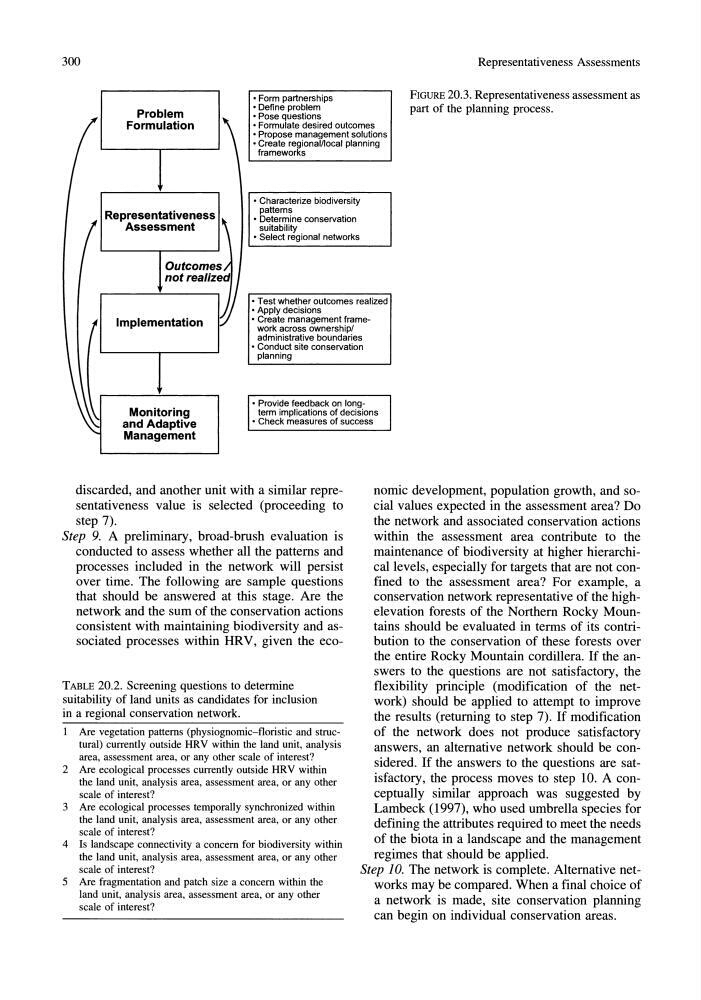
• Form partnerships
• Define problem
• Pose questions
Representativeness Assessments
FIGURE 20.3. Representativeness assessment as
part of the planning process.
Problem
Formulation
• Formulate desired outcomes
• Propose management solutions
• Create regionaillocal planning
frameworks
Representativeness
Assessment
• Characterize biodiversity
patterns
• Determine conservation
suitability
• Select regional networks
• Test whether outcomes realized
Implementation
• Apply decisions
• Create management framework across ownership!
administrative boundaries
• Conduct site conservation
planning
Monitoring
and Adaptive
Management
• Provide feedback on longterm implications of decisions
• Check measures of success
discarded, and another unit with a similar representativeness value is selected (proceeding to
step 7).
Step 9. A preliminary, broad-brush evaluation is
conducted to assess whether all the patterns and
processes included in the network will persist
over time. The following are sample questions
that should be answered at this stage. Are the
network and the sum of the conservation actions
consistent with maintaining biodiversity and associated processes within HRV, given the ecoTABLE 20.2. Screening questions to determine
suitability of land units as candidates for inclusion
in a regional conservation network.
Are vegetation patterns (physiognomic-floristic and structural) currently outside HRV within the land unit, analysis
area, assessment area, or any other scale of interest?
2 Are ecological processes currently outside HRV within
the land unit, analysis area, assessment area, or any other
scale of interest?
3 Are ecological processes temporally synchronized within
the land unit, analysis area, assessment area, or any other
scale of interest?
4 Is landscape connectivity a concern for biodiversity within
the land unit, analysis area, assessment area, or any other
scale of interest?
5 Are fragmentation and patch size a concern within the
land unit, analysis area, assessment area, or any other
scale of interest?
nomic development, population growth, and social values expected in the assessment area? Do
the network and associated conservation actions
within the assessment area contribute to the
maintenance of biodiversity at higher hierarchical levels, especially for targets that are not confined to the assessment area? For example, a
conservation network representative of the highelevation forests of the Northern Rocky Mountains should be evaluated in terms of its contribution to the conservation of these forests over
the entire Rocky Mountain cordillera. If the answers to the questions are not satisfactory, the
flexibility principle (modification of the network) should be applied to attempt to improve
the results (returning to step 7). If modification
of the network does not produce satisfactory
answers, an alternative network should be considered. If the answers to the questions are satisfactory, the process moves to step 10. A conceptually similar approach was suggested by
Lambeck (1997), who used umbrella species for
defining the attributes required to meet the needs
of the biota in a landscape and the management
regimes that should be applied.
Step 10. The network is complete. Alternative networks may be compared. When a final choice of
a network is made, site conservation planning
can begin on individual conservation areas.
• Form partnerships
• Define problem
• Pose questions
Representativeness Assessments
FIGURE 20.3. Representativeness assessment as
part of the planning process.
Problem
Formulation
• Formulate desired outcomes
• Propose management solutions
• Create regionaillocal planning
frameworks
Representativeness
Assessment
• Characterize biodiversity
patterns
• Determine conservation
suitability
• Select regional networks
• Test whether outcomes realized
Implementation
• Apply decisions
• Create management framework across ownership!
administrative boundaries
• Conduct site conservation
planning
Monitoring
and Adaptive
Management
• Provide feedback on longterm implications of decisions
• Check measures of success
discarded, and another unit with a similar representativeness value is selected (proceeding to
step 7).
Step 9. A preliminary, broad-brush evaluation is
conducted to assess whether all the patterns and
processes included in the network will persist
over time. The following are sample questions
that should be answered at this stage. Are the
network and the sum of the conservation actions
consistent with maintaining biodiversity and associated processes within HRV, given the ecoTABLE 20.2. Screening questions to determine
suitability of land units as candidates for inclusion
in a regional conservation network.
Are vegetation patterns (physiognomic-floristic and structural) currently outside HRV within the land unit, analysis
area, assessment area, or any other scale of interest?
2 Are ecological processes currently outside HRV within
the land unit, analysis area, assessment area, or any other
scale of interest?
3 Are ecological processes temporally synchronized within
the land unit, analysis area, assessment area, or any other
scale of interest?
4 Is landscape connectivity a concern for biodiversity within
the land unit, analysis area, assessment area, or any other
scale of interest?
5 Are fragmentation and patch size a concern within the
land unit, analysis area, assessment area, or any other
scale of interest?
nomic development, population growth, and social values expected in the assessment area? Do
the network and associated conservation actions
within the assessment area contribute to the
maintenance of biodiversity at higher hierarchical levels, especially for targets that are not confined to the assessment area? For example, a
conservation network representative of the highelevation forests of the Northern Rocky Mountains should be evaluated in terms of its contribution to the conservation of these forests over
the entire Rocky Mountain cordillera. If the answers to the questions are not satisfactory, the
flexibility principle (modification of the network) should be applied to attempt to improve
the results (returning to step 7). If modification
of the network does not produce satisfactory
answers, an alternative network should be considered. If the answers to the questions are satisfactory, the process moves to step 10. A conceptually similar approach was suggested by
Lambeck (1997), who used umbrella species for
defining the attributes required to meet the needs
of the biota in a landscape and the management
regimes that should be applied.
Step 10. The network is complete. Alternative networks may be compared. When a final choice of
a network is made, site conservation planning
can begin on individual conservation areas.