

20.6 Representativeness Assessment in Practice
be used in negotiations with parties of different interests and can strengthen the case for a conservation goal.
20.6 Representativeness
Assessment in Practice
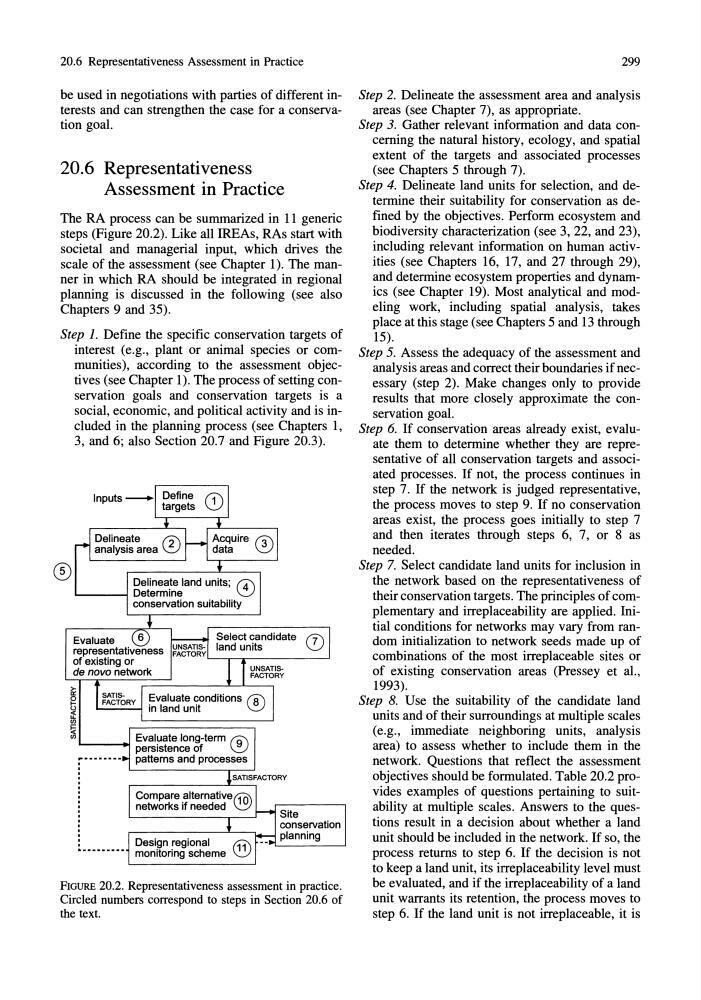
The RA process can be summarized in 11 generic
steps (Figure 20.2). Like all IREAs, RAs start with
societal and managerial input, which drives the
scale of the assessment (see Chapter 1). The manner in which RA should be integrated in regional
planning is discussed in the following (see also
Chapters 9 and 35).
Step 1. Define the specific conservation targets of
interest (e.g., plant or animal species or communities), according to the assessment objectives (see Chapter 1). The process of setting conservation goals and conservation targets is a
social, economic, and political activity and is included in the planning process (see Chapters 1,
3, and 6; also Section 20.7 and Figure 20.3).
®
InputsDelineate land units; f4\
L..----I Determine
\J
conservation suitability
Evaluate
representativeness
of existing or
de novo network
I rn
~
rn L--_ _ ~ Evaluate long-term ®
persistence of
patterns and processes
Site
conservation
r---------"'-----,......J planning
Design regional
f.i1\
monitoring scheme \!2J
FIGURE 20.2. Representativeness assessment in practice.
Circled numbers correspond to steps in Section 20.6 of
the text.
299
Step 2. Delineate the assessment area and analysis
areas (see Chapter 7), as appropriate.
Step 3. Gather relevant information and data concerning the natural history, ecology, and spatial
extent of the targets and associated processes
(see Chapters 5 through 7).
Step 4. Delineate land units for selection, and determine their suitability for conservation as defined by the objectives. Perform ecosystem and
biodiversity characterization (see 3, 22, and 23),
including relevant information on human activities (see Chapters 16, 17, and 27 through 29),
and determine ecosystem properties and dynamics (see Chapter 19). Most analytical and modeling work, including spatial analysis, takes
place at this stage (see Chapters 5 and 13 through
15).
Step 5. Assess the adequacy of the assessment and
analysis areas and correct their boundaries if necessary (step 2). Make changes only to provide
results that more closely approximate the conservation goal.
Step 6. If conservation areas already exist, evaluate them to determine whether they are representative of all conservation targets and associated processes. If not, the process continues in
step 7. If the network is judged representative,
the process moves to step 9. If no conservation
areas exist, the process goes initially to step 7
and then iterates through steps 6, 7, or 8 as
needed.
Step 7. Select candidate land units for inclusion in
the network based on the representativeness of
their conservation targets. The principles of complementary and irreplaceability are applied. Initial conditions for networks may vary from random initialization to network seeds made up of
combinations of the most irreplaceable sites or
of existing conservation areas (Pressey et aI.,
1993).
Step 8. Use the suitability of the candidate land
units and of their surroundings at multiple scales
(e.g., immediate neighboring units, analysis
area) to assess whether to include them in the
network. Questions that reflect the assessment
objectives should be formulated. Table 20.2 provides examples of questions pertaining to suitability at multiple scales. Answers to the questions result in a decision about whether a land
unit should be included in the network. If so, the
process returns to step 6. If the decision is not
to keep a land unit, its irreplaceability level must
be evaluated, and if the irreplaceability of a land
unit warrants its retention, the process moves to
step 6. If the land unit is not irreplaceable, it is
be used in negotiations with parties of different interests and can strengthen the case for a conservation goal.
20.6 Representativeness
Assessment in Practice
The RA process can be summarized in 11 generic
steps (Figure 20.2). Like all IREAs, RAs start with
societal and managerial input, which drives the
scale of the assessment (see Chapter 1). The manner in which RA should be integrated in regional
planning is discussed in the following (see also
Chapters 9 and 35).
Step 1. Define the specific conservation targets of
interest (e.g., plant or animal species or communities), according to the assessment objectives (see Chapter 1). The process of setting conservation goals and conservation targets is a
social, economic, and political activity and is included in the planning process (see Chapters 1,
3, and 6; also Section 20.7 and Figure 20.3).
®
InputsDelineate land units; f4\
L..----I Determine
\J
conservation suitability
Evaluate
representativeness
of existing or
de novo network
I rn
~
rn L--_ _ ~ Evaluate long-term ®
persistence of
patterns and processes
Site
conservation
r---------"'-----,......J planning
Design regional
f.i1\
monitoring scheme \!2J
FIGURE 20.2. Representativeness assessment in practice.
Circled numbers correspond to steps in Section 20.6 of
the text.
299
Step 2. Delineate the assessment area and analysis
areas (see Chapter 7), as appropriate.
Step 3. Gather relevant information and data concerning the natural history, ecology, and spatial
extent of the targets and associated processes
(see Chapters 5 through 7).
Step 4. Delineate land units for selection, and determine their suitability for conservation as defined by the objectives. Perform ecosystem and
biodiversity characterization (see 3, 22, and 23),
including relevant information on human activities (see Chapters 16, 17, and 27 through 29),
and determine ecosystem properties and dynamics (see Chapter 19). Most analytical and modeling work, including spatial analysis, takes
place at this stage (see Chapters 5 and 13 through
15).
Step 5. Assess the adequacy of the assessment and
analysis areas and correct their boundaries if necessary (step 2). Make changes only to provide
results that more closely approximate the conservation goal.
Step 6. If conservation areas already exist, evaluate them to determine whether they are representative of all conservation targets and associated processes. If not, the process continues in
step 7. If the network is judged representative,
the process moves to step 9. If no conservation
areas exist, the process goes initially to step 7
and then iterates through steps 6, 7, or 8 as
needed.
Step 7. Select candidate land units for inclusion in
the network based on the representativeness of
their conservation targets. The principles of complementary and irreplaceability are applied. Initial conditions for networks may vary from random initialization to network seeds made up of
combinations of the most irreplaceable sites or
of existing conservation areas (Pressey et aI.,
1993).
Step 8. Use the suitability of the candidate land
units and of their surroundings at multiple scales
(e.g., immediate neighboring units, analysis
area) to assess whether to include them in the
network. Questions that reflect the assessment
objectives should be formulated. Table 20.2 provides examples of questions pertaining to suitability at multiple scales. Answers to the questions result in a decision about whether a land
unit should be included in the network. If so, the
process returns to step 6. If the decision is not
to keep a land unit, its irreplaceability level must
be evaluated, and if the irreplaceability of a land
unit warrants its retention, the process moves to
step 6. If the land unit is not irreplaceable, it is