

16
An Overview of Ecological Assessment Principles and Applications
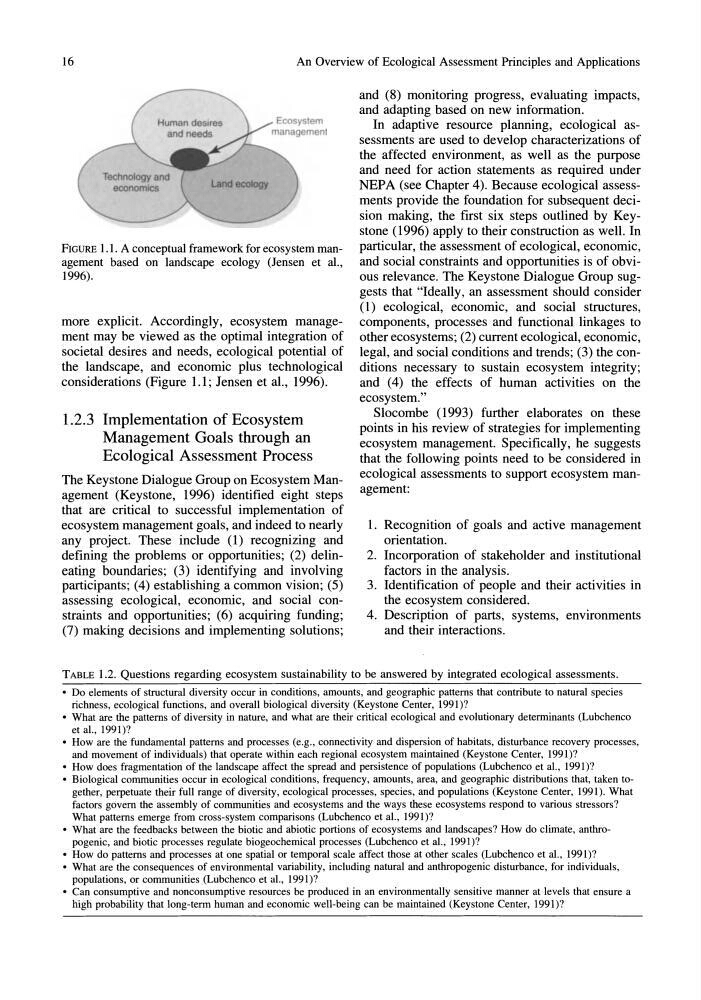
FIGURE 1.1. A conceptual framework for ecosystem management based on landscape ecology (Jensen et aI.,
1996).
more explicit. Accordingly, ecosystem management may be viewed as the optimal integration of
societal desires and needs, ecological potential of
the landscape, and economic plus technological
considerations (Figure 1.1 ; Jensen et al., 1996).
1.2.3 Implementation of Ecosystem
Management Goals through an
Ecological Assessment Process
The Keystone Dialogue Group on Ecosystem Management (Keystone, 1996) identified eight steps
that are critical to successful implementation of
ecosystem management goals, and indeed to nearly
any project. These include (1) recognizing and
defining the problems or opportunities; (2) delineating boundaries; (3) identifying and involving
participants; (4) establishing a common vision; (5)
assessing ecological, economic, and social constraints and opportunities; (6) acquiring funding;
(7) making decisions and implementing solutions;
and (8) monitoring progress, evaluating impacts,
and adapting based on new information.
In adaptive resource planning, ecological assessments are used to develop characterizations of
the affected environment, as well as the purpose
and need for action statements as required under
NEPA (see Chapter 4). Because ecological assessments provide the foundation for subsequent decision making, the first six steps outlined by Keystone (1996) apply to their construction as well. In
particular, the assessment of ecological, economic,
and social constraints and opportunities is of obvious relevance. The Keystone Dialogue Group suggests that "Ideally, an assessment should consider
(1) ecological, economic, and social structures,
components, processes and functional linkages to
other ecosystems; (2) current ecological, economic,
legal, and social conditions and trends; (3) the conditions necessary to sustain ecosystem integrity;
and (4) the effects of human activities on the
ecosystem."
Slocombe (1993) further elaborates on these
points in his review of strategies for implementing
ecosystem management. Specifically, he suggests
that the following points need to be considered in
ecological assessments to support ecosystem management:
1. Recognition of goals and active management
orientation.
2. Incorporation of stakeholder and institutional
factors in the analysis.
3. Identification of people and their activities in
the ecosystem considered.
4. Description of parts, systems, environments
and their interactions.
TABLE 1.2. Questions regarding ecosystem sustainability to be answered by integrated ecological assessments.
• Do elements of structural diversity occur in conditions, amounts, and geographic patterns that contribute to natural species
richness, ecological functions, and overall biological diversity (Keystone Center, 1991)?
• What are the patterns of diversity in nature, and what are their critical ecological and evolutionary determinants (Lubchenco
et aI., 1991)?
• How are the fundamental patterns and processes (e.g., connectivity and dispersion of habitats, disturbance recovery processes,
and movement of individuals) that operate within each regional ecosystem maintained (Keystone Center, 1991)?
• How does fragmentation of the landscape affect the spread and persistence of populations (Lubchenco et aI., 1991)?
• Biological communities occur in ecological conditions, frequency, amounts, area, and geographic distributions that, taken together, perpetuate their full range of diversity, ecological processes, species, and popUlations (Keystone Center, 1991). What
factors govern the assembly of communities and ecosystems and the ways these ecosystems respond to various stressors?
What patterns emerge from cross-system comparisons (Lubchenco et aI., 1991)?
• What are the feedbacks between the biotic and abiotic portions of ecosystems and landscapes? How do climate, anthropogenic, and biotic processes regulate biogeochemical processes (Lubchenco et aI., 1991)?
• How do patterns and processes at one spatial or temporal scale affect those at other scales (Lubchenco et aI., 1991)?
• What are the consequences of environmental variability, including natural and anthropogenic disturbance, for individuals,
populations, or communities (Lubchenco et aI., 1991)?
• Can consumptive and nonconsumptive resources be produced in an environmentally sensitive manner at levels that ensure a
high probability that long-term human and economic well-being can be maintained (Keystone Center, 1991)?
An Overview of Ecological Assessment Principles and Applications
FIGURE 1.1. A conceptual framework for ecosystem management based on landscape ecology (Jensen et aI.,
1996).
more explicit. Accordingly, ecosystem management may be viewed as the optimal integration of
societal desires and needs, ecological potential of
the landscape, and economic plus technological
considerations (Figure 1.1 ; Jensen et al., 1996).
1.2.3 Implementation of Ecosystem
Management Goals through an
Ecological Assessment Process
The Keystone Dialogue Group on Ecosystem Management (Keystone, 1996) identified eight steps
that are critical to successful implementation of
ecosystem management goals, and indeed to nearly
any project. These include (1) recognizing and
defining the problems or opportunities; (2) delineating boundaries; (3) identifying and involving
participants; (4) establishing a common vision; (5)
assessing ecological, economic, and social constraints and opportunities; (6) acquiring funding;
(7) making decisions and implementing solutions;
and (8) monitoring progress, evaluating impacts,
and adapting based on new information.
In adaptive resource planning, ecological assessments are used to develop characterizations of
the affected environment, as well as the purpose
and need for action statements as required under
NEPA (see Chapter 4). Because ecological assessments provide the foundation for subsequent decision making, the first six steps outlined by Keystone (1996) apply to their construction as well. In
particular, the assessment of ecological, economic,
and social constraints and opportunities is of obvious relevance. The Keystone Dialogue Group suggests that "Ideally, an assessment should consider
(1) ecological, economic, and social structures,
components, processes and functional linkages to
other ecosystems; (2) current ecological, economic,
legal, and social conditions and trends; (3) the conditions necessary to sustain ecosystem integrity;
and (4) the effects of human activities on the
ecosystem."
Slocombe (1993) further elaborates on these
points in his review of strategies for implementing
ecosystem management. Specifically, he suggests
that the following points need to be considered in
ecological assessments to support ecosystem management:
1. Recognition of goals and active management
orientation.
2. Incorporation of stakeholder and institutional
factors in the analysis.
3. Identification of people and their activities in
the ecosystem considered.
4. Description of parts, systems, environments
and their interactions.
TABLE 1.2. Questions regarding ecosystem sustainability to be answered by integrated ecological assessments.
• Do elements of structural diversity occur in conditions, amounts, and geographic patterns that contribute to natural species
richness, ecological functions, and overall biological diversity (Keystone Center, 1991)?
• What are the patterns of diversity in nature, and what are their critical ecological and evolutionary determinants (Lubchenco
et aI., 1991)?
• How are the fundamental patterns and processes (e.g., connectivity and dispersion of habitats, disturbance recovery processes,
and movement of individuals) that operate within each regional ecosystem maintained (Keystone Center, 1991)?
• How does fragmentation of the landscape affect the spread and persistence of populations (Lubchenco et aI., 1991)?
• Biological communities occur in ecological conditions, frequency, amounts, area, and geographic distributions that, taken together, perpetuate their full range of diversity, ecological processes, species, and popUlations (Keystone Center, 1991). What
factors govern the assembly of communities and ecosystems and the ways these ecosystems respond to various stressors?
What patterns emerge from cross-system comparisons (Lubchenco et aI., 1991)?
• What are the feedbacks between the biotic and abiotic portions of ecosystems and landscapes? How do climate, anthropogenic, and biotic processes regulate biogeochemical processes (Lubchenco et aI., 1991)?
• How do patterns and processes at one spatial or temporal scale affect those at other scales (Lubchenco et aI., 1991)?
• What are the consequences of environmental variability, including natural and anthropogenic disturbance, for individuals,
populations, or communities (Lubchenco et aI., 1991)?
• Can consumptive and nonconsumptive resources be produced in an environmentally sensitive manner at levels that ensure a
high probability that long-term human and economic well-being can be maintained (Keystone Center, 1991)?