

1.2 Ecosystem Management and Its Relation to Ecological Assessments
15
The 1969 National Environmental Policy Act
(NEPA) fully acknowledges the tension between
growing demands for natural resources and the
ability to sustain these resources. Its goal is to "encourage productive and enjoyable harmony between man and his environment; to promote efforts
which will prevent or eliminate damage to the environment and biosphere and stimulate the health
and welfare of man; to enrich the understanding of
the ecological systems and natural resources important to the nation." NEPA only applies to federallands and actions significantly affecting the environment, in contrast to the 1973 Endangered
Species Act (ESA), which protects threatened and
endangered species on all lands and management
activities. Although the ESA does acknowledge the
importance of ecosystems, in reality, efforts have
focused on management strategies for individual
species, rather than the ecosystems that they inhabit. Ecosystem management has been advocated
by many as a means of reconciling public conflict
over the management of endangered species (e.g.,
Diamond and Noonan, 1987).
Formalization of the notion of ecosystem management began about ten years ago with the publication of a set of papers on park and wilderness
management edited by Agee and Johnson (1988).
Since then, an array of publications have attempted
to clarify and define this concept (e.g., Overbay,
1992; Forest Ecosystem Management Assessment
Team, 1993; Slocombe, 1993; Society of American
Foresters, 1993; Eastside Forest Health Assessment
Team, 1994 [Everett et ai., 1994]; Grumbine, 1994;
Jensen and Bourgeron, 1994; Wood, 1994; Christensen, 1996; Christensen and Franklin, 1996;
Christensen et aI., 1996; Boyce and Haney, 1997).
Samson and Knopf (1996) have assembled an anthology of literature relevant to this issue.
Some have argued that the phrase "ecosystem
management" is unfortunate because we do not
manage ecosystems per se. Rather, our objectives
and goals are inevitably oriented toward particular
elements (e.g., species) or processes (e.g., hydrologic management) and, more often than not, our
protocols involve managing the actions of humans.
A more apt but cumbersome descriptor might be
"management in an ecosystem context" -management that acknowledges the dynamic and spatially
open character of ecosystems and the inevitability
and complexity of humans as ecosystem components.
1.2.2 Goals of Ecosystem Management
Most government agencies (e.g., USDA Forest Service, USDI Bureau of Land Management) have
adopted ecosystem management in their multip1euse, sustained-yield management of federal lands.
The primary objective of this philosophy is to sustain the integrity of ecosystems (i.e., their function,
composition, and structure) for future generations
while providing immediate goods and services to
an increasingly diverse public (Jensen and Everett,
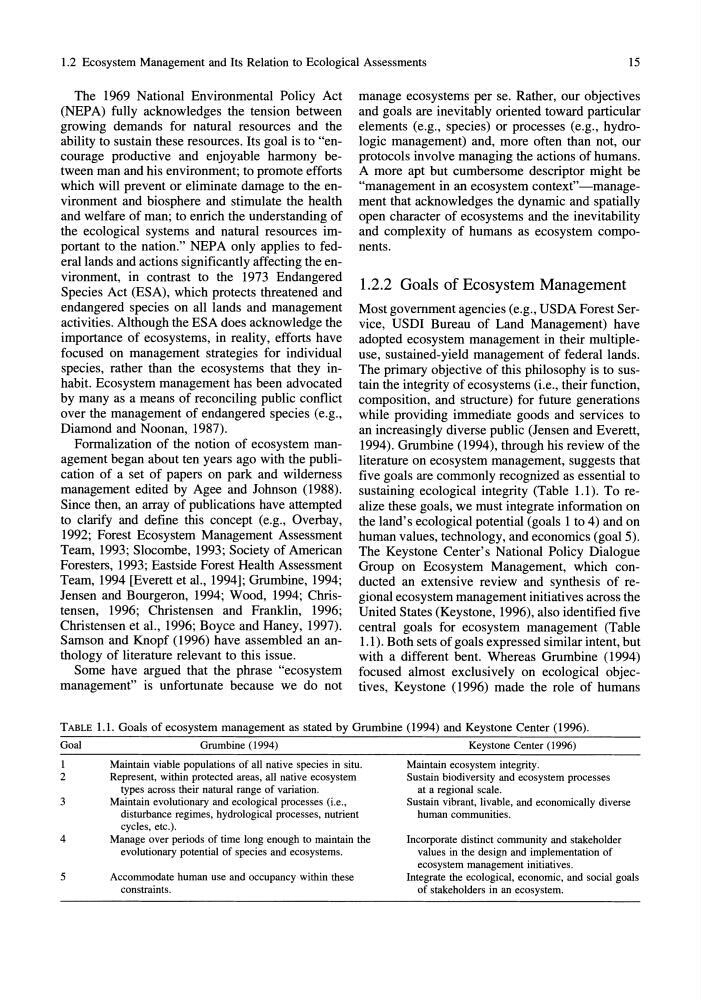
1994). Grumbine (1994), through his review of the
literature on ecosystem management, suggests that
five goals are commonly recognized as essential to
sustaining ecological integrity (Table 1.1). To realize these goals, we must integrate information on
the land's ecological potential (goals 1 to 4) and on
human values, technology, and economics (goal 5).
The Keystone Center's National Policy Dialogue
Group on Ecosystem Management, which conducted an extensive review and synthesis of regional ecosystem management initiatives across the
United States (Keystone, 1996), also identified five
central goals for ecosystem management (Table
1.1). Both sets of goals expressed similar intent, but
with a different bent. Whereas Grumbine (1994)
focused almost exclusively on ecological objectives, Keystone (1996) made the role of humans
TABLE 1.1. Goals of ecosystem management as stated by Grumbine (1994) and Keystone Center (1996).
Goal
2
3
4
5
Grumbine (1994)
Maintain viable populations of all native species in situ.
Represent, witbin protected areas, all native ecosystem
types across tbeir natural range of variation.
Maintain evolutionary and ecological processes (i.e.,
disturbance regimes, hydrological processes, nutrient
cycles, etc.).
Manage over periods of time long enough to maintain the
evolutionary potential of species and ecosystems.
Accommodate human use and occupancy within these
constraints.
Keystone Center (1996)
Maintain ecosystem integrity.
Sustain biodiversity and ecosystem processes
at a regional scale.
Sustain vibrant, livable, and economically diverse
human communities.
Incorporate distinct community and stakeholder
values in the design and implementation of
ecosystem management initiatives.
Integrate the ecological, economic, and social goals
of stakeholders in an ecosystem.
15
The 1969 National Environmental Policy Act
(NEPA) fully acknowledges the tension between
growing demands for natural resources and the
ability to sustain these resources. Its goal is to "encourage productive and enjoyable harmony between man and his environment; to promote efforts
which will prevent or eliminate damage to the environment and biosphere and stimulate the health
and welfare of man; to enrich the understanding of
the ecological systems and natural resources important to the nation." NEPA only applies to federallands and actions significantly affecting the environment, in contrast to the 1973 Endangered
Species Act (ESA), which protects threatened and
endangered species on all lands and management
activities. Although the ESA does acknowledge the
importance of ecosystems, in reality, efforts have
focused on management strategies for individual
species, rather than the ecosystems that they inhabit. Ecosystem management has been advocated
by many as a means of reconciling public conflict
over the management of endangered species (e.g.,
Diamond and Noonan, 1987).
Formalization of the notion of ecosystem management began about ten years ago with the publication of a set of papers on park and wilderness
management edited by Agee and Johnson (1988).
Since then, an array of publications have attempted
to clarify and define this concept (e.g., Overbay,
1992; Forest Ecosystem Management Assessment
Team, 1993; Slocombe, 1993; Society of American
Foresters, 1993; Eastside Forest Health Assessment
Team, 1994 [Everett et ai., 1994]; Grumbine, 1994;
Jensen and Bourgeron, 1994; Wood, 1994; Christensen, 1996; Christensen and Franklin, 1996;
Christensen et aI., 1996; Boyce and Haney, 1997).
Samson and Knopf (1996) have assembled an anthology of literature relevant to this issue.
Some have argued that the phrase "ecosystem
management" is unfortunate because we do not
manage ecosystems per se. Rather, our objectives
and goals are inevitably oriented toward particular
elements (e.g., species) or processes (e.g., hydrologic management) and, more often than not, our
protocols involve managing the actions of humans.
A more apt but cumbersome descriptor might be
"management in an ecosystem context" -management that acknowledges the dynamic and spatially
open character of ecosystems and the inevitability
and complexity of humans as ecosystem components.
1.2.2 Goals of Ecosystem Management
Most government agencies (e.g., USDA Forest Service, USDI Bureau of Land Management) have
adopted ecosystem management in their multip1euse, sustained-yield management of federal lands.
The primary objective of this philosophy is to sustain the integrity of ecosystems (i.e., their function,
composition, and structure) for future generations
while providing immediate goods and services to
an increasingly diverse public (Jensen and Everett,
1994). Grumbine (1994), through his review of the
literature on ecosystem management, suggests that
five goals are commonly recognized as essential to
sustaining ecological integrity (Table 1.1). To realize these goals, we must integrate information on
the land's ecological potential (goals 1 to 4) and on
human values, technology, and economics (goal 5).
The Keystone Center's National Policy Dialogue
Group on Ecosystem Management, which conducted an extensive review and synthesis of regional ecosystem management initiatives across the
United States (Keystone, 1996), also identified five
central goals for ecosystem management (Table
1.1). Both sets of goals expressed similar intent, but
with a different bent. Whereas Grumbine (1994)
focused almost exclusively on ecological objectives, Keystone (1996) made the role of humans
TABLE 1.1. Goals of ecosystem management as stated by Grumbine (1994) and Keystone Center (1996).
Goal
2
3
4
5
Grumbine (1994)
Maintain viable populations of all native species in situ.
Represent, witbin protected areas, all native ecosystem
types across tbeir natural range of variation.
Maintain evolutionary and ecological processes (i.e.,
disturbance regimes, hydrological processes, nutrient
cycles, etc.).
Manage over periods of time long enough to maintain the
evolutionary potential of species and ecosystems.
Accommodate human use and occupancy within these
constraints.
Keystone Center (1996)
Maintain ecosystem integrity.
Sustain biodiversity and ecosystem processes
at a regional scale.
Sustain vibrant, livable, and economically diverse
human communities.
Incorporate distinct community and stakeholder
values in the design and implementation of
ecosystem management initiatives.
Integrate the ecological, economic, and social goals
of stakeholders in an ecosystem.