

250
Economic Linkages to Natural Resources
17.6 Regional Accounts and
Their Uses in Economic
Impact Assessment
Economic accounting systems provide data for economic models. The most important sources of such
data are the U.S. Department of Commerce and
U.S. Department of Labor. The most important economic accounts are of the flow type. Two flow accounting systems are maintained on a regular basis: (1) income and product accounts and (2)
input-output accounts. Income and product accounts are updated most frequently and are the basis of estimates of gross domestic product (GDP).
Most important for economic impact assessment
are the input-output accounts (1-0 accounts).
These are updated infrequently because they are
very detailed-they quantify economic transactions between all sectors of the economy. The 1-0
accounting system is the basis of the economic impact models that rely on secondary data. Income
and product accounts and the 1-0 accounts are
compatible in that the identical gross national product (and GDP) can be calculated from either system.
To correctly quantify derived demand relationships, it is necessary to measure the structure of the
regional economy. Input-output accounts quantify
the structure of the regional economy in a sense.
They essentially show flows of outputs between
sectors. A sector is an aggregation of establishments producing a similar product (i.e., good or service) or mix of products.
Input-output accounts provide a quantitative representation of a regional economy's structure. This accounting
system is a flow system that includes all monetary transactions occurring in the region over a certain period of
time, usually a year. In this accounting system, the economy is divided into three types of sectors: processing, final demand, and payments or value added. Processing
sectors constitute intermediate industries made up of
firms that purchase outputs of other sectors, which are
in turn used in combination with labor and other inputs
in manufacturing products. Final demand sectors are various categories of economic activities that are final consumers of goods and services produced in the regional
economy. Payments sectors provide inputs other than
those provided by processing sectors (e.g., households
provide labor). (Chappelle et aI., 1986, p. 3)
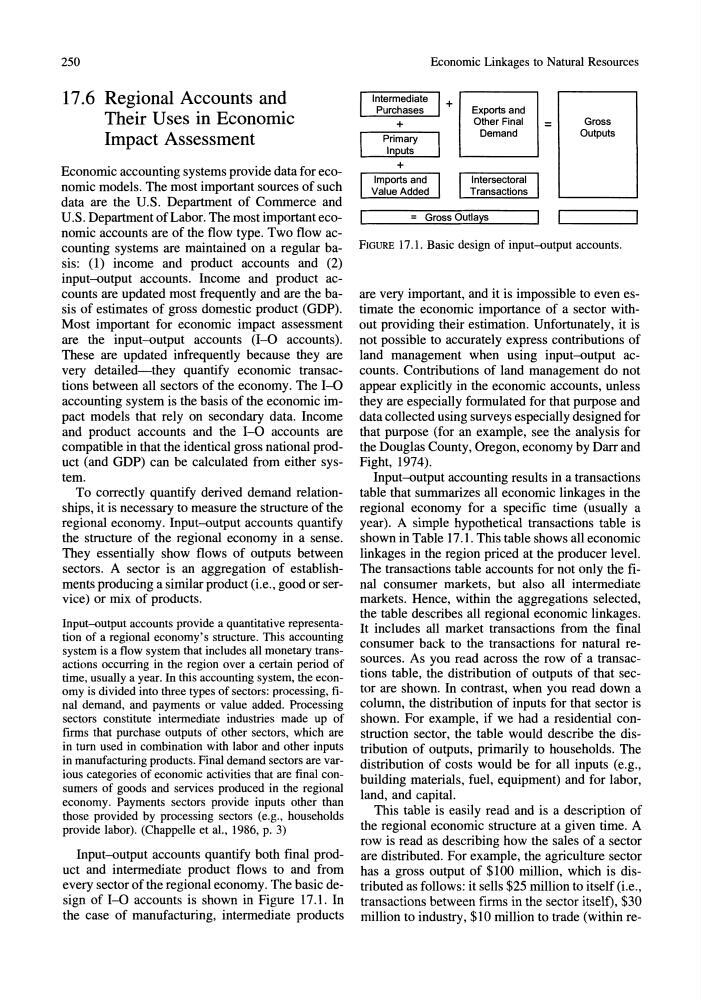
Input-output accounts quantify both final product and intermediate product flows to and from
every sector of the regional economy. The basic design of 1-0 accounts is shown in Figure 17.1. In
the case of manufacturing, intermediate products
Intermediate
+
Purchases
Exports and
+
Other Final
=
Gross
Primary
Demand
Outputs
Inputs
+
Imports and
Intersectoral
Value Added
Transactions
= Gross Outlays
FIGURE 17.1. Basic design of input-output accounts.
are very important, and it is impossible to even estimate the economic importance of a sector without providing their estimation. Unfortunately, it is
not possible to accurately express contributions of
land management when using input-output accounts. Contributions of land management do not
appear explicitly in the economic accounts, unless
they are especially formulated for that purpose and
data collected using surveys especially designed for
that purpose (for an example, see the analysis for
the Douglas County, Oregon, economy by Darr and
Fight, 1974).
Input-output accounting results in a transactions
table that summarizes all economic linkages in the
regional economy for a specific time (usually a
year). A simple hypothetical transactions table is
shown in Table 17.1. This table shows all economic
linkages in the region priced at the producer level.
The transactions table accounts for not only the final consumer markets, but also all intermediate
markets. Hence, within the aggregations selected,
the table describes all regional economic linkages.
It includes all market transactions from the final
consumer back to the transactions for natural resources. As you read across the row of a transactions table, the distribution of outputs of that sector are shown. In contrast, when you read down a
column, the distribution of inputs for that sector is
shown. For example, if we had a residential construction sector, the table would describe the distribution of outputs, primarily to households. The
distribution of costs would be for all inputs (e.g.,
building materials, fuel, equipment) and for labor,
land, and capital.
This table is easily read and is a description of
the regional economic structure at a given time. A
row is read as describing how the sales of a sector
are distributed. For example, the agriculture sector
has a gross output of $100 million, which is distributed as follows: it sells $25 million to itself (i.e.,
transactions between firms in the sector itself), $30
million to industry, $10 million to trade (within re-
Economic Linkages to Natural Resources
17.6 Regional Accounts and
Their Uses in Economic
Impact Assessment
Economic accounting systems provide data for economic models. The most important sources of such
data are the U.S. Department of Commerce and
U.S. Department of Labor. The most important economic accounts are of the flow type. Two flow accounting systems are maintained on a regular basis: (1) income and product accounts and (2)
input-output accounts. Income and product accounts are updated most frequently and are the basis of estimates of gross domestic product (GDP).
Most important for economic impact assessment
are the input-output accounts (1-0 accounts).
These are updated infrequently because they are
very detailed-they quantify economic transactions between all sectors of the economy. The 1-0
accounting system is the basis of the economic impact models that rely on secondary data. Income
and product accounts and the 1-0 accounts are
compatible in that the identical gross national product (and GDP) can be calculated from either system.
To correctly quantify derived demand relationships, it is necessary to measure the structure of the
regional economy. Input-output accounts quantify
the structure of the regional economy in a sense.
They essentially show flows of outputs between
sectors. A sector is an aggregation of establishments producing a similar product (i.e., good or service) or mix of products.
Input-output accounts provide a quantitative representation of a regional economy's structure. This accounting
system is a flow system that includes all monetary transactions occurring in the region over a certain period of
time, usually a year. In this accounting system, the economy is divided into three types of sectors: processing, final demand, and payments or value added. Processing
sectors constitute intermediate industries made up of
firms that purchase outputs of other sectors, which are
in turn used in combination with labor and other inputs
in manufacturing products. Final demand sectors are various categories of economic activities that are final consumers of goods and services produced in the regional
economy. Payments sectors provide inputs other than
those provided by processing sectors (e.g., households
provide labor). (Chappelle et aI., 1986, p. 3)
Input-output accounts quantify both final product and intermediate product flows to and from
every sector of the regional economy. The basic design of 1-0 accounts is shown in Figure 17.1. In
the case of manufacturing, intermediate products
Intermediate
+
Purchases
Exports and
+
Other Final
=
Gross
Primary
Demand
Outputs
Inputs
+
Imports and
Intersectoral
Value Added
Transactions
= Gross Outlays
FIGURE 17.1. Basic design of input-output accounts.
are very important, and it is impossible to even estimate the economic importance of a sector without providing their estimation. Unfortunately, it is
not possible to accurately express contributions of
land management when using input-output accounts. Contributions of land management do not
appear explicitly in the economic accounts, unless
they are especially formulated for that purpose and
data collected using surveys especially designed for
that purpose (for an example, see the analysis for
the Douglas County, Oregon, economy by Darr and
Fight, 1974).
Input-output accounting results in a transactions
table that summarizes all economic linkages in the
regional economy for a specific time (usually a
year). A simple hypothetical transactions table is
shown in Table 17.1. This table shows all economic
linkages in the region priced at the producer level.
The transactions table accounts for not only the final consumer markets, but also all intermediate
markets. Hence, within the aggregations selected,
the table describes all regional economic linkages.
It includes all market transactions from the final
consumer back to the transactions for natural resources. As you read across the row of a transactions table, the distribution of outputs of that sector are shown. In contrast, when you read down a
column, the distribution of inputs for that sector is
shown. For example, if we had a residential construction sector, the table would describe the distribution of outputs, primarily to households. The
distribution of costs would be for all inputs (e.g.,
building materials, fuel, equipment) and for labor,
land, and capital.
This table is easily read and is a description of
the regional economic structure at a given time. A
row is read as describing how the sales of a sector
are distributed. For example, the agriculture sector
has a gross output of $100 million, which is distributed as follows: it sells $25 million to itself (i.e.,
transactions between firms in the sector itself), $30
million to industry, $10 million to trade (within re-