

214
Fuzzy Statistical and Modeling Approach to Ecological Assessments
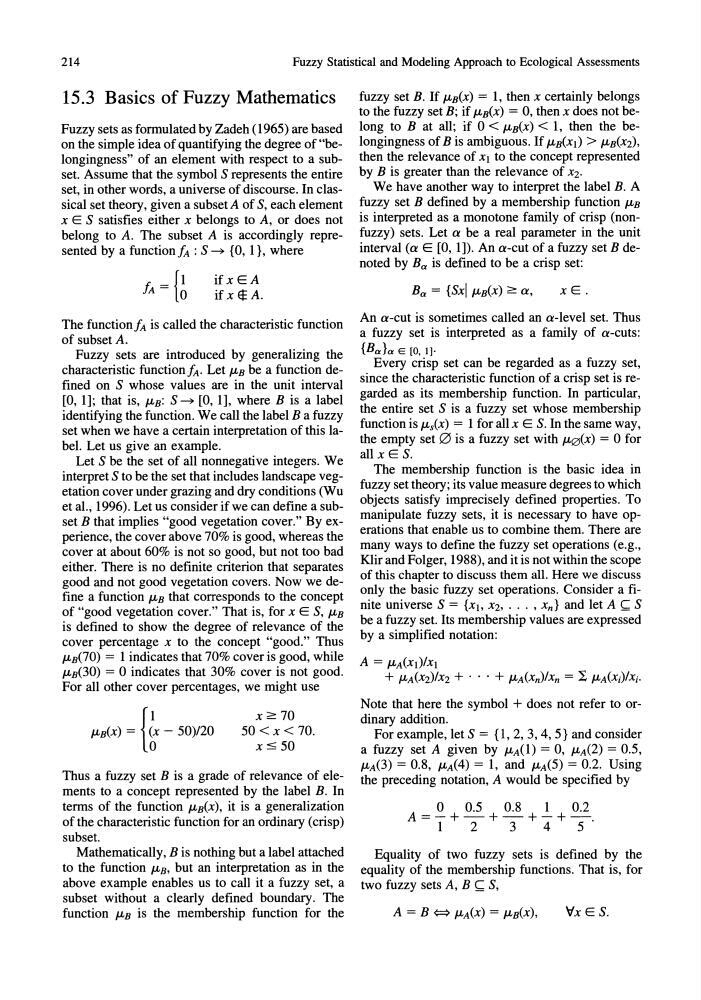
15.3 Basics of Fuzzy Mathematics
Fuzzy sets as formulated by Zadeh (1965) are based
on the simple idea of quantifying the degree of "belongingness" of an element with respect to a subset. Assume that the symbol S represents the entire
set, in other words, a universe of discourse. In classical set theory, given a subset A of S, each element
xES satisfies either x belongs to A, or does not
belong to A. The subset A is accordingly represented by a function/A: S ~ {O, I}, where
if xEA
if x ($ A.
The function/A is called the characteristic function
of subset A.
Fuzzy sets are introduced by generalizing the
characteristic function/A' Let f-LB be a function defined on S whose values are in the unit interval
[0, 1]; that is, f-LB: S ~ [0, 1], where B is a label
identifying the function. We call the label B a fuzzy
set when we have a certain interpretation of this label. Let us give an example.
Let S be the set of all nonnegative integers. We
interpret S to be the set that includes landscape vegetation cover under grazing and dry conditions (Wu
et aI., 1996). Let us consider if we can define a subset B that implies "good vegetation cover." By experience, the cover above 70% is good, whereas the
cover at about 60% is not so good, but not too bad
either. There is no definite criterion that separates
good and not good vegetation covers. Now we define a function f-LB that corresponds to the concept
of "good vegetation cover." That is, for xES, f-LB
is defined to show the degree of relevance of the
cover percentage x to the concept "good." Thus
f-LB(70) = 1 indicates that 70% cover is good, while
f-LB(30) = 0 indicates that 30% cover is not good.
For all other cover percentages, we might use
"B(X) ~ {~ - 50)120
X 2: 70
50
Thus a fuzzy set B is a grade of relevance of elements to a concept represented by the label B. In
terms of the function f-LB(X), it is a generalization
of the characteristic function for an ordinary (crisp)
subset.
Mathematically, B is nothing but a label attached
to the function f-LB' but an interpretation as in the
above example enables us to call it a fuzzy set, a
subset without a clearly defined boundary. The
function f-LB is the membership function for the
fuzzy set B. If f-LB(X) = 1, then x certainly belongs
to the fuzzy set B; if f-LB(X) = 0, then x does not belong to B at all; if 0 < /LB(X) < 1, then the belongingness of B is ambiguous. If /LB(X1) > /LB(X2),
then the relevance of Xl to the concept represented
by B is greater than the relevance of X2.
We have another way to interpret the label B. A
fuzzy set B defined by a membership function /LB
is interpreted as a monotone family of crisp (nonfuzzy) sets. Let a be a real parameter in the unit
interval (a E [0, 1]). An a-cut of a fuzzy set B denoted by Ba is defined to be a crisp set:
Ba = {Sxl /LB(X) 2: a,
x E .
An a-cut is sometimes called an a-level set. Thus
a fuzzy set is interpreted as a family of a-cuts:
{Ba}a E [0, 1)·
Every crisp set can be regarded as a fuzzy set,
since the characteristic function of a crisp set is regarded as its membership function. In particular,
the entire set S is a fuzzy set whose membership
function is /LsCx) = 1 for all xES. In the same way,
the empty set 0 is a fuzzy set with /L0(X) = 0 for
all xES.
The membership function is the basic idea in
fuzzy set theory; its value measure degrees to which
objects satisfy imprecisely defined properties. To
manipulate fuzzy sets, it is necessary to have operations that enable us to combine them. There are
many ways to define the fuzzy set operations (e.g.,
Klir and Folger, 1988), and it is not within the scope
of this chapter to discuss them all. Here we discuss
only the basic fuzzy set operations. Consider a finite universe S = {Xl> X2, ... , xn } and let A C S
be a fuzzy set. Its membership values are expressed
by a simplified notation:
A = /LA(X1)lx 1
+ f-LA(X2)/X2 + ... + /LA(Xn)/Xn = ~ /LA (Xi)lxi·
Note that here the symbol + does not refer to ordinary addition.
For example, let S = {I, 2, 3, 4, 5} and consider
a fuzzy set A given by /LA(l) = 0, /LA(2) = 0.5,
/LA(3) = 0.8, /LA(4) = 1, and /LA(5) = 0.2. Using
the preceding notation, A would be specified by
Equality of two fuzzy sets is defined by the
equality of the membership functions. That is, for
two fuzzy sets A, B C S,
'fixES.
Fuzzy Statistical and Modeling Approach to Ecological Assessments
15.3 Basics of Fuzzy Mathematics
Fuzzy sets as formulated by Zadeh (1965) are based
on the simple idea of quantifying the degree of "belongingness" of an element with respect to a subset. Assume that the symbol S represents the entire
set, in other words, a universe of discourse. In classical set theory, given a subset A of S, each element
xES satisfies either x belongs to A, or does not
belong to A. The subset A is accordingly represented by a function/A: S ~ {O, I}, where
if xEA
if x ($ A.
The function/A is called the characteristic function
of subset A.
Fuzzy sets are introduced by generalizing the
characteristic function/A' Let f-LB be a function defined on S whose values are in the unit interval
[0, 1]; that is, f-LB: S ~ [0, 1], where B is a label
identifying the function. We call the label B a fuzzy
set when we have a certain interpretation of this label. Let us give an example.
Let S be the set of all nonnegative integers. We
interpret S to be the set that includes landscape vegetation cover under grazing and dry conditions (Wu
et aI., 1996). Let us consider if we can define a subset B that implies "good vegetation cover." By experience, the cover above 70% is good, whereas the
cover at about 60% is not so good, but not too bad
either. There is no definite criterion that separates
good and not good vegetation covers. Now we define a function f-LB that corresponds to the concept
of "good vegetation cover." That is, for xES, f-LB
is defined to show the degree of relevance of the
cover percentage x to the concept "good." Thus
f-LB(70) = 1 indicates that 70% cover is good, while
f-LB(30) = 0 indicates that 30% cover is not good.
For all other cover percentages, we might use
"B(X) ~ {~ - 50)120
X 2: 70
50
Thus a fuzzy set B is a grade of relevance of elements to a concept represented by the label B. In
terms of the function f-LB(X), it is a generalization
of the characteristic function for an ordinary (crisp)
subset.
Mathematically, B is nothing but a label attached
to the function f-LB' but an interpretation as in the
above example enables us to call it a fuzzy set, a
subset without a clearly defined boundary. The
function f-LB is the membership function for the
fuzzy set B. If f-LB(X) = 1, then x certainly belongs
to the fuzzy set B; if f-LB(X) = 0, then x does not belong to B at all; if 0 < /LB(X) < 1, then the belongingness of B is ambiguous. If /LB(X1) > /LB(X2),
then the relevance of Xl to the concept represented
by B is greater than the relevance of X2.
We have another way to interpret the label B. A
fuzzy set B defined by a membership function /LB
is interpreted as a monotone family of crisp (nonfuzzy) sets. Let a be a real parameter in the unit
interval (a E [0, 1]). An a-cut of a fuzzy set B denoted by Ba is defined to be a crisp set:
Ba = {Sxl /LB(X) 2: a,
x E .
An a-cut is sometimes called an a-level set. Thus
a fuzzy set is interpreted as a family of a-cuts:
{Ba}a E [0, 1)·
Every crisp set can be regarded as a fuzzy set,
since the characteristic function of a crisp set is regarded as its membership function. In particular,
the entire set S is a fuzzy set whose membership
function is /LsCx) = 1 for all xES. In the same way,
the empty set 0 is a fuzzy set with /L0(X) = 0 for
all xES.
The membership function is the basic idea in
fuzzy set theory; its value measure degrees to which
objects satisfy imprecisely defined properties. To
manipulate fuzzy sets, it is necessary to have operations that enable us to combine them. There are
many ways to define the fuzzy set operations (e.g.,
Klir and Folger, 1988), and it is not within the scope
of this chapter to discuss them all. Here we discuss
only the basic fuzzy set operations. Consider a finite universe S = {Xl> X2, ... , xn } and let A C S
be a fuzzy set. Its membership values are expressed
by a simplified notation:
A = /LA(X1)lx 1
+ f-LA(X2)/X2 + ... + /LA(Xn)/Xn = ~ /LA (Xi)lxi·
Note that here the symbol + does not refer to ordinary addition.
For example, let S = {I, 2, 3, 4, 5} and consider
a fuzzy set A given by /LA(l) = 0, /LA(2) = 0.5,
/LA(3) = 0.8, /LA(4) = 1, and /LA(5) = 0.2. Using
the preceding notation, A would be specified by
Equality of two fuzzy sets is defined by the
equality of the membership functions. That is, for
two fuzzy sets A, B C S,
'fixES.