

~
>
0
U
1ii
!!!
0
u.
E
II>
e II>
Il.
208
Applications of Fractal Geometry and Percolation Theory to Landscape Analysis and Assessments
- - Geary County data
-£J -Area 1
- ~ - Area 2
60 -+----; - - * --Konza Prairie
- - • - - Area 1 simulated
50
-I::; - Area 2 simulated
40
30
20
10
0
0
20
40
60
80
100 120
Years
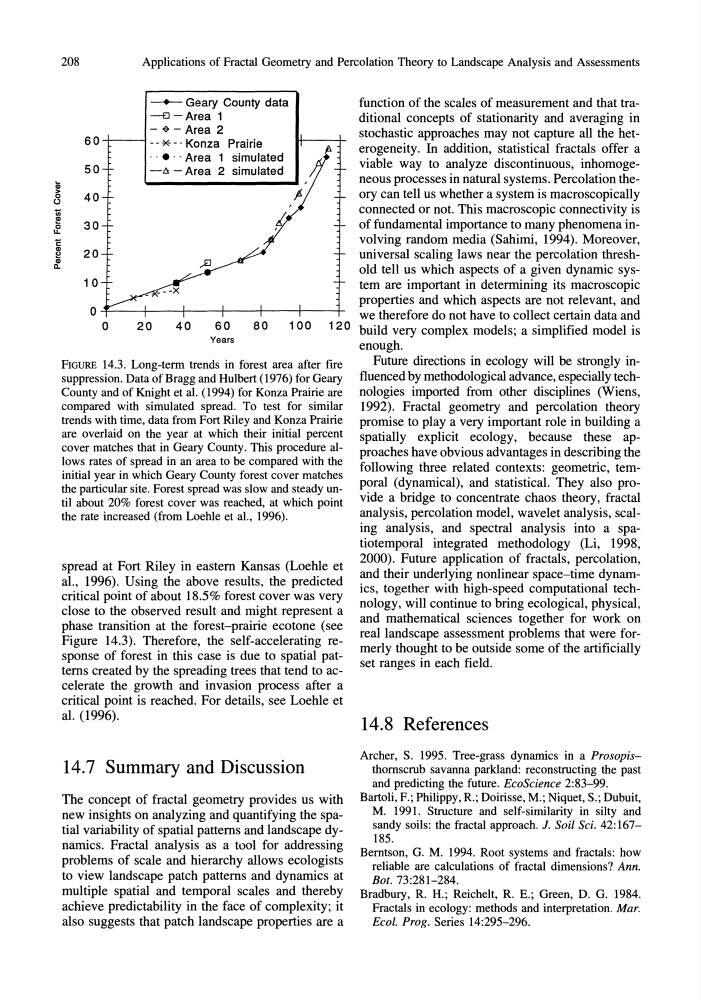
FIGURE 14.3. Long-term trends in forest area after fire
suppression. Data of Bragg and Hulbert (1976) for Geary
County and of Knight et ai. (1994) for Konza Prairie are
compared with simulated spread. To test for similar
trends with time, data from Fort Riley and Konza Prairie
are overlaid on the year at which their initial percent
cover matches that in Geary County. This procedure allows rates of spread in an area to be compared with the
initial year in which Geary County forest cover matches
the particular site. Forest spread was slow and steady until about 20% forest cover was reached, at which point
the rate increased (from Loehle et aI., 1996).
spread at Fort Riley in eastern Kansas (Loehle et
aI., 1996). Using the above results, the predicted
critical point of about 18.5% forest cover was very
close to the observed result and might represent a
phase transition at the forest-prairie ecotone (see
Figure 14.3). Therefore, the self-accelerating response of forest in this case is due to spatial patterns created by the spreading trees that tend to accelerate the growth and invasion process after a
critical point is reached. For details, see Loehle et
al. (1996).
14.7 Summary and Discussion
The concept of fractal geometry provides us with
new insights on analyzing and quantifying the spatial variability of spatial patterns and landscape dynamics. Fractal analysis as a tool for addressing
problems of scale and hierarchy allows ecologists
to view landscape patch patterns and dynamics at
multiple spatial and temporal scales and thereby
achieve predictability in the face of complexity; it
also suggests that patch landscape properties are a
function of the scales of measurement and that traditional concepts of stationarity and averaging in
stochastic approaches may not capture all the heterogeneity. In addition, statistical fractals offer a
viable way to analyze discontinuous, inhomogeneous processes in natural systems_ Percolation theory can tell us whether a system is macroscopically
connected or not. This macroscopic connectivity is
of fundamental importance to many phenomena involving random media (Sahimi, 1994). Moreover,
universal scaling laws near the percolation threshold tell us which aspects of a given dynamic system are important in determining its macroscopic
properties and which aspects are not relevant, and
we therefore do not have to collect certain data and
build very complex models; a simplified model is
enough.
Future directions in ecology will be strongly influenced by methodological advance, especially technologies imported from other disciplines (Wiens,
1992). Fractal geometry and percolation theory
promise to playa very important role in building a
spatially explicit ecology, because these approaches have obvious advantages in describing the
following three related contexts: geometric, temporal (dynamical), and statistical. They also provide a bridge to concentrate chaos theory, fractal
analysis, percolation model, wavelet analysis, scaling analysis, and spectral analysis into a spatiotemporal integrated methodology CLi, 1998,
2000). Future application of fractals, percolation,
and their underlying nonlinear space-time dynamics, together with high-speed computational technology, will continue to bring ecological, physical,
and mathematical sciences together for work on
real landscape assessment problems that were formerly thought to be outside some of the artificially
set ranges in each field.
14.8 References
Archer, S. 1995. Tree-grass dynamics in a Prosopisthomscrub savanna parkland: reconstructing the past
and predicting the future. EcoScience 2:83-99.
Bartoli, F.; Philippy, R.; Doirisse, M.; Niquet, S.; Dubuit,
M. 1991. Structure and self-similarity in silty and
sandy soils: the fractal approach. 1. Soil Sci. 42:167185.
Berntson, G. M. 1994. Root systems and fractals: how
reliable are calculations of fractal dimensions? Ann.
Bot. 73:281-284.
Bradbury, R. H.; Reichelt, R. E.; Green, D. G. 1984.
Fractals in ecology: methods and interpretation_ Mar.
Eco/. Prog. Series 14:295-296.
>
0
U
1ii
!!!
0
u.
E
II>
e II>
Il.
208
Applications of Fractal Geometry and Percolation Theory to Landscape Analysis and Assessments
- - Geary County data
-£J -Area 1
- ~ - Area 2
60 -+----; - - * --Konza Prairie
- - • - - Area 1 simulated
50
-I::; - Area 2 simulated
40
30
20
10
0
0
20
40
60
80
100 120
Years
FIGURE 14.3. Long-term trends in forest area after fire
suppression. Data of Bragg and Hulbert (1976) for Geary
County and of Knight et ai. (1994) for Konza Prairie are
compared with simulated spread. To test for similar
trends with time, data from Fort Riley and Konza Prairie
are overlaid on the year at which their initial percent
cover matches that in Geary County. This procedure allows rates of spread in an area to be compared with the
initial year in which Geary County forest cover matches
the particular site. Forest spread was slow and steady until about 20% forest cover was reached, at which point
the rate increased (from Loehle et aI., 1996).
spread at Fort Riley in eastern Kansas (Loehle et
aI., 1996). Using the above results, the predicted
critical point of about 18.5% forest cover was very
close to the observed result and might represent a
phase transition at the forest-prairie ecotone (see
Figure 14.3). Therefore, the self-accelerating response of forest in this case is due to spatial patterns created by the spreading trees that tend to accelerate the growth and invasion process after a
critical point is reached. For details, see Loehle et
al. (1996).
14.7 Summary and Discussion
The concept of fractal geometry provides us with
new insights on analyzing and quantifying the spatial variability of spatial patterns and landscape dynamics. Fractal analysis as a tool for addressing
problems of scale and hierarchy allows ecologists
to view landscape patch patterns and dynamics at
multiple spatial and temporal scales and thereby
achieve predictability in the face of complexity; it
also suggests that patch landscape properties are a
function of the scales of measurement and that traditional concepts of stationarity and averaging in
stochastic approaches may not capture all the heterogeneity. In addition, statistical fractals offer a
viable way to analyze discontinuous, inhomogeneous processes in natural systems_ Percolation theory can tell us whether a system is macroscopically
connected or not. This macroscopic connectivity is
of fundamental importance to many phenomena involving random media (Sahimi, 1994). Moreover,
universal scaling laws near the percolation threshold tell us which aspects of a given dynamic system are important in determining its macroscopic
properties and which aspects are not relevant, and
we therefore do not have to collect certain data and
build very complex models; a simplified model is
enough.
Future directions in ecology will be strongly influenced by methodological advance, especially technologies imported from other disciplines (Wiens,
1992). Fractal geometry and percolation theory
promise to playa very important role in building a
spatially explicit ecology, because these approaches have obvious advantages in describing the
following three related contexts: geometric, temporal (dynamical), and statistical. They also provide a bridge to concentrate chaos theory, fractal
analysis, percolation model, wavelet analysis, scaling analysis, and spectral analysis into a spatiotemporal integrated methodology CLi, 1998,
2000). Future application of fractals, percolation,
and their underlying nonlinear space-time dynamics, together with high-speed computational technology, will continue to bring ecological, physical,
and mathematical sciences together for work on
real landscape assessment problems that were formerly thought to be outside some of the artificially
set ranges in each field.
14.8 References
Archer, S. 1995. Tree-grass dynamics in a Prosopisthomscrub savanna parkland: reconstructing the past
and predicting the future. EcoScience 2:83-99.
Bartoli, F.; Philippy, R.; Doirisse, M.; Niquet, S.; Dubuit,
M. 1991. Structure and self-similarity in silty and
sandy soils: the fractal approach. 1. Soil Sci. 42:167185.
Berntson, G. M. 1994. Root systems and fractals: how
reliable are calculations of fractal dimensions? Ann.
Bot. 73:281-284.
Bradbury, R. H.; Reichelt, R. E.; Green, D. G. 1984.
Fractals in ecology: methods and interpretation_ Mar.
Eco/. Prog. Series 14:295-296.