

206
Applications of Fractal Geometry and Percolation Theory to Landscape Analysis and Assessments
TABLE 14.2. Anisotropic characteristics of correlated
growth of woody patches.
Fractal dimension
(roughness) in
Year
X direction
1941
i
Dry
!
1960
i
Wet
!
1983
1.1478(5.7231)
1.1588(5.6976)
1.1526(5.7051)
Fractal dimension
(roughness) in
Y direction
1.2250(5.2634)
1.1189(5.3163)
1.1189(5.9614)
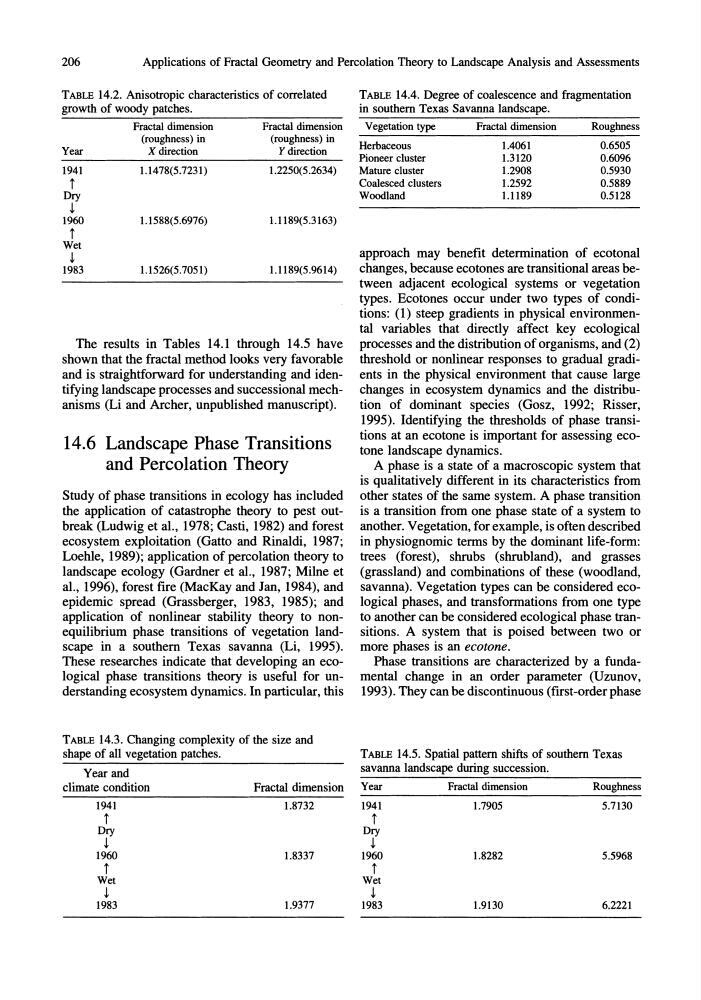
The results in Tables 14.1 through 14.5 have
shown that the fractal method looks very favorable
and is straightforward for understanding and identifying landscape processes and successional mechanisms (Li and Archer, unpublished manuscript).
14.6 Landscape Phase Transitions
and Percolation Theory
Study of phase transitions in ecology has included
the application of catastrophe theory to pest outbreak (Ludwig et al., 1978; Casti, 1982) and forest
ecosystem exploitation (Gatto and Rinaldi, 1987;
Loehle, 1989); application of percolation theory to
landscape ecology (Gardner et al., 1987; Milne et
aI., 1996), forest fire (MacKay and Jan, 1984), and
epidemic spread (Grassberger, 1983, 1985); and
application of nonlinear stability theory to nonequilibrium phase transitions of vegetation landscape in a southern Texas savanna (Li, 1995).
These researches indicate that developing an ecological phase transitions theory is useful for understanding ecosystem dynamics. In particular, this
TABLE 14.3. Changing complexity of the size and
shape of all vegetation patches.
Year and
climate condition
1941
i
Dry
!
1960
i
Wet
!
1983
Fractal dimension
1.8732
1.8337
1.9377
TABLE 14.4. Degree of coalescence and fragmentation
in southern Texas Savanna landscape.
Vegetation type
Fractal dimension
Roughness
Herbaceous
1.4061
0.6505
Pioneer cluster
1.3120
0.6096
Mature cluster
1.2908
0.5930
Coalesced clusters
1.2592
0.5889
Woodland
1.1189
0.5128
approach may benefit determination of ecotonal
changes, because ecotones are transitional areas between adjacent ecological systems or vegetation
types. Ecotones occur under two types of conditions: (1) steep gradients in physical environmental variables that directly affect key ecological
processes and the distribution of organisms, and (2)
threshold or nonlinear responses to gradual gradients in the physical environment that cause large
changes in ecosystem dynamics and the distribution of dominant species (Gosz, 1992; Risser,
1995). Identifying the thresholds of phase transitions at an ecotone is important for assessing ecotone landscape dynamics.
A phase is a state of a macroscopic system that
is qualitatively different in its characteristics from
other states of the same system. A phase transition
is a transition from one phase state of a system to
another. Vegetation, for example, is often described
in physiognomic terms by the dominant life-form:
trees (forest), shrubs (shrubland), and grasses
(grassland) and combinations of these (woodland,
savanna). Vegetation types can be considered ecological phases, and transformations from one type
to another can be considered ecological phase transitions. A system that is poised between two or
more phases is an ecotone.
Phase transitions are characterized by a fundamental change in an order parameter (Uzunov,
1993). They can be discontinuous (first-order phase
TABLE 14.5. Spatial pattern shifts of southern Texas
savanna landscape during succession.
Year
Fractal dimension
Roughness
1941
1.7905
5.7130
i
Dry
!
1960
1.8282
5.5968
i
Wet
!
1983
1.9130
6.2221
Applications of Fractal Geometry and Percolation Theory to Landscape Analysis and Assessments
TABLE 14.2. Anisotropic characteristics of correlated
growth of woody patches.
Fractal dimension
(roughness) in
Year
X direction
1941
i
Dry
!
1960
i
Wet
!
1983
1.1478(5.7231)
1.1588(5.6976)
1.1526(5.7051)
Fractal dimension
(roughness) in
Y direction
1.2250(5.2634)
1.1189(5.3163)
1.1189(5.9614)
The results in Tables 14.1 through 14.5 have
shown that the fractal method looks very favorable
and is straightforward for understanding and identifying landscape processes and successional mechanisms (Li and Archer, unpublished manuscript).
14.6 Landscape Phase Transitions
and Percolation Theory
Study of phase transitions in ecology has included
the application of catastrophe theory to pest outbreak (Ludwig et al., 1978; Casti, 1982) and forest
ecosystem exploitation (Gatto and Rinaldi, 1987;
Loehle, 1989); application of percolation theory to
landscape ecology (Gardner et al., 1987; Milne et
aI., 1996), forest fire (MacKay and Jan, 1984), and
epidemic spread (Grassberger, 1983, 1985); and
application of nonlinear stability theory to nonequilibrium phase transitions of vegetation landscape in a southern Texas savanna (Li, 1995).
These researches indicate that developing an ecological phase transitions theory is useful for understanding ecosystem dynamics. In particular, this
TABLE 14.3. Changing complexity of the size and
shape of all vegetation patches.
Year and
climate condition
1941
i
Dry
!
1960
i
Wet
!
1983
Fractal dimension
1.8732
1.8337
1.9377
TABLE 14.4. Degree of coalescence and fragmentation
in southern Texas Savanna landscape.
Vegetation type
Fractal dimension
Roughness
Herbaceous
1.4061
0.6505
Pioneer cluster
1.3120
0.6096
Mature cluster
1.2908
0.5930
Coalesced clusters
1.2592
0.5889
Woodland
1.1189
0.5128
approach may benefit determination of ecotonal
changes, because ecotones are transitional areas between adjacent ecological systems or vegetation
types. Ecotones occur under two types of conditions: (1) steep gradients in physical environmental variables that directly affect key ecological
processes and the distribution of organisms, and (2)
threshold or nonlinear responses to gradual gradients in the physical environment that cause large
changes in ecosystem dynamics and the distribution of dominant species (Gosz, 1992; Risser,
1995). Identifying the thresholds of phase transitions at an ecotone is important for assessing ecotone landscape dynamics.
A phase is a state of a macroscopic system that
is qualitatively different in its characteristics from
other states of the same system. A phase transition
is a transition from one phase state of a system to
another. Vegetation, for example, is often described
in physiognomic terms by the dominant life-form:
trees (forest), shrubs (shrubland), and grasses
(grassland) and combinations of these (woodland,
savanna). Vegetation types can be considered ecological phases, and transformations from one type
to another can be considered ecological phase transitions. A system that is poised between two or
more phases is an ecotone.
Phase transitions are characterized by a fundamental change in an order parameter (Uzunov,
1993). They can be discontinuous (first-order phase
TABLE 14.5. Spatial pattern shifts of southern Texas
savanna landscape during succession.
Year
Fractal dimension
Roughness
1941
1.7905
5.7130
i
Dry
!
1960
1.8282
5.5968
i
Wet
!
1983
1.9130
6.2221