

14.5 Fractal Analysis of Southern Texas Savanna Landscape
205
when we blend data from different sources we need
to find a suitable transformation to form a stable
distribution. There are some statistical methods to
deal with data from unequal probability sampling,
for example, the weighted distribution method
(Patil and Taillie, 1989). Further discussion about
this issue can be found in Li (2000).
14.4 Fractal Fragmentation of
Habitat into Patches
The fragmentation of the habitat into discrete
patches is a topic of concern in relation to biodiversity conservation and resource management efforts (Harris, 1984; Pimm and Gilpin, 1989; Loehle
and Li, 1996a). It is an important feature of landscapes. Landscape habitat is fragmented by joints
of natural processes and human and natural disturbances. Fragmentation is thought to play a dominant role in determining the size-frequency relation
for astrophysics (Brown et al., 1983). There are a
variety of ways to represent the size-frequency distribution of habitat fragments or patches. Li (2000)
uses a simple power-law relation to define the fractal distribution for quantifying the habitat fragmentation processes and gives a hypothesis about
the fragility or vulnerability of landscape habitat
based on the result of Turcotte's renormalization
group approach to the problem of fragmentation
(Turcotte, 1986).
Using the renormalization group approach to
scale invariant problems with fractal distributions,
Turcotte (1986) proposes two renormalization
group models to the fragmentation problem. The
models yield a fractal behavior for fragmentation,
but give different values for the fractal dimension.
He indicates that the fractal dimension is a measure of the fracture resistance of the material relative to the process causing fragmentation. His conclusion can be used as our hypothesis about the
fragility or vulnerability of habitat fragmentation.
That is, a more fragile or vulnerable landscape
habitat may be associated with a smaller fractal dimension. The results of Krummel et al. (1987) support our hypothesis. Their results imply that landscape habitats are more sensitive to human
disturbances than to natural processes. This may be
useful for managing and conserving the ecological
habitat.
Several other studies in fractal measures of habitat fragmentation for quantifying human impact and
describing various habitat structures or patchy landscape features can be found in Krummel et al. (1987),
Milne (1988), Palmer (1988,1992), Williamson and
Lawton (1991), Haslett (1994), Loehle and Wein
(1994), and Li (2000).
14.5 Fractal Analysis of Southern
Texas Savanna Landscape
Recent trends toward increased woody plant abundance in temperate and tropical grasslands and savanna in recent history have been reported worldwide. We have little knowledge of the rates,
dynamics, patterns, or successional processes involved. To determine the long-term patterns and
dynamics of vegetation patch-to-patch interactions
in a southern Texas subtropical savanna landscape,
we defmed different fractals and fractal relationships to describe (1) cluster growth relationships,
(2) changes in the size and shape of clusters, (3)
degree of coalescence or fragmentation, and (4) spatial pattern shifts of different types of vegetation
clusters during succession. These fractals and their
relationships included fractal kinetics of aggregation
processes, area-perimeter fractals, patch-size distribution fractals, self-affine fractals, correlation fractals, and the information fractals introduced above.
The Rio Grande Plains of southern Texas and
northern Mexico offer distinct examples of processes
involved in the physiognomic conversion of grassland and savannas to woodlands. The process begins
when the leguminous shrub, Prosopis glandulosa
(mesquite), establishes in herbaceous zones. The
seeds of Prosopis are widely dispersed by livestock
and establish readily on sites where fire and competition from grasses have been reduced by grazing. As the Prosopis plant grows, it modifies soils
and microclimate and facilitates the ingress and establishment of other shrubs. These patches of
woody vegetation that form around the Prosopis
nucleus enlarge over time as new plants appear and
existing plants grow. As the canopies of the woody
patches develop, light attenuation increases such
that herbaceous production in well-developed
patches is only 20% of that in herbaceous zones.
As new patches are initiated and existing patches
expand, coalescence will eventually occur and a
grassland will have become a woodland. See
Archer (1995) and Li (1993, 1995) for the details.
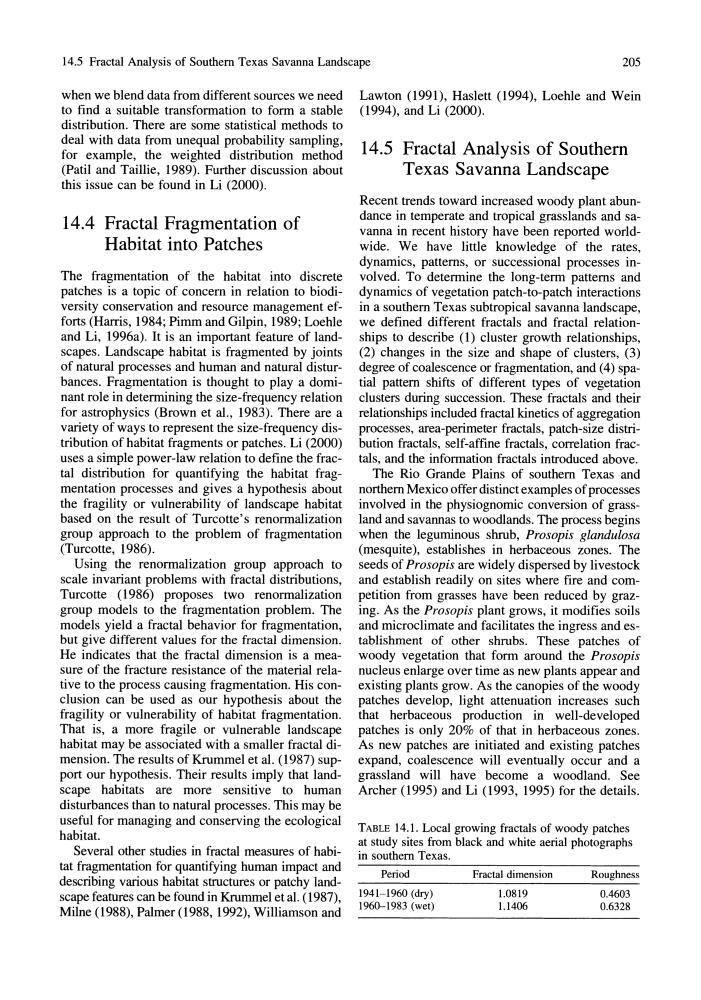
TABLE 14.1. Local growing fractals of woody patches
at study sites from black and white aerial photographs
in southern Texas.
Period
1941-1960 (dry)
1960-1983 (wet)
Fractal dimension
1.0819
1.1406
Roughness
0.4603
0.6328
205
when we blend data from different sources we need
to find a suitable transformation to form a stable
distribution. There are some statistical methods to
deal with data from unequal probability sampling,
for example, the weighted distribution method
(Patil and Taillie, 1989). Further discussion about
this issue can be found in Li (2000).
14.4 Fractal Fragmentation of
Habitat into Patches
The fragmentation of the habitat into discrete
patches is a topic of concern in relation to biodiversity conservation and resource management efforts (Harris, 1984; Pimm and Gilpin, 1989; Loehle
and Li, 1996a). It is an important feature of landscapes. Landscape habitat is fragmented by joints
of natural processes and human and natural disturbances. Fragmentation is thought to play a dominant role in determining the size-frequency relation
for astrophysics (Brown et al., 1983). There are a
variety of ways to represent the size-frequency distribution of habitat fragments or patches. Li (2000)
uses a simple power-law relation to define the fractal distribution for quantifying the habitat fragmentation processes and gives a hypothesis about
the fragility or vulnerability of landscape habitat
based on the result of Turcotte's renormalization
group approach to the problem of fragmentation
(Turcotte, 1986).
Using the renormalization group approach to
scale invariant problems with fractal distributions,
Turcotte (1986) proposes two renormalization
group models to the fragmentation problem. The
models yield a fractal behavior for fragmentation,
but give different values for the fractal dimension.
He indicates that the fractal dimension is a measure of the fracture resistance of the material relative to the process causing fragmentation. His conclusion can be used as our hypothesis about the
fragility or vulnerability of habitat fragmentation.
That is, a more fragile or vulnerable landscape
habitat may be associated with a smaller fractal dimension. The results of Krummel et al. (1987) support our hypothesis. Their results imply that landscape habitats are more sensitive to human
disturbances than to natural processes. This may be
useful for managing and conserving the ecological
habitat.
Several other studies in fractal measures of habitat fragmentation for quantifying human impact and
describing various habitat structures or patchy landscape features can be found in Krummel et al. (1987),
Milne (1988), Palmer (1988,1992), Williamson and
Lawton (1991), Haslett (1994), Loehle and Wein
(1994), and Li (2000).
14.5 Fractal Analysis of Southern
Texas Savanna Landscape
Recent trends toward increased woody plant abundance in temperate and tropical grasslands and savanna in recent history have been reported worldwide. We have little knowledge of the rates,
dynamics, patterns, or successional processes involved. To determine the long-term patterns and
dynamics of vegetation patch-to-patch interactions
in a southern Texas subtropical savanna landscape,
we defmed different fractals and fractal relationships to describe (1) cluster growth relationships,
(2) changes in the size and shape of clusters, (3)
degree of coalescence or fragmentation, and (4) spatial pattern shifts of different types of vegetation
clusters during succession. These fractals and their
relationships included fractal kinetics of aggregation
processes, area-perimeter fractals, patch-size distribution fractals, self-affine fractals, correlation fractals, and the information fractals introduced above.
The Rio Grande Plains of southern Texas and
northern Mexico offer distinct examples of processes
involved in the physiognomic conversion of grassland and savannas to woodlands. The process begins
when the leguminous shrub, Prosopis glandulosa
(mesquite), establishes in herbaceous zones. The
seeds of Prosopis are widely dispersed by livestock
and establish readily on sites where fire and competition from grasses have been reduced by grazing. As the Prosopis plant grows, it modifies soils
and microclimate and facilitates the ingress and establishment of other shrubs. These patches of
woody vegetation that form around the Prosopis
nucleus enlarge over time as new plants appear and
existing plants grow. As the canopies of the woody
patches develop, light attenuation increases such
that herbaceous production in well-developed
patches is only 20% of that in herbaceous zones.
As new patches are initiated and existing patches
expand, coalescence will eventually occur and a
grassland will have become a woodland. See
Archer (1995) and Li (1993, 1995) for the details.
TABLE 14.1. Local growing fractals of woody patches
at study sites from black and white aerial photographs
in southern Texas.
Period
1941-1960 (dry)
1960-1983 (wet)
Fractal dimension
1.0819
1.1406
Roughness
0.4603
0.6328