

12.3 Ecosystem Management Processes
Problem
Identification
I
Revised Goals
~
New Knowledge _
New Inventory Data /
New Technology /
Alternative
Development
I
Alternative
Selection
I
E
PLAN
V
~
A
L
U
A
~
T
E
MONITOR
place. Without adding further detail to this definition, almost any management activity could erroneously be labeled adaptive management. In reality, adaptive management is a well-described,
detailed, formally rigorous, and scientifically defensible management-by-experiment system (Walters and Holling, 1990). Baskerville (1985) prescribes a nine-step process for implementing
adaptive management correctly. Adaptive management requires that a series of steps be followed for
each of the four major activities described.
12.3.1 Plan
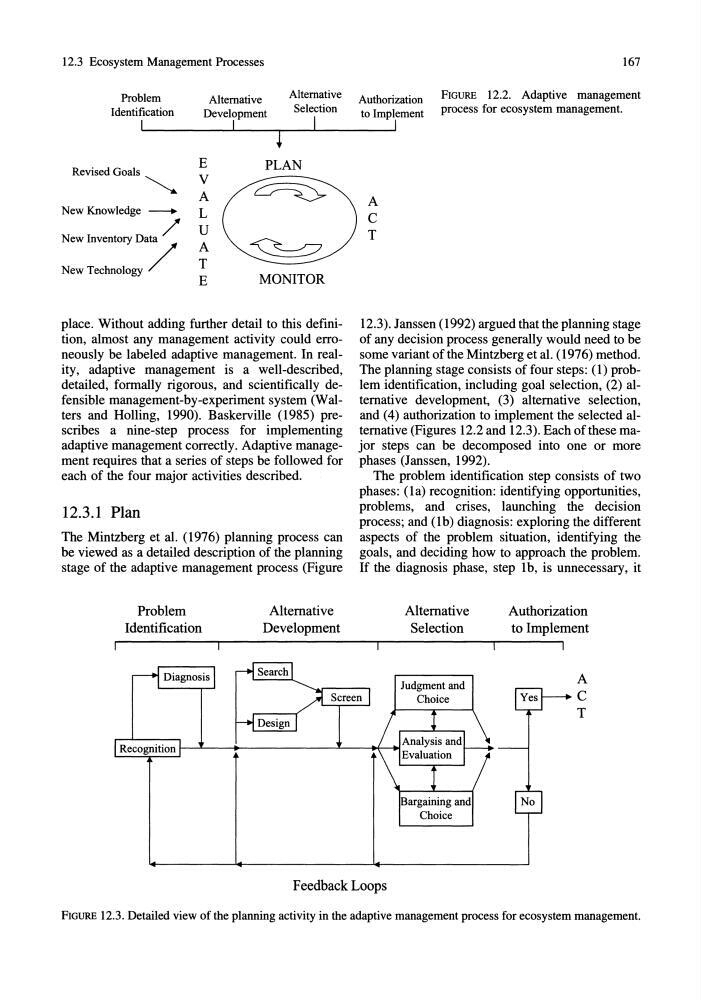
The Mintzberg et al. (1976) planning process can
be viewed as a detailed description of the planning
stage of the adaptive management process (Figure
Problem
Identification
Alternative
Development
167
Authorization
to Implement
I
FIGURE 12.2. Adaptive management
process for ecosystem management.
A
C
T
12.3). Janssen (1992) argued that the planning stage
of any decision process generally would need to be
some variant of the Mintzberg et al. (1976) method.
The planning stage consists of four steps: (1) problem identification, including goal selection, (2) alternative development, (3) alternative selection,
and (4) authorization to implement the selected alternative (Figures 12.2 and 12.3). Each of these major steps can be decomposed into one or more
phases (Janssen, 1992).
The problem identification step consists of two
phases: (la) recognition: identifying opportunities,
problems, and crises, launching the decision
process; and (lb) diagnosis: exploring the different
aspects of the problem situation, identifying the
goals, and deciding how to approach the problem.
If the diagnosis phase, step 1b, is unnecessary, it
Alternative
Selection
Authorization
to Implement
A
C
T
Recognition I-....L.---.>----------''--''*---+I
Bargaining and
No
Choice
Feedback Loops
FIGURE 12.3. Detailed view of the planning activity in the adaptive management process for ecosystem management.
Problem
Identification
I
Revised Goals
~
New Knowledge _
New Inventory Data /
New Technology /
Alternative
Development
I
Alternative
Selection
I
E
PLAN
V
~
A
L
U
A
~
T
E
MONITOR
place. Without adding further detail to this definition, almost any management activity could erroneously be labeled adaptive management. In reality, adaptive management is a well-described,
detailed, formally rigorous, and scientifically defensible management-by-experiment system (Walters and Holling, 1990). Baskerville (1985) prescribes a nine-step process for implementing
adaptive management correctly. Adaptive management requires that a series of steps be followed for
each of the four major activities described.
12.3.1 Plan
The Mintzberg et al. (1976) planning process can
be viewed as a detailed description of the planning
stage of the adaptive management process (Figure
Problem
Identification
Alternative
Development
167
Authorization
to Implement
I
FIGURE 12.2. Adaptive management
process for ecosystem management.
A
C
T
12.3). Janssen (1992) argued that the planning stage
of any decision process generally would need to be
some variant of the Mintzberg et al. (1976) method.
The planning stage consists of four steps: (1) problem identification, including goal selection, (2) alternative development, (3) alternative selection,
and (4) authorization to implement the selected alternative (Figures 12.2 and 12.3). Each of these major steps can be decomposed into one or more
phases (Janssen, 1992).
The problem identification step consists of two
phases: (la) recognition: identifying opportunities,
problems, and crises, launching the decision
process; and (lb) diagnosis: exploring the different
aspects of the problem situation, identifying the
goals, and deciding how to approach the problem.
If the diagnosis phase, step 1b, is unnecessary, it
Alternative
Selection
Authorization
to Implement
A
C
T
Recognition I-....L.---.>----------''--''*---+I
Bargaining and
No
Choice
Feedback Loops
FIGURE 12.3. Detailed view of the planning activity in the adaptive management process for ecosystem management.