

8.5 Ecosystem Information System
.BQQI~
Attributes (data values)
Services (data
115
.. transformations)
~
SubClass #1
(of root)
New (local) Attributes
New (local) Services
METHOD X
a local service
implementation
SubClass #2
(of root)
New (local) Attributes
New (local) Services
METHODY
SubClass #3
(of root)
New (local) Attributes
New (local) Services
Instance of
SubClass #3
~
SubClasslM
(of Subclass 3)
New (local) Attributes
New (local) Services
a local service
implementation
Instance of
SubClass #2
Class I Subclass
I Instance I Method
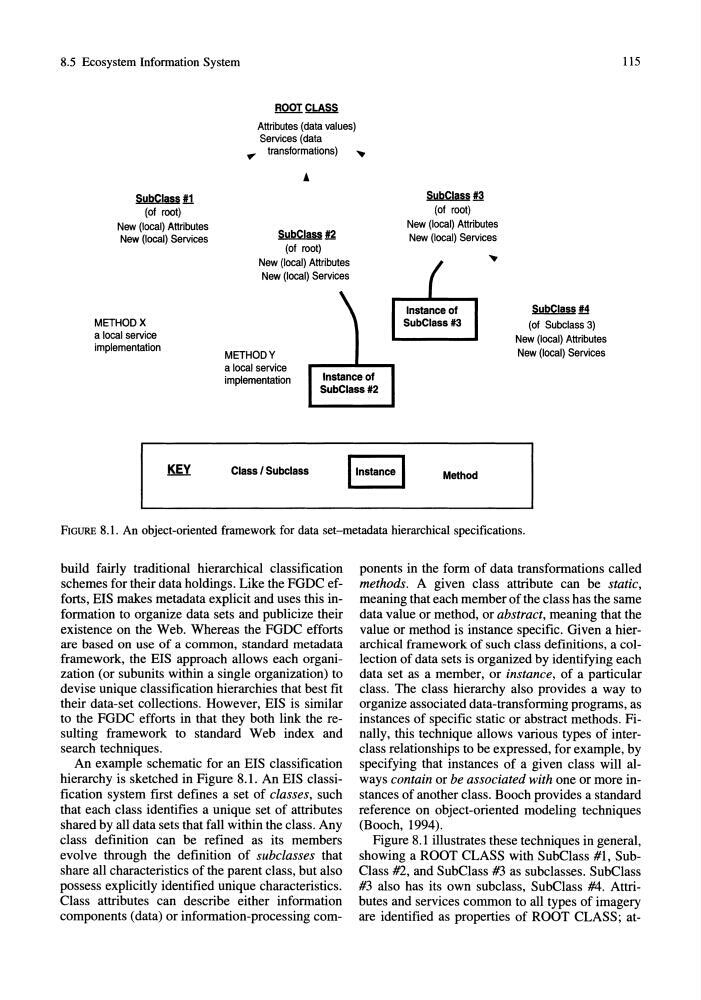
FIGURE 8.1. An object-oriented framework for data set-metadata hierarchical specifications.
build fairly traditional hierarchical classification
schemes for their data holdings. Like the FGDC efforts, EIS makes metadata explicit and uses this information to organize data sets and publicize their
existence on the Web. Whereas the FGDC efforts
are based on use of a common, standard metadata
framework, the EIS approach allows each organization (or subunits within a single organization) to
devise unique classification hierarchies that best fit
their data-set collections. However, EIS is similar
to the FGDC efforts in that they both link the resulting framework to standard Web index and
search techniques.
An example schematic for an EIS classification
hierarchy is sketched in Figure 8.1. An EIS classification system first defines a set of classes, such
that each class identifies a unique set of attributes
shared by all data sets that fall within the class. Any
class definition can be refined as its members
evolve through the definition of subclasses that
share all characteristics of the parent class, but also
possess explicitly identified unique characteristics.
Class attributes can describe either information
components (data) or information-processing components in the form of data transformations called
methods. A given class attribute can be static,
meaning that each member of the class has the same
data value or method, or abstract, meaning that the
value or method is instance specific. Given a hierarchical framework of such class definitions, a collection of data sets is organized by identifying each
data set as a member, or instance, of a particular
class. The class hierarchy also provides a way to
organize associated data-transforming programs, as
instances of specific static or abstract methods. Finally, this technique allows various types of interclass relationships to be expressed, for example, by
specifying that instances of a given class will always contain or be associated with one or more instances of another class. Booch provides a standard
reference on object-oriented modeling techniques
(Booch, 1994).
Figure 8.1 illustrates these techniques in general,
showing a ROOT CLASS with SubClass #1, SubClass #2, and SubClass #3 as subclasses. SubClass
#3 also has its own subclass, SubClass #4. Attributes and services common to all types of imagery
are identified as properties of ROOT CLASS; at-
.BQQI~
Attributes (data values)
Services (data
115
.. transformations)
~
SubClass #1
(of root)
New (local) Attributes
New (local) Services
METHOD X
a local service
implementation
SubClass #2
(of root)
New (local) Attributes
New (local) Services
METHODY
SubClass #3
(of root)
New (local) Attributes
New (local) Services
Instance of
SubClass #3
~
SubClasslM
(of Subclass 3)
New (local) Attributes
New (local) Services
a local service
implementation
Instance of
SubClass #2
Class I Subclass
I Instance I Method
FIGURE 8.1. An object-oriented framework for data set-metadata hierarchical specifications.
build fairly traditional hierarchical classification
schemes for their data holdings. Like the FGDC efforts, EIS makes metadata explicit and uses this information to organize data sets and publicize their
existence on the Web. Whereas the FGDC efforts
are based on use of a common, standard metadata
framework, the EIS approach allows each organization (or subunits within a single organization) to
devise unique classification hierarchies that best fit
their data-set collections. However, EIS is similar
to the FGDC efforts in that they both link the resulting framework to standard Web index and
search techniques.
An example schematic for an EIS classification
hierarchy is sketched in Figure 8.1. An EIS classification system first defines a set of classes, such
that each class identifies a unique set of attributes
shared by all data sets that fall within the class. Any
class definition can be refined as its members
evolve through the definition of subclasses that
share all characteristics of the parent class, but also
possess explicitly identified unique characteristics.
Class attributes can describe either information
components (data) or information-processing components in the form of data transformations called
methods. A given class attribute can be static,
meaning that each member of the class has the same
data value or method, or abstract, meaning that the
value or method is instance specific. Given a hierarchical framework of such class definitions, a collection of data sets is organized by identifying each
data set as a member, or instance, of a particular
class. The class hierarchy also provides a way to
organize associated data-transforming programs, as
instances of specific static or abstract methods. Finally, this technique allows various types of interclass relationships to be expressed, for example, by
specifying that instances of a given class will always contain or be associated with one or more instances of another class. Booch provides a standard
reference on object-oriented modeling techniques
(Booch, 1994).
Figure 8.1 illustrates these techniques in general,
showing a ROOT CLASS with SubClass #1, SubClass #2, and SubClass #3 as subclasses. SubClass
#3 also has its own subclass, SubClass #4. Attributes and services common to all types of imagery
are identified as properties of ROOT CLASS; at-