

and between federal and state agencies are formidable and can provide
a strong disincentive for cooperation, especially when natural resource
agencies’ budgets are in decline. Fortunately, a unique mechanism for
coordinating the activities of agencies in matters regarding the Southern
Appalachians already existed. Chartered in 1988, the Southern Appalachian
Man and the Biosphere Cooperative was established to provide a mechanism for developing cooperative initiatives between public and nongovernmental groups to address issues of regional interest (see SAMAB
2001). While the interagency agreement for SAMAB did not explicitly
commit agencies to any kind of specific support, it provided the essential
institutional framework for bringing together these multiple interests when
appropriate, and perhaps more importantly, it documented a common interest in the Southern Appalachian region. This organization proved to be a
critical foundation for forming and conducting the SAA.
Through SAMAB, an executive team was convened to define the process
and to sort out logistical aspects of the assessment, including interagency
coordination. The initial step was to clearly define the geographic and
conceptual scope of the SAA. The conceptual scope of the assessment was
developed through a series of public meetings. With a facilitated-workshop
approach, these meetings solicited input on the resource issues that needed
attention. These issues were then used to develop a set of specific questions
regarding resources and their uses in the Southern Appalachians. Once the
questions were defined, the executive committee, working through two
assessment co-leaders from the USDA Forest Service, grouped issues into
thematic areas and recruited assessment teams for each area. The four
74
David N. Wear
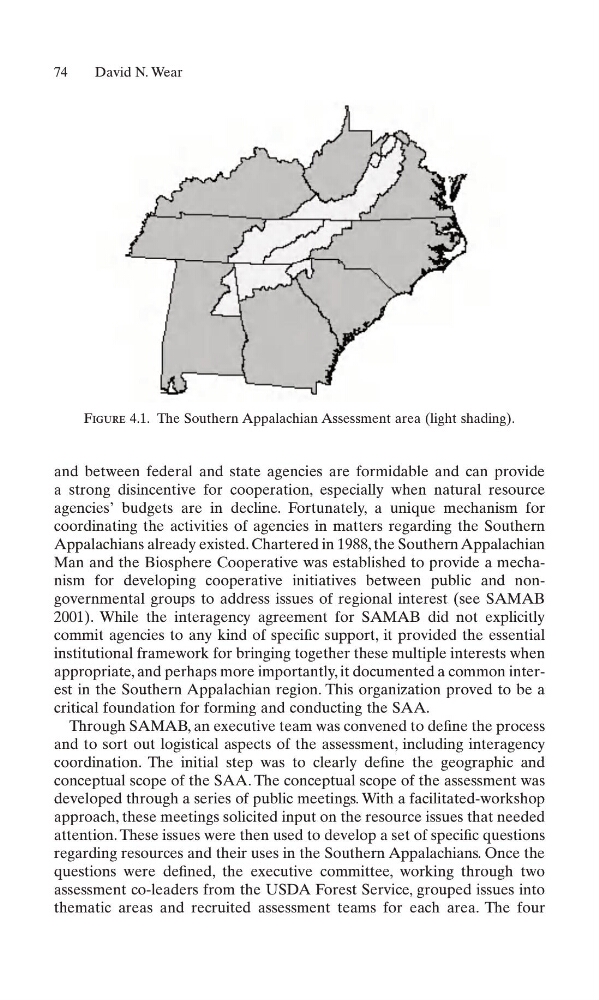
Figure 4.1. The Southern Appalachian Assessment area (light shading).
a strong disincentive for cooperation, especially when natural resource
agencies’ budgets are in decline. Fortunately, a unique mechanism for
coordinating the activities of agencies in matters regarding the Southern
Appalachians already existed. Chartered in 1988, the Southern Appalachian
Man and the Biosphere Cooperative was established to provide a mechanism for developing cooperative initiatives between public and nongovernmental groups to address issues of regional interest (see SAMAB
2001). While the interagency agreement for SAMAB did not explicitly
commit agencies to any kind of specific support, it provided the essential
institutional framework for bringing together these multiple interests when
appropriate, and perhaps more importantly, it documented a common interest in the Southern Appalachian region. This organization proved to be a
critical foundation for forming and conducting the SAA.
Through SAMAB, an executive team was convened to define the process
and to sort out logistical aspects of the assessment, including interagency
coordination. The initial step was to clearly define the geographic and
conceptual scope of the SAA. The conceptual scope of the assessment was
developed through a series of public meetings. With a facilitated-workshop
approach, these meetings solicited input on the resource issues that needed
attention. These issues were then used to develop a set of specific questions
regarding resources and their uses in the Southern Appalachians. Once the
questions were defined, the executive committee, working through two
assessment co-leaders from the USDA Forest Service, grouped issues into
thematic areas and recruited assessment teams for each area. The four
74
David N. Wear
Figure 4.1. The Southern Appalachian Assessment area (light shading).