

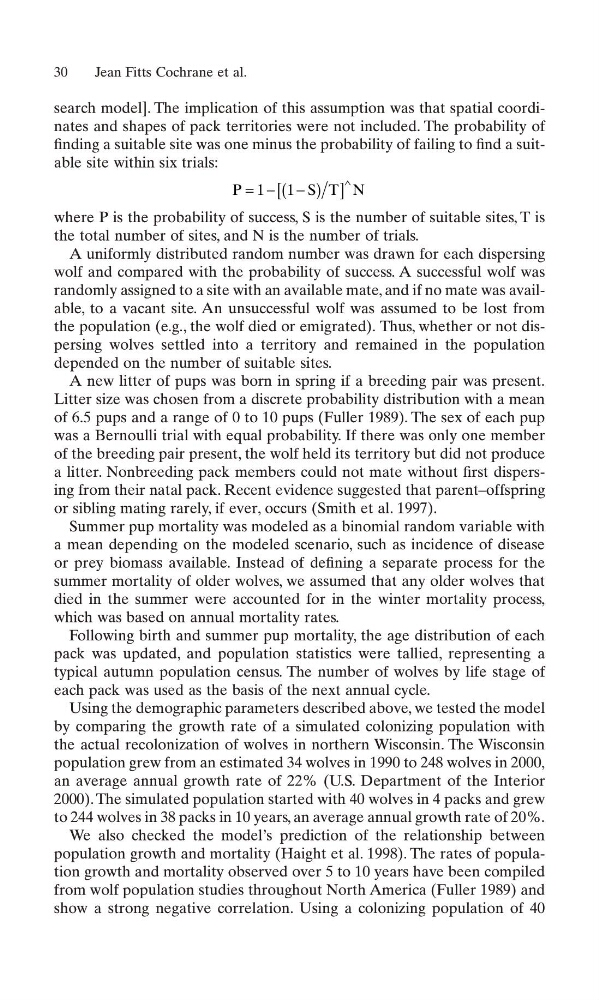
search model]. The implication of this assumption was that spatial coordinates and shapes of pack territories were not included. The probability of
finding a suitable site was one minus the probability of failing to find a suitable site within six trials:
where P is the probability of success, S is the number of suitable sites, T is
the total number of sites, and N is the number of trials.
A uniformly distributed random number was drawn for each dispersing
wolf and compared with the probability of success. A successful wolf was
randomly assigned to a site with an available mate, and if no mate was available, to a vacant site. An unsuccessful wolf was assumed to be lost from
the population (e.g., the wolf died or emigrated). Thus, whether or not dispersing wolves settled into a territory and remained in the population
depended on the number of suitable sites.
A new litter of pups was born in spring if a breeding pair was present.
Litter size was chosen from a discrete probability distribution with a mean
of 6.5 pups and a range of 0 to 10 pups (Fuller 1989). The sex of each pup
was a Bernoulli trial with equal probability. If there was only one member
of the breeding pair present, the wolf held its territory but did not produce
a litter. Nonbreeding pack members could not mate without first dispersing from their natal pack. Recent evidence suggested that parent–offspring
or sibling mating rarely, if ever, occurs (Smith et al. 1997).
Summer pup mortality was modeled as a binomial random variable with
a mean depending on the modeled scenario, such as incidence of disease
or prey biomass available. Instead of defining a separate process for the
summer mortality of older wolves, we assumed that any older wolves that
died in the summer were accounted for in the winter mortality process,
which was based on annual mortality rates.
Following birth and summer pup mortality, the age distribution of each
pack was updated, and population statistics were tallied, representing a
typical autumn population census. The number of wolves by life stage of
each pack was used as the basis of the next annual cycle.
Using the demographic parameters described above, we tested the model
by comparing the growth rate of a simulated colonizing population with
the actual recolonization of wolves in northern Wisconsin. The Wisconsin
population grew from an estimated 34 wolves in 1990 to 248 wolves in 2000,
an average annual growth rate of 22% (U.S. Department of the Interior
2000). The simulated population started with 40 wolves in 4 packs and grew
to 244 wolves in 38 packs in 10 years, an average annual growth rate of 20%.
We also checked the model’s prediction of the relationship between
population growth and mortality (Haight et al. 1998). The rates of population growth and mortality observed over 5 to 10 years have been compiled
from wolf population studies throughout North America (Fuller 1989) and
show a strong negative correlation. Using a colonizing population of 40
P 1 1 S T N
= − −
(
)
[
]
∧
30
Jean Fitts Cochrane et al.
finding a suitable site was one minus the probability of failing to find a suitable site within six trials:
where P is the probability of success, S is the number of suitable sites, T is
the total number of sites, and N is the number of trials.
A uniformly distributed random number was drawn for each dispersing
wolf and compared with the probability of success. A successful wolf was
randomly assigned to a site with an available mate, and if no mate was available, to a vacant site. An unsuccessful wolf was assumed to be lost from
the population (e.g., the wolf died or emigrated). Thus, whether or not dispersing wolves settled into a territory and remained in the population
depended on the number of suitable sites.
A new litter of pups was born in spring if a breeding pair was present.
Litter size was chosen from a discrete probability distribution with a mean
of 6.5 pups and a range of 0 to 10 pups (Fuller 1989). The sex of each pup
was a Bernoulli trial with equal probability. If there was only one member
of the breeding pair present, the wolf held its territory but did not produce
a litter. Nonbreeding pack members could not mate without first dispersing from their natal pack. Recent evidence suggested that parent–offspring
or sibling mating rarely, if ever, occurs (Smith et al. 1997).
Summer pup mortality was modeled as a binomial random variable with
a mean depending on the modeled scenario, such as incidence of disease
or prey biomass available. Instead of defining a separate process for the
summer mortality of older wolves, we assumed that any older wolves that
died in the summer were accounted for in the winter mortality process,
which was based on annual mortality rates.
Following birth and summer pup mortality, the age distribution of each
pack was updated, and population statistics were tallied, representing a
typical autumn population census. The number of wolves by life stage of
each pack was used as the basis of the next annual cycle.
Using the demographic parameters described above, we tested the model
by comparing the growth rate of a simulated colonizing population with
the actual recolonization of wolves in northern Wisconsin. The Wisconsin
population grew from an estimated 34 wolves in 1990 to 248 wolves in 2000,
an average annual growth rate of 22% (U.S. Department of the Interior
2000). The simulated population started with 40 wolves in 4 packs and grew
to 244 wolves in 38 packs in 10 years, an average annual growth rate of 20%.
We also checked the model’s prediction of the relationship between
population growth and mortality (Haight et al. 1998). The rates of population growth and mortality observed over 5 to 10 years have been compiled
from wolf population studies throughout North America (Fuller 1989) and
show a strong negative correlation. Using a colonizing population of 40
P 1 1 S T N
= − −
(
)
[
]
∧
30
Jean Fitts Cochrane et al.