

Dispersal took place in late winter and depended on the survival of the
breeding pair. If the breeding pair died, remaining pack members dispersed.
If one or both breeders were present, the number of dispersers from each
age class was a binomial random variable. Dispersal probabilities for pups,
yearlings, and nonbreeding adults were 25, 50, and 90%, respectively, so that
most nonbreeding wolves dispersed before reaching 4 years old (Gese
and Mech 1991). We assumed that 20% of the dispersing wolves were
long-distance dispersers that immediately emigrated from the area and thus
were lost from the population, based on studies demonstrating this type of
rapid, long-distance dispersal behavior in Minnesota wolves (Gese and
Mech 1991).
Each remaining disperser searched the area for a suitable site, which was
defined as a vacant site or a site with an available mate. Wolves could only
settle into territories by mating or becoming a territory-holding, available
breeder. To account for immigration from a population outside the area,
we assumed that six outside wolves joined this pool of dispersing wolves
in the search for suitable sites. Each dispersing wolf and immigrant was
assumed to sample six territories at random with replacement [see Lande
(1987) and Lamberson et al. (1994) for other applications of this kind of
2. Modeling for Endangered-Species Recovery
29
Fall/Winter
Mortality
Winter
Dispersal
Update Age Classes
& Tally Population
Summer
Pup Mortality
Long Distance
Dispersal
Spring
Litters
Recruit
Dispersers
Recruit
Immigrants
Initial
Population
Outside
Population
Emigration
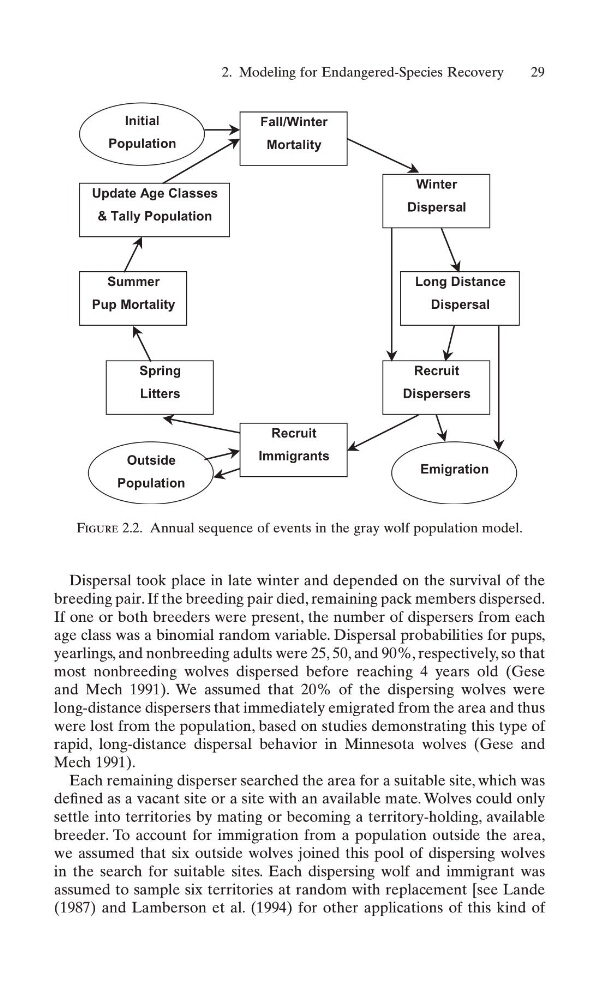
Figure 2.2. Annual sequence of events in the gray wolf population model.
breeding pair. If the breeding pair died, remaining pack members dispersed.
If one or both breeders were present, the number of dispersers from each
age class was a binomial random variable. Dispersal probabilities for pups,
yearlings, and nonbreeding adults were 25, 50, and 90%, respectively, so that
most nonbreeding wolves dispersed before reaching 4 years old (Gese
and Mech 1991). We assumed that 20% of the dispersing wolves were
long-distance dispersers that immediately emigrated from the area and thus
were lost from the population, based on studies demonstrating this type of
rapid, long-distance dispersal behavior in Minnesota wolves (Gese and
Mech 1991).
Each remaining disperser searched the area for a suitable site, which was
defined as a vacant site or a site with an available mate. Wolves could only
settle into territories by mating or becoming a territory-holding, available
breeder. To account for immigration from a population outside the area,
we assumed that six outside wolves joined this pool of dispersing wolves
in the search for suitable sites. Each dispersing wolf and immigrant was
assumed to sample six territories at random with replacement [see Lande
(1987) and Lamberson et al. (1994) for other applications of this kind of
2. Modeling for Endangered-Species Recovery
29
Fall/Winter
Mortality
Winter
Dispersal
Update Age Classes
& Tally Population
Summer
Pup Mortality
Long Distance
Dispersal
Spring
Litters
Recruit
Dispersers
Recruit
Immigrants
Initial
Population
Outside
Population
Emigration
Figure 2.2. Annual sequence of events in the gray wolf population model.