

16. New Directions in Ecological Modeling for Resource Management
313
Table 16.3. Key points for managing national forests and grasslands from the
Committee of Scientists report (From Johnson et al. 1999).
Ecological sustainability as a necessary foundation for sustainability
Considering the larger landscape in which national forests and grasslands are located to
understand their role in achieving sustainability
Making decisions at the spatial scale of the issue
Making “desired future conditions” and the outcomes associated with them central reference
points for planning
Table 16.4. Guidelines for land use and management from the report of the LandUse Committee of the Ecological Society of America (From Dale et al. 2000).
Examining the impacts of local decisions in a regional context
Planning for long-term change and unexpected events
Preserving rare landscape elements, critical habitats, and associated species
Avoiding land uses that deplete natural resources over a broad area
Retaining large contiguous or connected areas that contain critical habitats
Minimizing the introduction and spread of nonnative species
Avoiding or compensating for effects of development on ecological processes
Implementing land-use and -management practices that are compatible with the natural
potential of the area
Table 16.5. Guiding principles of the 1994 memorandum from the Office of the
Deputy Secretary of Defense for Environmental Security (From Goodman 1995).
Maintaining and approving sustainability and native biodiversity of ecosystems
Administering in accordance with ecological units and time frames
Supporting sustainable human activities
Developing a vision of ecosystem health
Developing priorities and reconciling conflicts
Developing coordinated approaches to working toward ecosystem health
Relying on the best science available
Using benchmarks to monitor and evaluate
Using adaptive management
Implementing through site-specific plans and programs
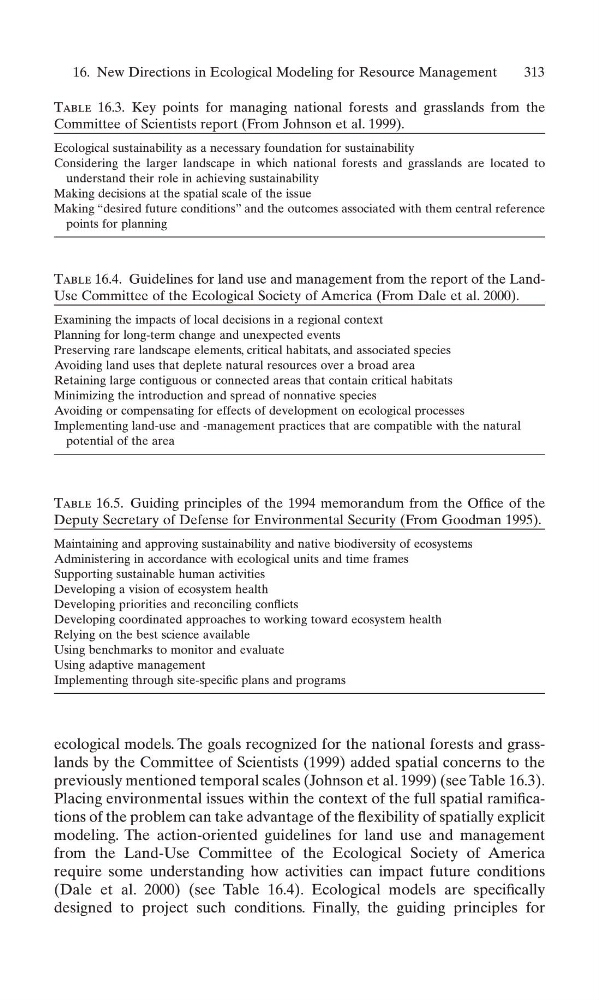
ecological models. The goals recognized for the national forests and grasslands by the Committee of Scientists (1999) added spatial concerns to the
previously mentioned temporal scales (Johnson et al. 1999) (see Table 16.3).
Placing environmental issues within the context of the full spatial ramifications of the problem can take advantage of the flexibility of spatially explicit
modeling. The action-oriented guidelines for land use and management
from the Land-Use Committee of the Ecological Society of America
require some understanding how activities can impact future conditions
(Dale et al. 2000) (see Table 16.4). Ecological models are specifically
designed to project such conditions. Finally, the guiding principles for
313
Table 16.3. Key points for managing national forests and grasslands from the
Committee of Scientists report (From Johnson et al. 1999).
Ecological sustainability as a necessary foundation for sustainability
Considering the larger landscape in which national forests and grasslands are located to
understand their role in achieving sustainability
Making decisions at the spatial scale of the issue
Making “desired future conditions” and the outcomes associated with them central reference
points for planning
Table 16.4. Guidelines for land use and management from the report of the LandUse Committee of the Ecological Society of America (From Dale et al. 2000).
Examining the impacts of local decisions in a regional context
Planning for long-term change and unexpected events
Preserving rare landscape elements, critical habitats, and associated species
Avoiding land uses that deplete natural resources over a broad area
Retaining large contiguous or connected areas that contain critical habitats
Minimizing the introduction and spread of nonnative species
Avoiding or compensating for effects of development on ecological processes
Implementing land-use and -management practices that are compatible with the natural
potential of the area
Table 16.5. Guiding principles of the 1994 memorandum from the Office of the
Deputy Secretary of Defense for Environmental Security (From Goodman 1995).
Maintaining and approving sustainability and native biodiversity of ecosystems
Administering in accordance with ecological units and time frames
Supporting sustainable human activities
Developing a vision of ecosystem health
Developing priorities and reconciling conflicts
Developing coordinated approaches to working toward ecosystem health
Relying on the best science available
Using benchmarks to monitor and evaluate
Using adaptive management
Implementing through site-specific plans and programs
ecological models. The goals recognized for the national forests and grasslands by the Committee of Scientists (1999) added spatial concerns to the
previously mentioned temporal scales (Johnson et al. 1999) (see Table 16.3).
Placing environmental issues within the context of the full spatial ramifications of the problem can take advantage of the flexibility of spatially explicit
modeling. The action-oriented guidelines for land use and management
from the Land-Use Committee of the Ecological Society of America
require some understanding how activities can impact future conditions
(Dale et al. 2000) (see Table 16.4). Ecological models are specifically
designed to project such conditions. Finally, the guiding principles for