

A final trend is an increase in the use of models for decision making.
Application of models to management issues has increased but is still not
meeting the full range of possibilities.
All in all, a more complex view of the world is developing. Communication and feedbacks on a global scale are part of this new perspective. Unfortunately, the use of models for resource management has not kept up with
these other advances. However, the time is ripe to enhance the application
and spread of models to resource management.
16.1.2 Resource Management Needs
The trends noted above have facilitated the recognition of needs for
resource management. Several national and international groups have
assembled principles or guidelines for managing natural resources (Tables
16.1 to 16.5). These guides all agree on the importance of natural resources,
their risk under increasing development, and the need to develop integrated
ways to understand how human activities can affect the integrity of
resources. All of these guidelines call for a focus on changes to the environment including disturbances, changes in land use and management, and
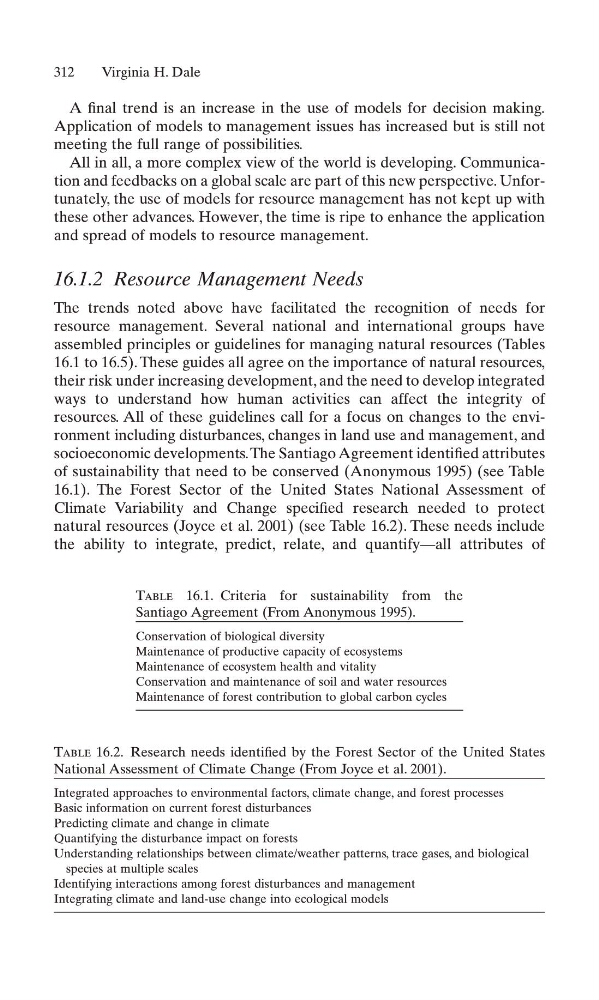
socioeconomic developments.The Santiago Agreement identified attributes
of sustainability that need to be conserved (Anonymous 1995) (see Table
16.1). The Forest Sector of the United States National Assessment of
Climate Variability and Change specified research needed to protect
natural resources (Joyce et al. 2001) (see Table 16.2). These needs include
the ability to integrate, predict, relate, and quantify—all attributes of
312
Virginia H. Dale
Table 16.1. Criteria for sustainability from the
Santiago Agreement (From Anonymous 1995).
Conservation of biological diversity
Maintenance of productive capacity of ecosystems
Maintenance of ecosystem health and vitality
Conservation and maintenance of soil and water resources
Maintenance of forest contribution to global carbon cycles
Table 16.2. Research needs identified by the Forest Sector of the United States
National Assessment of Climate Change (From Joyce et al. 2001).
Integrated approaches to environmental factors, climate change, and forest processes
Basic information on current forest disturbances
Predicting climate and change in climate
Quantifying the disturbance impact on forests
Understanding relationships between climate/weather patterns, trace gases, and biological
species at multiple scales
Identifying interactions among forest disturbances and management
Integrating climate and land-use change into ecological models
Application of models to management issues has increased but is still not
meeting the full range of possibilities.
All in all, a more complex view of the world is developing. Communication and feedbacks on a global scale are part of this new perspective. Unfortunately, the use of models for resource management has not kept up with
these other advances. However, the time is ripe to enhance the application
and spread of models to resource management.
16.1.2 Resource Management Needs
The trends noted above have facilitated the recognition of needs for
resource management. Several national and international groups have
assembled principles or guidelines for managing natural resources (Tables
16.1 to 16.5). These guides all agree on the importance of natural resources,
their risk under increasing development, and the need to develop integrated
ways to understand how human activities can affect the integrity of
resources. All of these guidelines call for a focus on changes to the environment including disturbances, changes in land use and management, and
socioeconomic developments.The Santiago Agreement identified attributes
of sustainability that need to be conserved (Anonymous 1995) (see Table
16.1). The Forest Sector of the United States National Assessment of
Climate Variability and Change specified research needed to protect
natural resources (Joyce et al. 2001) (see Table 16.2). These needs include
the ability to integrate, predict, relate, and quantify—all attributes of
312
Virginia H. Dale
Table 16.1. Criteria for sustainability from the
Santiago Agreement (From Anonymous 1995).
Conservation of biological diversity
Maintenance of productive capacity of ecosystems
Maintenance of ecosystem health and vitality
Conservation and maintenance of soil and water resources
Maintenance of forest contribution to global carbon cycles
Table 16.2. Research needs identified by the Forest Sector of the United States
National Assessment of Climate Change (From Joyce et al. 2001).
Integrated approaches to environmental factors, climate change, and forest processes
Basic information on current forest disturbances
Predicting climate and change in climate
Quantifying the disturbance impact on forests
Understanding relationships between climate/weather patterns, trace gases, and biological
species at multiple scales
Identifying interactions among forest disturbances and management
Integrating climate and land-use change into ecological models