

The bottom line for water as a resource is:
• Demand will continue to increase steadily and in direct proportion to
population growth.
• Modernization (development) will increase demand, not reduce it.
• In areas experiencing water shortages now, conditions will worsen, while
many more areas of the world will reach their limits of available water
resources.
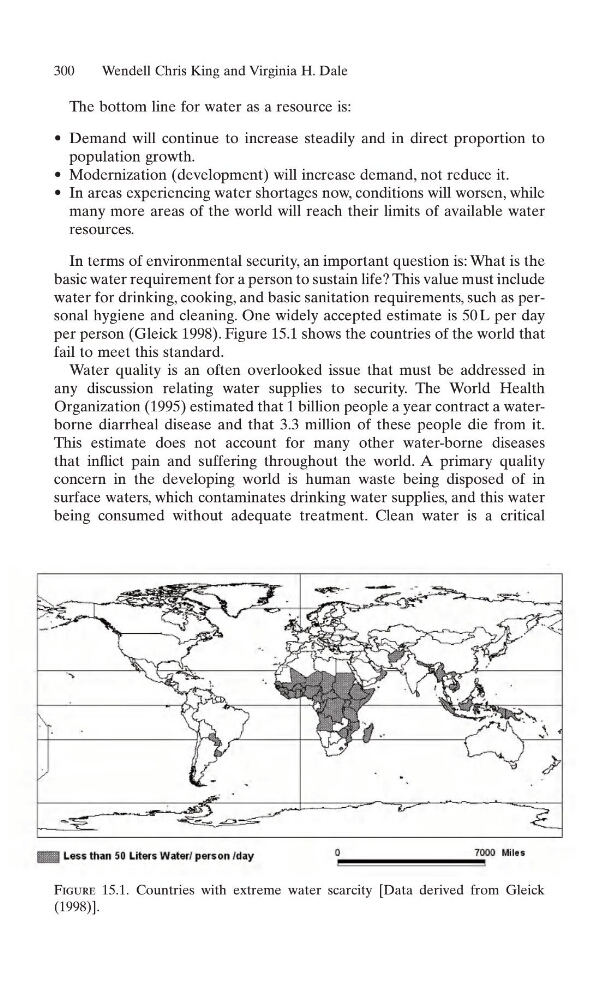
In terms of environmental security, an important question is: What is the
basic water requirement for a person to sustain life? This value must include
water for drinking, cooking, and basic sanitation requirements, such as personal hygiene and cleaning. One widely accepted estimate is 50 L per day
per person (Gleick 1998). Figure 15.1 shows the countries of the world that
fail to meet this standard.
Water quality is an often overlooked issue that must be addressed in
any discussion relating water supplies to security. The World Health
Organization (1995) estimated that 1 billion people a year contract a waterborne diarrheal disease and that 3.3 million of these people die from it.
This estimate does not account for many other water-borne diseases
that inflict pain and suffering throughout the world. A primary quality
concern in the developing world is human waste being disposed of in
surface waters, which contaminates drinking water supplies, and this water
being consumed without adequate treatment. Clean water is a critical
300
Wendell Chris King and Virginia H. Dale
Figure 15.1. Countries with extreme water scarcity [Data derived from Gleick
(1998)].
• Demand will continue to increase steadily and in direct proportion to
population growth.
• Modernization (development) will increase demand, not reduce it.
• In areas experiencing water shortages now, conditions will worsen, while
many more areas of the world will reach their limits of available water
resources.
In terms of environmental security, an important question is: What is the
basic water requirement for a person to sustain life? This value must include
water for drinking, cooking, and basic sanitation requirements, such as personal hygiene and cleaning. One widely accepted estimate is 50 L per day
per person (Gleick 1998). Figure 15.1 shows the countries of the world that
fail to meet this standard.
Water quality is an often overlooked issue that must be addressed in
any discussion relating water supplies to security. The World Health
Organization (1995) estimated that 1 billion people a year contract a waterborne diarrheal disease and that 3.3 million of these people die from it.
This estimate does not account for many other water-borne diseases
that inflict pain and suffering throughout the world. A primary quality
concern in the developing world is human waste being disposed of in
surface waters, which contaminates drinking water supplies, and this water
being consumed without adequate treatment. Clean water is a critical
300
Wendell Chris King and Virginia H. Dale
Figure 15.1. Countries with extreme water scarcity [Data derived from Gleick
(1998)].