

11.4.1 Model Users
The design and construction of the toolkit must reflect the needs of the
model users. The primary user group, by definition, includes those individuals charged with making decisions that potentially affect environmental
resources (e.g., land use, forests, fisheries, water quality, and agricultural
chemicals), including resource planners, environmental engineers, applied
ecologists, resource managers, risk analysts, and environmental lawyers. The
toolkit might also be of practical or academic interest to the academic community of environmental scientists, social scientists, economists, landscape
architects, land owners, and risk communicators.
Model users desire to avoid situations where effects are predicted by
models but do not subsequently occur (see Figure 11.2). Costly plans or
actions to avoid or minimize an anticipated environmental impact may be
enacted unnecessarily as the result of incorrect model forecasts (model
user’s ruin). Such modeling “false positives” also diminish the ability of
managers to act decisively in the face of future predictions of impending
impacts. That is, will the next predicted impact be another false positive?
11.4.2 Managers and Decision Makers
The management of environmental resources is fundamentally a decisionmaking process. Therefore, the toolkit might reasonably include decision
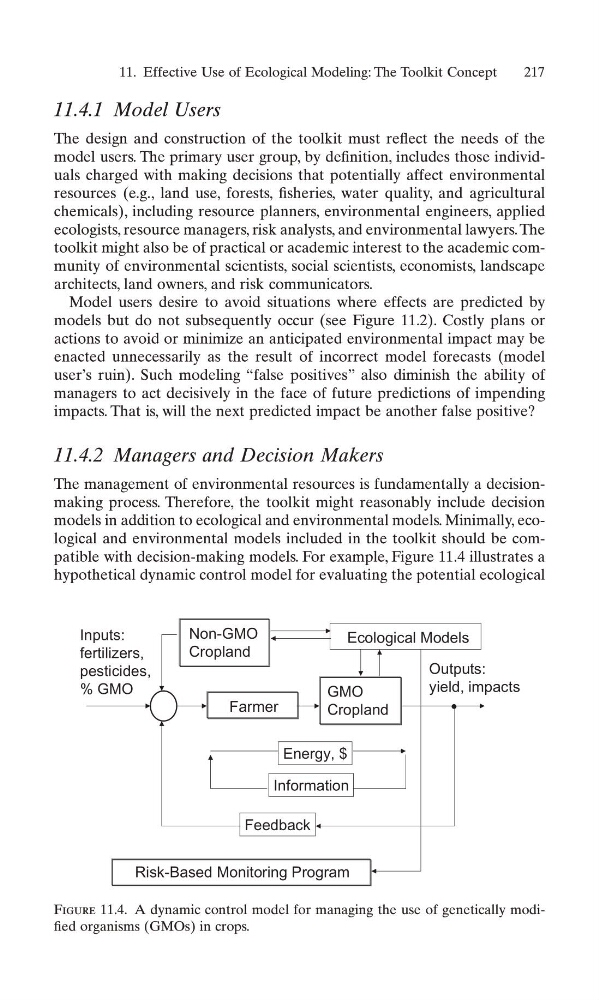
models in addition to ecological and environmental models. Minimally, ecological and environmental models included in the toolkit should be compatible with decision-making models. For example, Figure 11.4 illustrates a
hypothetical dynamic control model for evaluating the potential ecological
11. Effective Use of Ecological Modeling: The Toolkit Concept
217
Non-GMO
Cropland
Farmer
GMO
Cropland
Energy, $
Information
Inputs:
fertilizers,
pesticides,
% GMO
Outputs:
yield, impacts
Feedback
.
Risk-Based Monitoring Program
Ecological Models
Figure 11.4. A dynamic control model for managing the use of genetically modified organisms (GMOs) in crops.
The design and construction of the toolkit must reflect the needs of the
model users. The primary user group, by definition, includes those individuals charged with making decisions that potentially affect environmental
resources (e.g., land use, forests, fisheries, water quality, and agricultural
chemicals), including resource planners, environmental engineers, applied
ecologists, resource managers, risk analysts, and environmental lawyers. The
toolkit might also be of practical or academic interest to the academic community of environmental scientists, social scientists, economists, landscape
architects, land owners, and risk communicators.
Model users desire to avoid situations where effects are predicted by
models but do not subsequently occur (see Figure 11.2). Costly plans or
actions to avoid or minimize an anticipated environmental impact may be
enacted unnecessarily as the result of incorrect model forecasts (model
user’s ruin). Such modeling “false positives” also diminish the ability of
managers to act decisively in the face of future predictions of impending
impacts. That is, will the next predicted impact be another false positive?
11.4.2 Managers and Decision Makers
The management of environmental resources is fundamentally a decisionmaking process. Therefore, the toolkit might reasonably include decision
models in addition to ecological and environmental models. Minimally, ecological and environmental models included in the toolkit should be compatible with decision-making models. For example, Figure 11.4 illustrates a
hypothetical dynamic control model for evaluating the potential ecological
11. Effective Use of Ecological Modeling: The Toolkit Concept
217
Non-GMO
Cropland
Farmer
GMO
Cropland
Energy, $
Information
Inputs:
fertilizers,
pesticides,
% GMO
Outputs:
yield, impacts
Feedback
.
Risk-Based Monitoring Program
Ecological Models
Figure 11.4. A dynamic control model for managing the use of genetically modified organisms (GMOs) in crops.