

be stated as “the assertion of biophysical feasibility is true to the degree
that structure, composition, and processes of the ecosystem are in a suitable condition.”
The premises providing support for or against biophysical feasibility and
social acceptability are still relatively abstract, but, in general, propositions
become progressively more specific and concrete as the logic specification
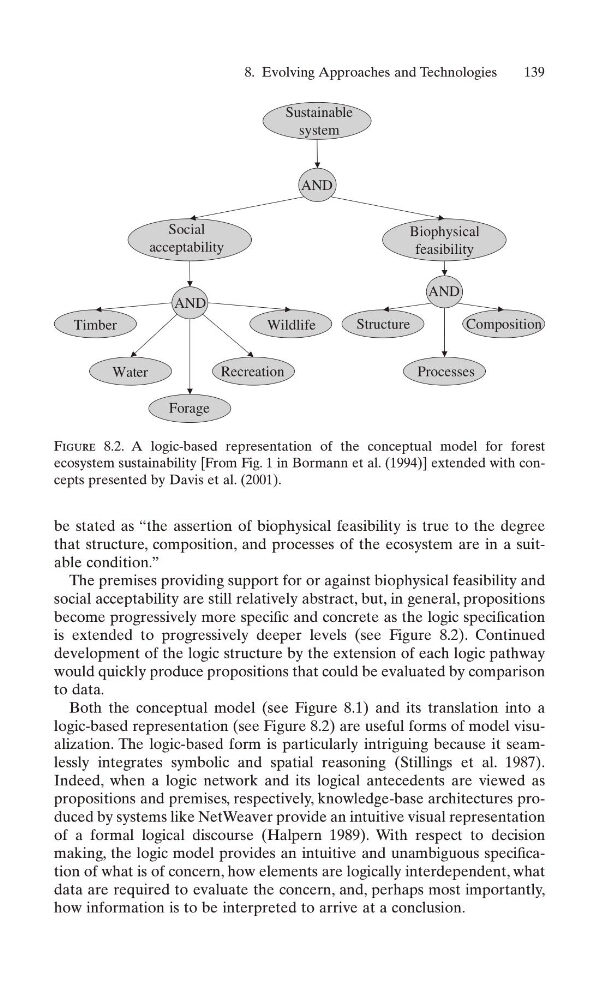
is extended to progressively deeper levels (see Figure 8.2). Continued
development of the logic structure by the extension of each logic pathway
would quickly produce propositions that could be evaluated by comparison
to data.
Both the conceptual model (see Figure 8.1) and its translation into a
logic-based representation (see Figure 8.2) are useful forms of model visualization. The logic-based form is particularly intriguing because it seamlessly integrates symbolic and spatial reasoning (Stillings et al. 1987).
Indeed, when a logic network and its logical antecedents are viewed as
propositions and premises, respectively, knowledge-base architectures produced by systems like NetWeaver provide an intuitive visual representation
of a formal logical discourse (Halpern 1989). With respect to decision
making, the logic model provides an intuitive and unambiguous specification of what is of concern, how elements are logically interdependent, what
data are required to evaluate the concern, and, perhaps most importantly,
how information is to be interpreted to arrive at a conclusion.
8. Evolving Approaches and Technologies
139
Sustainable
system
AND
Biophysical
feasibility
Social
acceptability
Timber
Water
Forage
Recreation
Wildlife
AND
AND
Structure
Processes
Composition
Figure 8.2. A logic-based representation of the conceptual model for forest
ecosystem sustainability [From Fig. 1 in Bormann et al. (1994)] extended with concepts presented by Davis et al. (2001).
that structure, composition, and processes of the ecosystem are in a suitable condition.”
The premises providing support for or against biophysical feasibility and
social acceptability are still relatively abstract, but, in general, propositions
become progressively more specific and concrete as the logic specification
is extended to progressively deeper levels (see Figure 8.2). Continued
development of the logic structure by the extension of each logic pathway
would quickly produce propositions that could be evaluated by comparison
to data.
Both the conceptual model (see Figure 8.1) and its translation into a
logic-based representation (see Figure 8.2) are useful forms of model visualization. The logic-based form is particularly intriguing because it seamlessly integrates symbolic and spatial reasoning (Stillings et al. 1987).
Indeed, when a logic network and its logical antecedents are viewed as
propositions and premises, respectively, knowledge-base architectures produced by systems like NetWeaver provide an intuitive visual representation
of a formal logical discourse (Halpern 1989). With respect to decision
making, the logic model provides an intuitive and unambiguous specification of what is of concern, how elements are logically interdependent, what
data are required to evaluate the concern, and, perhaps most importantly,
how information is to be interpreted to arrive at a conclusion.
8. Evolving Approaches and Technologies
139
Sustainable
system
AND
Biophysical
feasibility
Social
acceptability
Timber
Water
Forage
Recreation
Wildlife
AND
AND
Structure
Processes
Composition
Figure 8.2. A logic-based representation of the conceptual model for forest
ecosystem sustainability [From Fig. 1 in Bormann et al. (1994)] extended with concepts presented by Davis et al. (2001).