

8.2.2 Translating a Conceptual Model into a Logic-Based
Specification
To translate a conceptual model provided by a domain expert (or set
of experts) into a logic-based network model, we begin with a simple
conceptual model, such as that described by Bormann et al. (1994) for
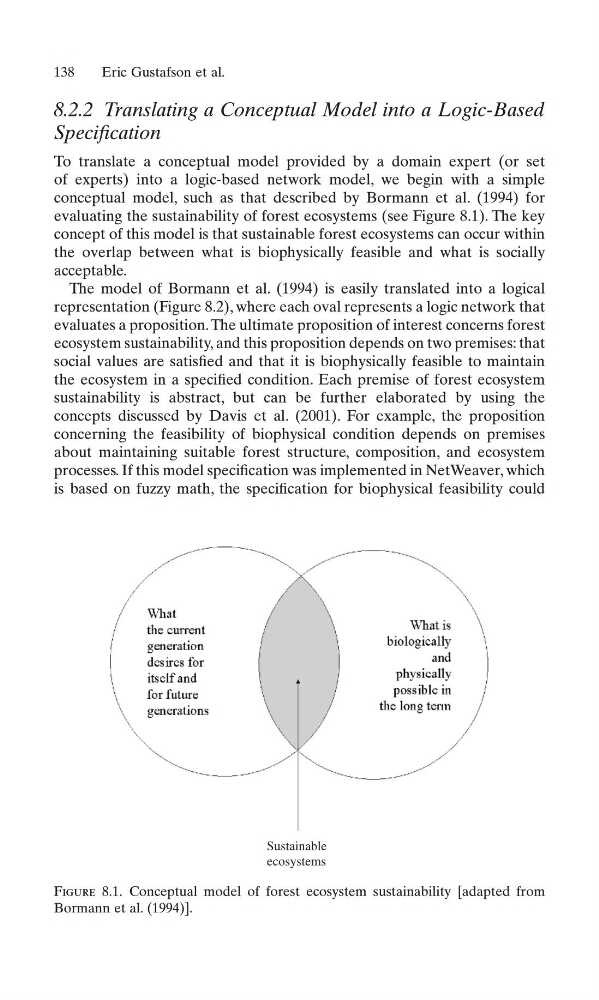
evaluating the sustainability of forest ecosystems (see Figure 8.1). The key
concept of this model is that sustainable forest ecosystems can occur within
the overlap between what is biophysically feasible and what is socially
acceptable.
The model of Bormann et al. (1994) is easily translated into a logical
representation (Figure 8.2), where each oval represents a logic network that
evaluates a proposition. The ultimate proposition of interest concerns forest
ecosystem sustainability, and this proposition depends on two premises: that
social values are satisfied and that it is biophysically feasible to maintain
the ecosystem in a specified condition. Each premise of forest ecosystem
sustainability is abstract, but can be further elaborated by using the
concepts discussed by Davis et al. (2001). For example, the proposition
concerning the feasibility of biophysical condition depends on premises
about maintaining suitable forest structure, composition, and ecosystem
processes. If this model specification was implemented in NetWeaver, which
is based on fuzzy math, the specification for biophysical feasibility could
138
Eric Gustafson et al.
Sustainable
ecosystems
Figure 8.1. Conceptual model of forest ecosystem sustainability [adapted from
Bormann et al. (1994)].
Specification
To translate a conceptual model provided by a domain expert (or set
of experts) into a logic-based network model, we begin with a simple
conceptual model, such as that described by Bormann et al. (1994) for
evaluating the sustainability of forest ecosystems (see Figure 8.1). The key
concept of this model is that sustainable forest ecosystems can occur within
the overlap between what is biophysically feasible and what is socially
acceptable.
The model of Bormann et al. (1994) is easily translated into a logical
representation (Figure 8.2), where each oval represents a logic network that
evaluates a proposition. The ultimate proposition of interest concerns forest
ecosystem sustainability, and this proposition depends on two premises: that
social values are satisfied and that it is biophysically feasible to maintain
the ecosystem in a specified condition. Each premise of forest ecosystem
sustainability is abstract, but can be further elaborated by using the
concepts discussed by Davis et al. (2001). For example, the proposition
concerning the feasibility of biophysical condition depends on premises
about maintaining suitable forest structure, composition, and ecosystem
processes. If this model specification was implemented in NetWeaver, which
is based on fuzzy math, the specification for biophysical feasibility could
138
Eric Gustafson et al.
Sustainable
ecosystems
Figure 8.1. Conceptual model of forest ecosystem sustainability [adapted from
Bormann et al. (1994)].