

dynamics (Hanski 1999), the amount of habitat with viable populations can
decrease dramatically at this critical threshold in landscape connectivity,
possibly resulting in biodiversity collapse (see Figure 7.2).
Critical transitions in landscape connectivity have played an important
role in the conceptual development of landscape ecology. However, for a
number of reasons, the existing theory is quite limited in its application to
real landscapes. First, real landscapes do not fragment randomly. Rather,
forest fragmentation occurs in specific places, generally because these locations contain commercially valuable tree species, are highly suitable for
agriculture, or are near existing settlements. The effect of nonrandom
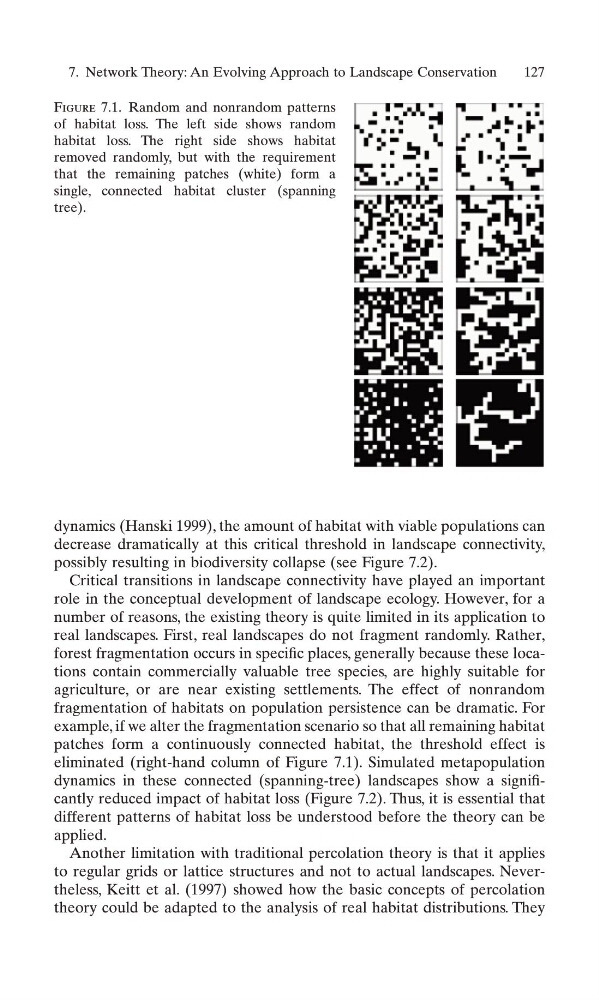
fragmentation of habitats on population persistence can be dramatic. For
example, if we alter the fragmentation scenario so that all remaining habitat
patches form a continuously connected habitat, the threshold effect is
eliminated (right-hand column of Figure 7.1). Simulated metapopulation
dynamics in these connected (spanning-tree) landscapes show a significantly reduced impact of habitat loss (Figure 7.2). Thus, it is essential that
different patterns of habitat loss be understood before the theory can be
applied.
Another limitation with traditional percolation theory is that it applies
to regular grids or lattice structures and not to actual landscapes. Nevertheless, Keitt et al. (1997) showed how the basic concepts of percolation
theory could be adapted to the analysis of real habitat distributions. They
7. Network Theory: An Evolving Approach to Landscape Conservation
127
Figure 7.1. Random and nonrandom patterns
of habitat loss. The left side shows random
habitat loss. The right side shows habitat
removed randomly, but with the requirement
that the remaining patches (white) form a
single, connected habitat cluster (spanning
tree).
decrease dramatically at this critical threshold in landscape connectivity,
possibly resulting in biodiversity collapse (see Figure 7.2).
Critical transitions in landscape connectivity have played an important
role in the conceptual development of landscape ecology. However, for a
number of reasons, the existing theory is quite limited in its application to
real landscapes. First, real landscapes do not fragment randomly. Rather,
forest fragmentation occurs in specific places, generally because these locations contain commercially valuable tree species, are highly suitable for
agriculture, or are near existing settlements. The effect of nonrandom
fragmentation of habitats on population persistence can be dramatic. For
example, if we alter the fragmentation scenario so that all remaining habitat
patches form a continuously connected habitat, the threshold effect is
eliminated (right-hand column of Figure 7.1). Simulated metapopulation
dynamics in these connected (spanning-tree) landscapes show a significantly reduced impact of habitat loss (Figure 7.2). Thus, it is essential that
different patterns of habitat loss be understood before the theory can be
applied.
Another limitation with traditional percolation theory is that it applies
to regular grids or lattice structures and not to actual landscapes. Nevertheless, Keitt et al. (1997) showed how the basic concepts of percolation
theory could be adapted to the analysis of real habitat distributions. They
7. Network Theory: An Evolving Approach to Landscape Conservation
127
Figure 7.1. Random and nonrandom patterns
of habitat loss. The left side shows random
habitat loss. The right side shows habitat
removed randomly, but with the requirement
that the remaining patches (white) form a
single, connected habitat cluster (spanning
tree).