

having modelers explain the value of depicting a range of variation around
mean tendencies is important to the broad adoption of models.
The barriers attributed to stakeholders largely come from this group
being so diverse. Conflicts in values and differences in background and
understanding often occur within this group. Furthermore, the group typically has extremely limited resources of time and expertise, restricting its
ability to spend the time necessary to learn about model application and
versatility. But sometimes stakeholder groups include experts who have the
knowledge and background to make a contribution to the use of models
and decision making. Other times, models are developed that facilitate
stakeholder interactions. For example, stakeholder opinions are an explicit
part of a cropping model for a Tasmanian agricultural catchment (Walker
et al. 2001). A model has even been used to demonstrate how stakeholder
contributions can be effectively integrated into the decision-making process
by building upon the capacity of grassroots conservation organizations, such
as local wildlife clubs in Kenya (McDuff 2001). Software is beginning to be
developed that provides stakeholders ways to use resources on the World
Wide Web for multicriteria analysis and decision making, critical examination of the underlying assumptions, and thus incorporating qualitative and
subjective considerations into quantitative factors for decision making [e.g.,
Zhu and Dale (2001)].
116
Virginia H. Dale et al.
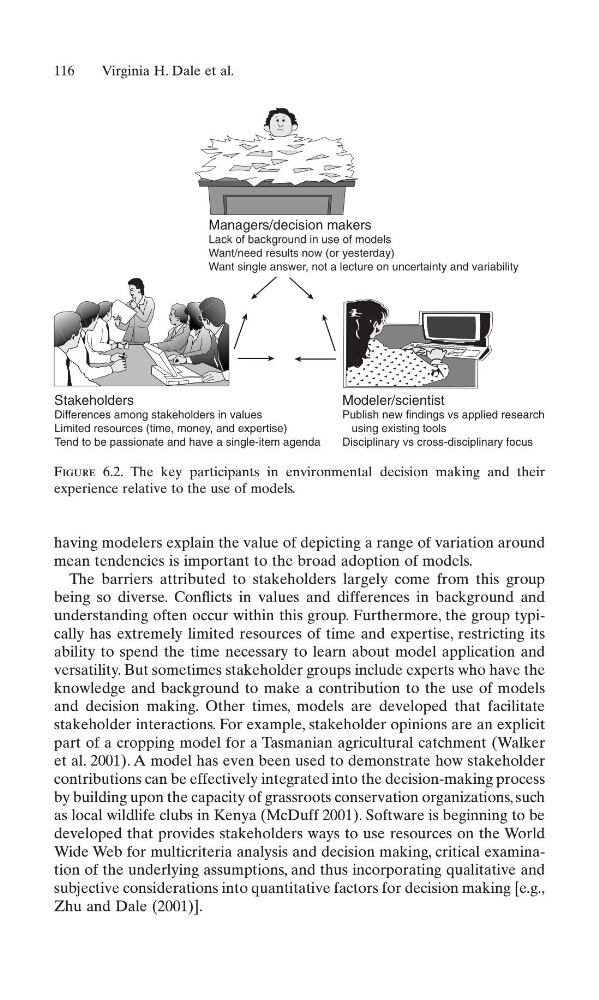
Managers/decision makers
Lack of background in use of models
Want/need results now (or yesterday)
Want single answer, not a lecture on uncertainty and variability
Stakeholders
Differences among stakeholders in values
Limited resources (time, money, and expertise)
Tend to be passionate and have a single-item agenda
Modeler/scientist
Publish new findings vs applied research
using existing tools
Disciplinary vs cross-disciplinary focus
Figure 6.2. The key participants in environmental decision making and their
experience relative to the use of models.
mean tendencies is important to the broad adoption of models.
The barriers attributed to stakeholders largely come from this group
being so diverse. Conflicts in values and differences in background and
understanding often occur within this group. Furthermore, the group typically has extremely limited resources of time and expertise, restricting its
ability to spend the time necessary to learn about model application and
versatility. But sometimes stakeholder groups include experts who have the
knowledge and background to make a contribution to the use of models
and decision making. Other times, models are developed that facilitate
stakeholder interactions. For example, stakeholder opinions are an explicit
part of a cropping model for a Tasmanian agricultural catchment (Walker
et al. 2001). A model has even been used to demonstrate how stakeholder
contributions can be effectively integrated into the decision-making process
by building upon the capacity of grassroots conservation organizations, such
as local wildlife clubs in Kenya (McDuff 2001). Software is beginning to be
developed that provides stakeholders ways to use resources on the World
Wide Web for multicriteria analysis and decision making, critical examination of the underlying assumptions, and thus incorporating qualitative and
subjective considerations into quantitative factors for decision making [e.g.,
Zhu and Dale (2001)].
116
Virginia H. Dale et al.
Managers/decision makers
Lack of background in use of models
Want/need results now (or yesterday)
Want single answer, not a lecture on uncertainty and variability
Stakeholders
Differences among stakeholders in values
Limited resources (time, money, and expertise)
Tend to be passionate and have a single-item agenda
Modeler/scientist
Publish new findings vs applied research
using existing tools
Disciplinary vs cross-disciplinary focus
Figure 6.2. The key participants in environmental decision making and their
experience relative to the use of models.