

4.5 Ward’s Minimum Variance Clustering
This method is based on the linear model criterion of least squares. The objective is
to define groups in such a way that the within-group sum of squares (i.e., the squared
error of ANOVA) is minimized. The within-cluster sum of squared errors can be
computed as the sum of the squared distances among members of a cluster divided
by the number of objects. Note also that although the computation of within-group
sums-of-squares is based on a Euclidean model, the Ward method will produce
meaningful results from dissimilarities that are Euclidean or not.
In the literature, two different algorithms are found for Ward clustering; one
implements Ward’s (1963) minimum variance clustering criterion, the other does not
(Murtagh and Legendre 2014). Function hclust() was modified in R 3.1.1;
method ¼ "ward.D2" now implements the Ward (1963) criterion where dissimilarities are squared before cluster updating, whereas method ¼ "ward.D" does
not implement that criterion. The latter was implemented by hclust() with
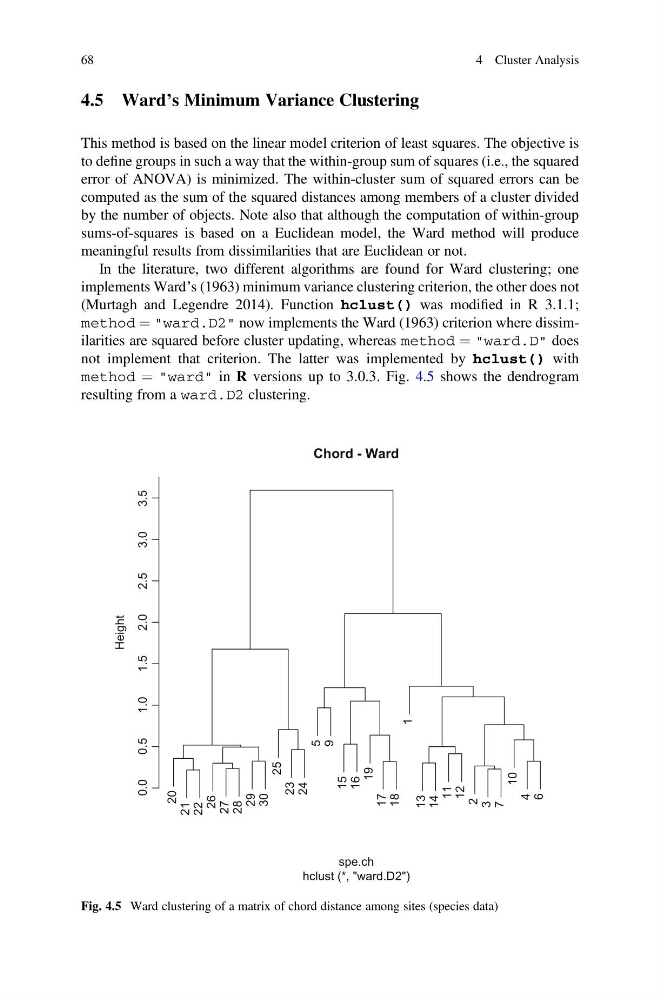
method ¼ "ward" in R versions up to 3.0.3. Fig. 4.5 shows the dendrogram
resulting from a ward.D2 clustering.
20
21
22
26
27
28
29
30
25
23
24
5
9
15
16
19
17
18
1
13
14
11
12
2
3
7
10
4
6
Chord - Ward
spe.ch
hclust (*, "ward.D2")
Height
3.5
3.0
2.5
2.0
1.5
1.0
0.5
0.0
Fig. 4.5 Ward clustering of a matrix of chord distance among sites (species data)
68
4 Cluster Analysis
This method is based on the linear model criterion of least squares. The objective is
to define groups in such a way that the within-group sum of squares (i.e., the squared
error of ANOVA) is minimized. The within-cluster sum of squared errors can be
computed as the sum of the squared distances among members of a cluster divided
by the number of objects. Note also that although the computation of within-group
sums-of-squares is based on a Euclidean model, the Ward method will produce
meaningful results from dissimilarities that are Euclidean or not.
In the literature, two different algorithms are found for Ward clustering; one
implements Ward’s (1963) minimum variance clustering criterion, the other does not
(Murtagh and Legendre 2014). Function hclust() was modified in R 3.1.1;
method ¼ "ward.D2" now implements the Ward (1963) criterion where dissimilarities are squared before cluster updating, whereas method ¼ "ward.D" does
not implement that criterion. The latter was implemented by hclust() with
method ¼ "ward" in R versions up to 3.0.3. Fig. 4.5 shows the dendrogram
resulting from a ward.D2 clustering.
20
21
22
26
27
28
29
30
25
23
24
5
9
15
16
19
17
18
1
13
14
11
12
2
3
7
10
4
6
Chord - Ward
spe.ch
hclust (*, "ward.D2")
Height
3.5
3.0
2.5
2.0
1.5
1.0
0.5
0.0
Fig. 4.5 Ward clustering of a matrix of chord distance among sites (species data)
68
4 Cluster Analysis