

and the percentage difference D 14 (aka Bray-Curtis, quantitative equivalent of
Sørensen).
In the papers reviewed by Legendre (2014), the quantities estimating species
replacement, used as numerators in the various indices for presence-absence data, are
either min(b, c) or 2 Â min(b, c). Indeed, among the b and c unique species, the
smaller number is considered as the number of species replacing the equivalent
number at the other site. For quantitative data, the corresponding quantities min(B,
C) or 2 Â min(B, C) are used. For richness difference, the statistic of interest is |b–c|;
for instance in Table 8.2, b ¼ 5 and c ¼ 3, so 3 species at site 1 are considered to
replace 3 species at site 2, and the remaining 2 species represent the richness
difference between the two sites. The corresponding quantity for differences in
abundance is |B – C|, which is also the difference between the total abundances of
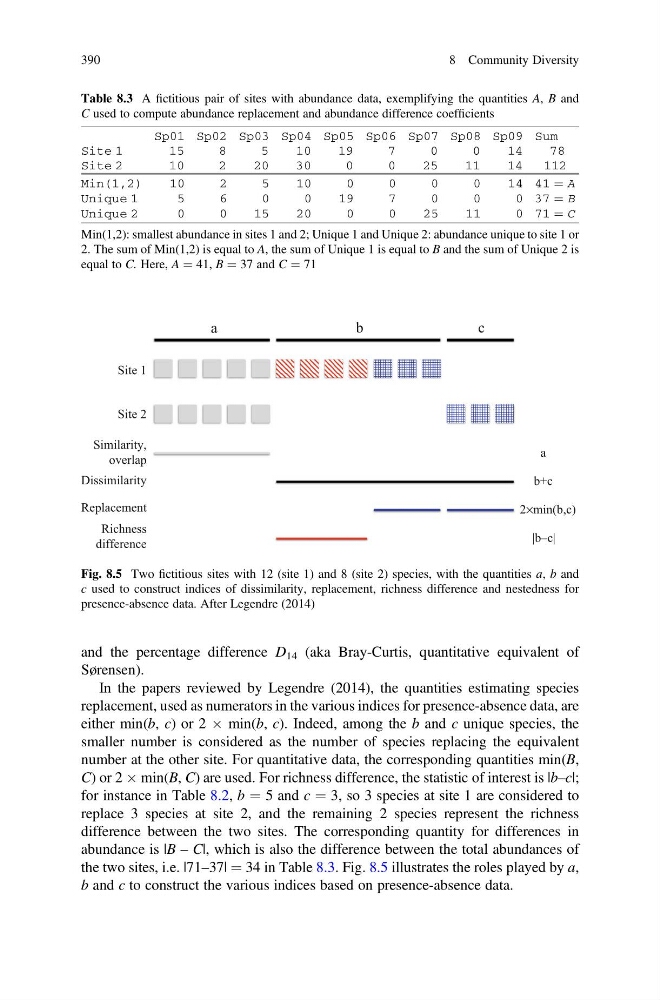
the two sites, i.e. |71–37| ¼ 34 in Table 8.3. Fig. 8.5 illustrates the roles played by a,
b and c to construct the various indices based on presence-absence data.
Table 8.3 A fictitious pair of sites with abundance data, exemplifying the quantities A, B and
C used to compute abundance replacement and abundance difference coefficients
Sp01 Sp02 Sp03 Sp04 Sp05 Sp06 Sp07 Sp08 Sp09 Sum
Site 1
15
8
5
10
19
7
0
0
14
78
Site 2
10
2
20
30
0
0
25
11
14
112
Min(1,2)
10
2
5
10
0
0
0
0
14 41 ¼ A
Unique 1
5
6
0
0
1 9
7
0
0
0 3 7¼ B
Unique 2
0
0
15
20
0
0
25
11
0 71 ¼ C
Min(1,2): smallest abundance in sites 1 and 2; Unique 1 and Unique 2: abundance unique to site 1 or
2. The sum of Min(1,2) is equal to A, the sum of Unique 1 is equal to B and the sum of Unique 2 is
equal to C. Here, A ¼ 41, B ¼ 37 and C ¼ 71
a
b
c
Site 1
Site 2
Similarity,
overlap
a
Dissimilarity
b+c
Replacement
2×min(b,c)
Richness
difference
|b–c|
Fig. 8.5 Two fictitious sites with 12 (site 1) and 8 (site 2) species, with the quantities a, b and
c used to construct indices of dissimilarity, replacement, richness difference and nestedness for
presence-absence data. After Legendre (2014)
390
8 Community Diversity
Sørensen).
In the papers reviewed by Legendre (2014), the quantities estimating species
replacement, used as numerators in the various indices for presence-absence data, are
either min(b, c) or 2 Â min(b, c). Indeed, among the b and c unique species, the
smaller number is considered as the number of species replacing the equivalent
number at the other site. For quantitative data, the corresponding quantities min(B,
C) or 2 Â min(B, C) are used. For richness difference, the statistic of interest is |b–c|;
for instance in Table 8.2, b ¼ 5 and c ¼ 3, so 3 species at site 1 are considered to
replace 3 species at site 2, and the remaining 2 species represent the richness
difference between the two sites. The corresponding quantity for differences in
abundance is |B – C|, which is also the difference between the total abundances of
the two sites, i.e. |71–37| ¼ 34 in Table 8.3. Fig. 8.5 illustrates the roles played by a,
b and c to construct the various indices based on presence-absence data.
Table 8.3 A fictitious pair of sites with abundance data, exemplifying the quantities A, B and
C used to compute abundance replacement and abundance difference coefficients
Sp01 Sp02 Sp03 Sp04 Sp05 Sp06 Sp07 Sp08 Sp09 Sum
Site 1
15
8
5
10
19
7
0
0
14
78
Site 2
10
2
20
30
0
0
25
11
14
112
Min(1,2)
10
2
5
10
0
0
0
0
14 41 ¼ A
Unique 1
5
6
0
0
1 9
7
0
0
0 3 7¼ B
Unique 2
0
0
15
20
0
0
25
11
0 71 ¼ C
Min(1,2): smallest abundance in sites 1 and 2; Unique 1 and Unique 2: abundance unique to site 1 or
2. The sum of Min(1,2) is equal to A, the sum of Unique 1 is equal to B and the sum of Unique 2 is
equal to C. Here, A ¼ 41, B ¼ 37 and C ¼ 71
a
b
c
Site 1
Site 2
Similarity,
overlap
a
Dissimilarity
b+c
Replacement
2×min(b,c)
Richness
difference
|b–c|
Fig. 8.5 Two fictitious sites with 12 (site 1) and 8 (site 2) species, with the quantities a, b and
c used to construct indices of dissimilarity, replacement, richness difference and nestedness for
presence-absence data. After Legendre (2014)
390
8 Community Diversity