

8.4.3 Partitioning Beta Diversity into Replacement, Richness
Difference and Nestedness Components
Harrison et al. (1992), Williams (1996) and Lennon et al. (2001) proposed that the
differences among communities (beta diversity) result from two processes: species
replacement (sometimes called turnover) and richness difference (species gain and
loss; or its special case, nestedness).
Species replacement is what is observed along ecological gradients where some
species are found on a limited range of the gradient according to their ecological
optima and tolerances. Some species are observed at one end of the gradient, then
disappear and are replaced by others, and so on. The causes of these patterns include
environmental forcing, but also, potentially, competition and historical events (i.e.,
disturbances and other processes that have occurred in the past and left their marks in
the communities).
0
5 0
1 0 0
1 5 0
0
2 0
4 0
6 0
8 0
1 0 0
1 2 0
LCBD values
x coordinate (km)
y coordinate (km)
***
***
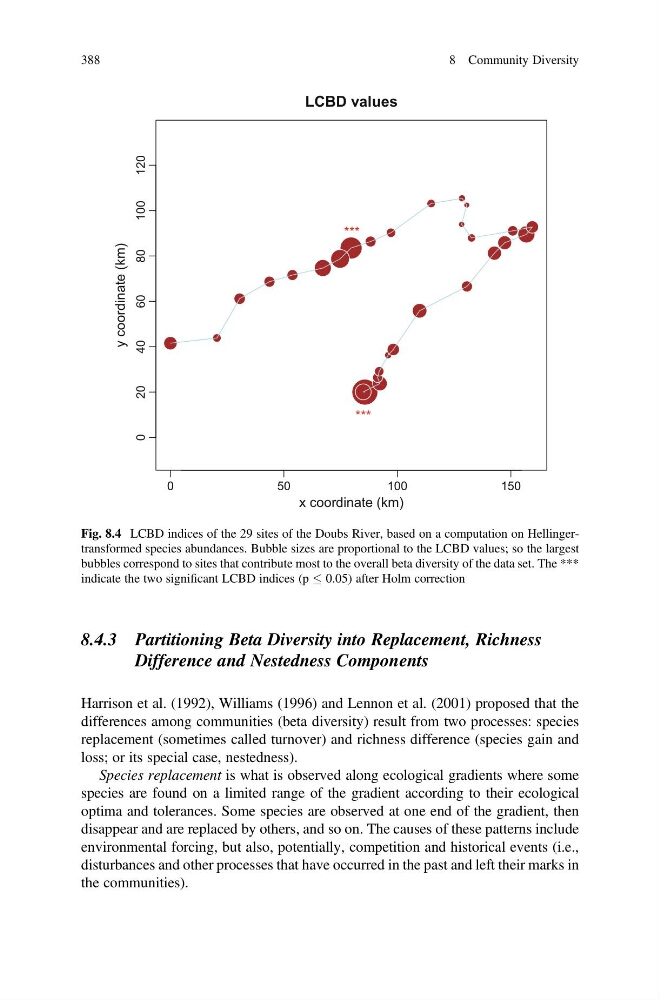
Fig. 8.4 LCBD indices of the 29 sites of the Doubs River, based on a computation on Hellingertransformed species abundances. Bubble sizes are proportional to the LCBD values; so the largest
bubbles correspond to sites that contribute most to the overall beta diversity of the data set. The ***
indicate the two significant LCBD indices (p 0.05) after Holm correction
388
8 Community Diversity
Difference and Nestedness Components
Harrison et al. (1992), Williams (1996) and Lennon et al. (2001) proposed that the
differences among communities (beta diversity) result from two processes: species
replacement (sometimes called turnover) and richness difference (species gain and
loss; or its special case, nestedness).
Species replacement is what is observed along ecological gradients where some
species are found on a limited range of the gradient according to their ecological
optima and tolerances. Some species are observed at one end of the gradient, then
disappear and are replaced by others, and so on. The causes of these patterns include
environmental forcing, but also, potentially, competition and historical events (i.e.,
disturbances and other processes that have occurred in the past and left their marks in
the communities).
0
5 0
1 0 0
1 5 0
0
2 0
4 0
6 0
8 0
1 0 0
1 2 0
LCBD values
x coordinate (km)
y coordinate (km)
***
***
Fig. 8.4 LCBD indices of the 29 sites of the Doubs River, based on a computation on Hellingertransformed species abundances. Bubble sizes are proportional to the LCBD values; so the largest
bubbles correspond to sites that contribute most to the overall beta diversity of the data set. The ***
indicate the two significant LCBD indices (p 0.05) after Holm correction
388
8 Community Diversity