

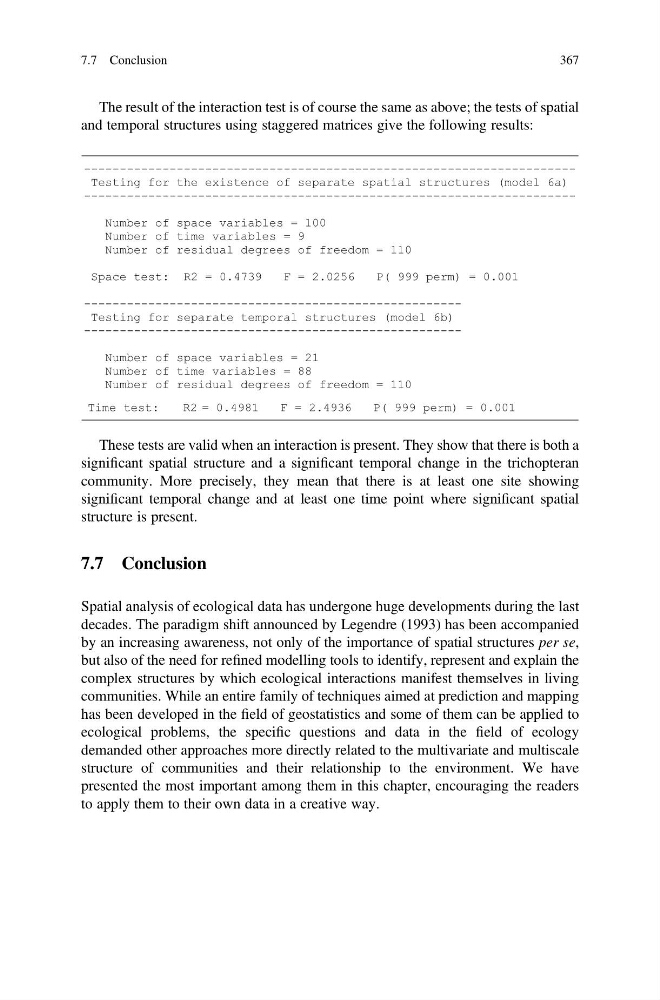
The result of the interaction test is of course the same as above; the tests of spatial
and temporal structures using staggered matrices give the following results:
--------------------------------------------------------------------Testing for the existence of separate spatial structures (model 6a)
--------------------------------------------------------------------Number of space variables = 100
Number of time variables = 9
Number of residual degrees of freedom = 110
Space test: R2 = 0.4739
F = 2.0256
P( 999 perm) = 0.001
Time test:
R2 = 0.4981
F = 2.4936
P( 999 perm) = 0.001
----------------------------------------------------Testing for separate temporal structures (model 6b)
----------------------------------------------------Number of space variables = 21
Number of time variables = 88
Number of residual degrees of freedom = 110
These tests are valid when an interaction is present. They show that there is both a
significant spatial structure and a significant temporal change in the trichopteran
community. More precisely, they mean that there is at least one site showing
significant temporal change and at least one time point where significant spatial
structure is present.
7.7 Conclusion
Spatial analysis of ecological data has undergone huge developments during the last
decades. The paradigm shift announced by Legendre (1993) has been accompanied
by an increasing awareness, not only of the importance of spatial structures per se,
but also of the need for refined modelling tools to identify, represent and explain the
complex structures by which ecological interactions manifest themselves in living
communities. While an entire family of techniques aimed at prediction and mapping
has been developed in the field of geostatistics and some of them can be applied to
ecological problems, the specific questions and data in the field of ecology
demanded other approaches more directly related to the multivariate and multiscale
structure of communities and their relationship to the environment. We have
presented the most important among them in this chapter, encouraging the readers
to apply them to their own data in a creative way.
7.7 Conclusion
367
and temporal structures using staggered matrices give the following results:
--------------------------------------------------------------------Testing for the existence of separate spatial structures (model 6a)
--------------------------------------------------------------------Number of space variables = 100
Number of time variables = 9
Number of residual degrees of freedom = 110
Space test: R2 = 0.4739
F = 2.0256
P( 999 perm) = 0.001
Time test:
R2 = 0.4981
F = 2.4936
P( 999 perm) = 0.001
----------------------------------------------------Testing for separate temporal structures (model 6b)
----------------------------------------------------Number of space variables = 21
Number of time variables = 88
Number of residual degrees of freedom = 110
These tests are valid when an interaction is present. They show that there is both a
significant spatial structure and a significant temporal change in the trichopteran
community. More precisely, they mean that there is at least one site showing
significant temporal change and at least one time point where significant spatial
structure is present.
7.7 Conclusion
Spatial analysis of ecological data has undergone huge developments during the last
decades. The paradigm shift announced by Legendre (1993) has been accompanied
by an increasing awareness, not only of the importance of spatial structures per se,
but also of the need for refined modelling tools to identify, represent and explain the
complex structures by which ecological interactions manifest themselves in living
communities. While an entire family of techniques aimed at prediction and mapping
has been developed in the field of geostatistics and some of them can be applied to
ecological problems, the specific questions and data in the field of ecology
demanded other approaches more directly related to the multivariate and multiscale
structure of communities and their relationship to the environment. We have
presented the most important among them in this chapter, encouraging the readers
to apply them to their own data in a creative way.
7.7 Conclusion
367