

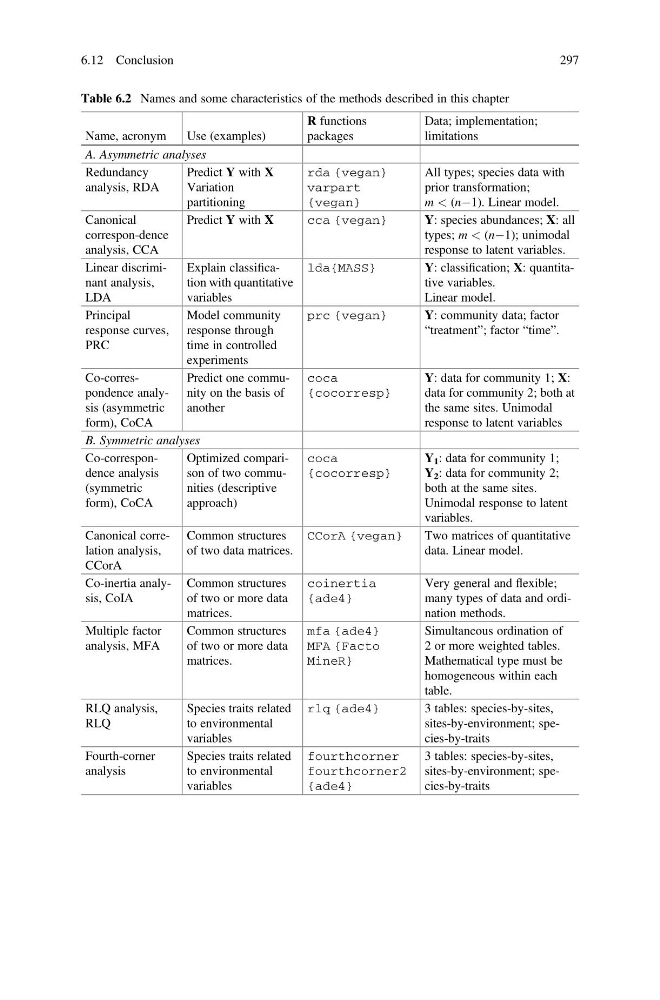
Table 6.2 Names and some characteristics of the methods described in this chapter
Name, acronym
Use (examples)
R functions
packages
Data; implementation;
limitations
A. Asymmetric analyses
Redundancy
analysis, RDA
Predict Y with X
Variation
partitioning
rda {vegan}
varpart
{vegan}
All types; species data with
prior transformation;
m < (nÀ1). Linear model.
Canonical
correspon-dence
analysis, CCA
Predict Y with X
cca {vegan}
Y: species abundances; X: all
types; m < (nÀ1); unimodal
response to latent variables.
Linear discriminant analysis,
LDA
Explain classification with quantitative
variables
lda{MASS}
Y: classification; X: quantitative variables.
Linear model.
Principal
response curves,
PRC
Model community
response through
time in controlled
experiments
prc {vegan}
Y: community data; factor
“treatment”; factor “time”.
Co-correspondence analysis (asymmetric
form), CoCA
Predict one community on the basis of
another
coca
{cocorresp}
Y: data for community 1; X:
data for community 2; both at
the same sites. Unimodal
response to latent variables
B. Symmetric analyses
Co-correspondence analysis
(symmetric
form), CoCA
Optimized comparison of two communities (descriptive
approach)
coca
{cocorresp}
Y 1 : data for community 1;
Y 2 : data for community 2;
both at the same sites.
Unimodal response to latent
variables.
Canonical correlation analysis,
CCorA
Common structures
of two data matrices.
CCorA {vegan}
Two matrices of quantitative
data. Linear model.
Co-inertia analysis, CoIA
Common structures
of two or more data
matrices.
coinertia
{ade4}
Very general and flexible;
many types of data and ordination methods.
Multiple factor
analysis, MFA
Common structures
of two or more data
matrices.
mfa {ade4}
MFA {Facto
MineR}
Simultaneous ordination of
2 or more weighted tables.
Mathematical type must be
homogeneous within each
table.
RLQ analysis,
RLQ
Species traits related
to environmental
variables
rlq {ade4}
3 tables: species-by-sites,
sites-by-environment; species-by-traits
Fourth-corner
analysis
Species traits related
to environmental
variables
fourthcorner
fourthcorner2
{ade4}
3 tables: species-by-sites,
sites-by-environment; species-by-traits
6.12 Conclusion
297
Name, acronym
Use (examples)
R functions
packages
Data; implementation;
limitations
A. Asymmetric analyses
Redundancy
analysis, RDA
Predict Y with X
Variation
partitioning
rda {vegan}
varpart
{vegan}
All types; species data with
prior transformation;
m < (nÀ1). Linear model.
Canonical
correspon-dence
analysis, CCA
Predict Y with X
cca {vegan}
Y: species abundances; X: all
types; m < (nÀ1); unimodal
response to latent variables.
Linear discriminant analysis,
LDA
Explain classification with quantitative
variables
lda{MASS}
Y: classification; X: quantitative variables.
Linear model.
Principal
response curves,
PRC
Model community
response through
time in controlled
experiments
prc {vegan}
Y: community data; factor
“treatment”; factor “time”.
Co-correspondence analysis (asymmetric
form), CoCA
Predict one community on the basis of
another
coca
{cocorresp}
Y: data for community 1; X:
data for community 2; both at
the same sites. Unimodal
response to latent variables
B. Symmetric analyses
Co-correspondence analysis
(symmetric
form), CoCA
Optimized comparison of two communities (descriptive
approach)
coca
{cocorresp}
Y 1 : data for community 1;
Y 2 : data for community 2;
both at the same sites.
Unimodal response to latent
variables.
Canonical correlation analysis,
CCorA
Common structures
of two data matrices.
CCorA {vegan}
Two matrices of quantitative
data. Linear model.
Co-inertia analysis, CoIA
Common structures
of two or more data
matrices.
coinertia
{ade4}
Very general and flexible;
many types of data and ordination methods.
Multiple factor
analysis, MFA
Common structures
of two or more data
matrices.
mfa {ade4}
MFA {Facto
MineR}
Simultaneous ordination of
2 or more weighted tables.
Mathematical type must be
homogeneous within each
table.
RLQ analysis,
RLQ
Species traits related
to environmental
variables
rlq {ade4}
3 tables: species-by-sites,
sites-by-environment; species-by-traits
Fourth-corner
analysis
Species traits related
to environmental
variables
fourthcorner
fourthcorner2
{ade4}
3 tables: species-by-sites,
sites-by-environment; species-by-traits
6.12 Conclusion
297