

6.12 Conclusion
Ordination is a natural and informative way to look at ecological data, and ordination
involving more than one data matrix is certainly the most powerful family of
methods to reveal, interpret, test and model ecological relationships in the multivariate context. We presented what we think are the most important and useful methods
(Table 6.2), illustrating them using examples that highlighted their potentials. This is
by no means the end of the story. Researchers continuously propose either new ways
of exploiting existing methods, or new methods altogether to answer new types of
questions, whose merits and limits must be put under close scrutiny to allow them to
be properly integrated into the already powerful statistical toolbox of the ecological
community. Readers of this book are encouraged to join this movement.
d = 0.5
Aspect
Form.2
Form.4
ZoogD.no
ZoogD.some
Spread
Thick
Seed
Form.3
PhysD
ZoogD.high
Form.5
Snow
Form.1
Slope
Height
Angle
Area
SLA
N_mass
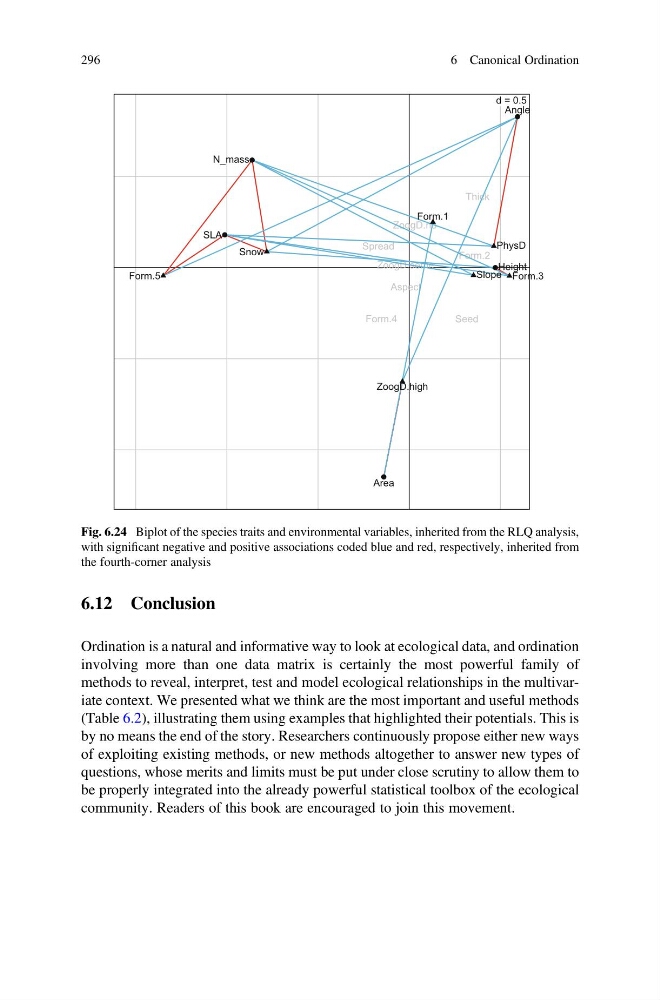
Fig. 6.24 Biplot of the species traits and environmental variables, inherited from the RLQ analysis,
with significant negative and positive associations coded blue and red, respectively, inherited from
the fourth-corner analysis
296
6 Canonical Ordination
Ordination is a natural and informative way to look at ecological data, and ordination
involving more than one data matrix is certainly the most powerful family of
methods to reveal, interpret, test and model ecological relationships in the multivariate context. We presented what we think are the most important and useful methods
(Table 6.2), illustrating them using examples that highlighted their potentials. This is
by no means the end of the story. Researchers continuously propose either new ways
of exploiting existing methods, or new methods altogether to answer new types of
questions, whose merits and limits must be put under close scrutiny to allow them to
be properly integrated into the already powerful statistical toolbox of the ecological
community. Readers of this book are encouraged to join this movement.
d = 0.5
Aspect
Form.2
Form.4
ZoogD.no
ZoogD.some
Spread
Thick
Seed
Form.3
PhysD
ZoogD.high
Form.5
Snow
Form.1
Slope
Height
Angle
Area
SLA
N_mass
Fig. 6.24 Biplot of the species traits and environmental variables, inherited from the RLQ analysis,
with significant negative and positive associations coded blue and red, respectively, inherited from
the fourth-corner analysis
296
6 Canonical Ordination