

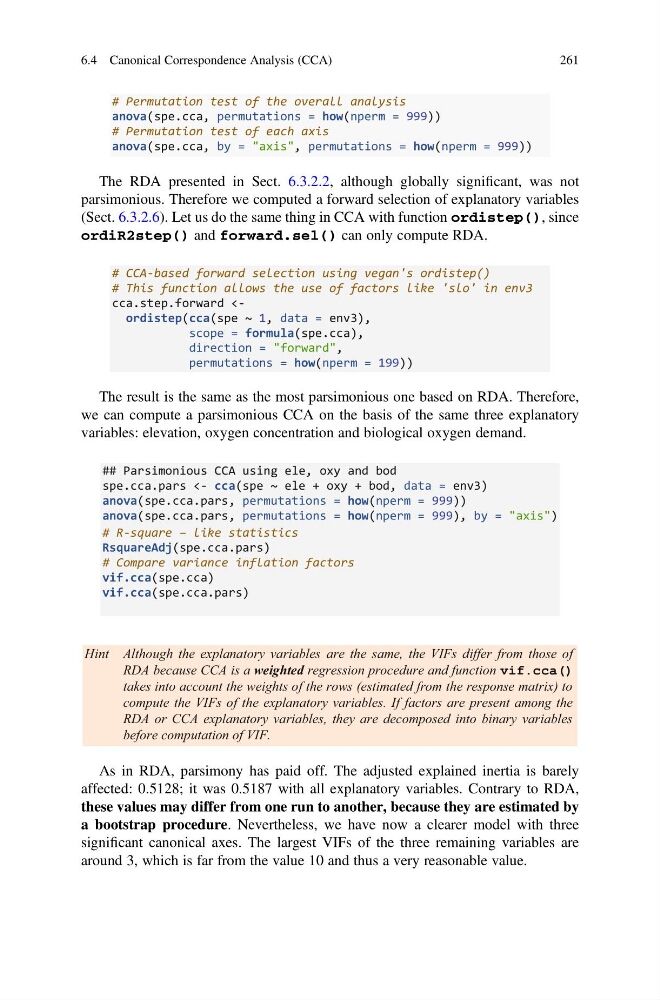
# Permutation test of the overall analysis
anova(spe.cca, permutations = how(nperm = 999))
# Permutation test of each axis
anova(spe.cca, by = "axis", permutations = how(nperm = 999))
The RDA presented in Sect. 6.3.2.2, although globally significant, was not
parsimonious. Therefore we computed a forward selection of explanatory variables
(Sect. 6.3.2.6). Let us do the same thing in CCA with function ordistep(), since
ordiR2step() and forward.sel() can only compute RDA.
# CCA-based forward selection using vegan's ordistep()
# This function allows the use of factors like 'slo' in env3
cca.step.forward
scope = formula(spe.cca),
direction = "forward",
permutations = how(nperm = 199))
The result is the same as the most parsimonious one based on RDA. Therefore,
we can compute a parsimonious CCA on the basis of the same three explanatory
variables: elevation, oxygen concentration and biological oxygen demand.
## Parsimonious CCA using ele, oxy and bod
spe.cca.pars <- cca(spe ~ ele + oxy + bod, data = env3)
anova(spe.cca.pars, permutations = how(nperm = 999))
anova(spe.cca.pars, permutations = how(nperm = 999), by = "axis")
# R-square – like statistics
RsquareAdj(spe.cca.pars)
# Compare variance inflation factors
vif.cca(spe.cca)
vif.cca(spe.cca.pars)
Hint Although the explanatory variables are the same, the VIFs differ from those of
RDA because CCA is a weighted regression procedure and function vif.cca()
takes into account the weights of the rows (estimated from the response matrix) to
compute the VIFs of the explanatory variables. If factors are present among the
RDA or CCA explanatory variables, they are decomposed into binary variables
before computation of VIF.
As in RDA, parsimony has paid off. The adjusted explained inertia is barely
affected: 0.5128; it was 0.5187 with all explanatory variables. Contrary to RDA,
these values may differ from one run to another, because they are estimated by
a bootstrap procedure. Nevertheless, we have now a clearer model with three
significant canonical axes. The largest VIFs of the three remaining variables are
around 3, which is far from the value 10 and thus a very reasonable value.
6.4 Canonical Correspondence Analysis (CCA)
261
anova(spe.cca, permutations = how(nperm = 999))
# Permutation test of each axis
anova(spe.cca, by = "axis", permutations = how(nperm = 999))
The RDA presented in Sect. 6.3.2.2, although globally significant, was not
parsimonious. Therefore we computed a forward selection of explanatory variables
(Sect. 6.3.2.6). Let us do the same thing in CCA with function ordistep(), since
ordiR2step() and forward.sel() can only compute RDA.
# CCA-based forward selection using vegan's ordistep()
# This function allows the use of factors like 'slo' in env3
cca.step.forward
direction = "forward",
permutations = how(nperm = 199))
The result is the same as the most parsimonious one based on RDA. Therefore,
we can compute a parsimonious CCA on the basis of the same three explanatory
variables: elevation, oxygen concentration and biological oxygen demand.
## Parsimonious CCA using ele, oxy and bod
spe.cca.pars <- cca(spe ~ ele + oxy + bod, data = env3)
anova(spe.cca.pars, permutations = how(nperm = 999))
anova(spe.cca.pars, permutations = how(nperm = 999), by = "axis")
# R-square – like statistics
RsquareAdj(spe.cca.pars)
# Compare variance inflation factors
vif.cca(spe.cca)
vif.cca(spe.cca.pars)
Hint Although the explanatory variables are the same, the VIFs differ from those of
RDA because CCA is a weighted regression procedure and function vif.cca()
takes into account the weights of the rows (estimated from the response matrix) to
compute the VIFs of the explanatory variables. If factors are present among the
RDA or CCA explanatory variables, they are decomposed into binary variables
before computation of VIF.
As in RDA, parsimony has paid off. The adjusted explained inertia is barely
affected: 0.5128; it was 0.5187 with all explanatory variables. Contrary to RDA,
these values may differ from one run to another, because they are estimated by
a bootstrap procedure. Nevertheless, we have now a clearer model with three
significant canonical axes. The largest VIFs of the three remaining variables are
around 3, which is far from the value 10 and thus a very reasonable value.
6.4 Canonical Correspondence Analysis (CCA)
261