

4.15 A Very Different Approach: Fuzzy Clustering
At the beginning of this chapter, we defined clusters produced by clustering methods
as non-overlapping entities. This definition is a natural consequence of the focus of
most clustering methods on discontinuities. However, there is another approach to
clustering that recognizes that sometimes cluster limits may not be so clear-cut as
one would like them to be. In that approach, an object may be, to different degrees, a
member of two or several groups. As an example, the colour green may be obtained
by mixing blue and yellow paint, the proportion of each of the two primary colours
determining the shade of green. Consequently, a different family of hierarchical and
non-hierarchical methods has been developed, namely fuzzy clustering. We will not
develop this family in detail, but briefly show one approach that is akin to
non-hierarchical k-means partitioning. Its name is c-means clustering (Kaufman
and Rousseeuw 2005).
4.15.1 Fuzzy c-means Using Package cluster’s Function
fanny()
Instead of a classification where a given object belongs to one and only one cluster,
c-means clustering associates to all objects a series of membership values measuring
0
5 0
1 0 0
1 5 0
20
40
60
80
100
Sequential clusters along the river
x coordinate (km)
y coordinate (km)
Upstream
Downstream
21
3
4
5
6
7
9
10
11
12
13
14
15
16
17
18
19
20
21
22
23
24
25
26
27
28
29
30
Cluster 1
Cluster 2
Cluster 3
Cluster 4
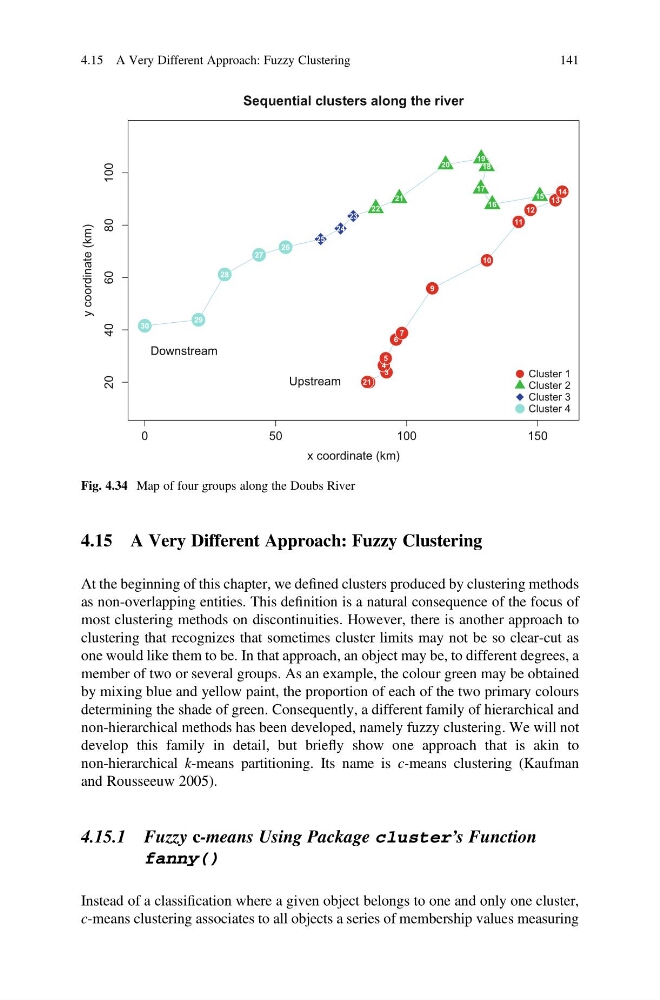
Fig. 4.34 Map of four groups along the Doubs River
4.15 A Very Different Approach: Fuzzy Clustering
141
At the beginning of this chapter, we defined clusters produced by clustering methods
as non-overlapping entities. This definition is a natural consequence of the focus of
most clustering methods on discontinuities. However, there is another approach to
clustering that recognizes that sometimes cluster limits may not be so clear-cut as
one would like them to be. In that approach, an object may be, to different degrees, a
member of two or several groups. As an example, the colour green may be obtained
by mixing blue and yellow paint, the proportion of each of the two primary colours
determining the shade of green. Consequently, a different family of hierarchical and
non-hierarchical methods has been developed, namely fuzzy clustering. We will not
develop this family in detail, but briefly show one approach that is akin to
non-hierarchical k-means partitioning. Its name is c-means clustering (Kaufman
and Rousseeuw 2005).
4.15.1 Fuzzy c-means Using Package cluster’s Function
fanny()
Instead of a classification where a given object belongs to one and only one cluster,
c-means clustering associates to all objects a series of membership values measuring
0
5 0
1 0 0
1 5 0
20
40
60
80
100
Sequential clusters along the river
x coordinate (km)
y coordinate (km)
Upstream
Downstream
21
3
4
5
6
7
9
10
11
12
13
14
15
16
17
18
19
20
21
22
23
24
25
26
27
28
29
30
Cluster 1
Cluster 2
Cluster 3
Cluster 4
Fig. 4.34 Map of four groups along the Doubs River
4.15 A Very Different Approach: Fuzzy Clustering
141