

42
J. Polania eta!.
mangrove stands, respectively. Differences between bird assemblages of
healthy (30) and dead (20) mangrove forests in terms of numbers of individuals and species are not significant, probably due to the mobility of
birds and their use of dead trees as roost and nesting sites (Botero and
Marshall 1994). However, while insectivorous bird species occur both in
healthy and dead stands, primary consumers among the birds are absent
from the dead mangrove forests.
More than 3,000 people are directly involved in fisheries, using cast nets
(2,342), gill nets (1,692), and encircling gill nets (301). Today artisanal
fisheries in the CGSM represent 47% of all catches in the Colombian
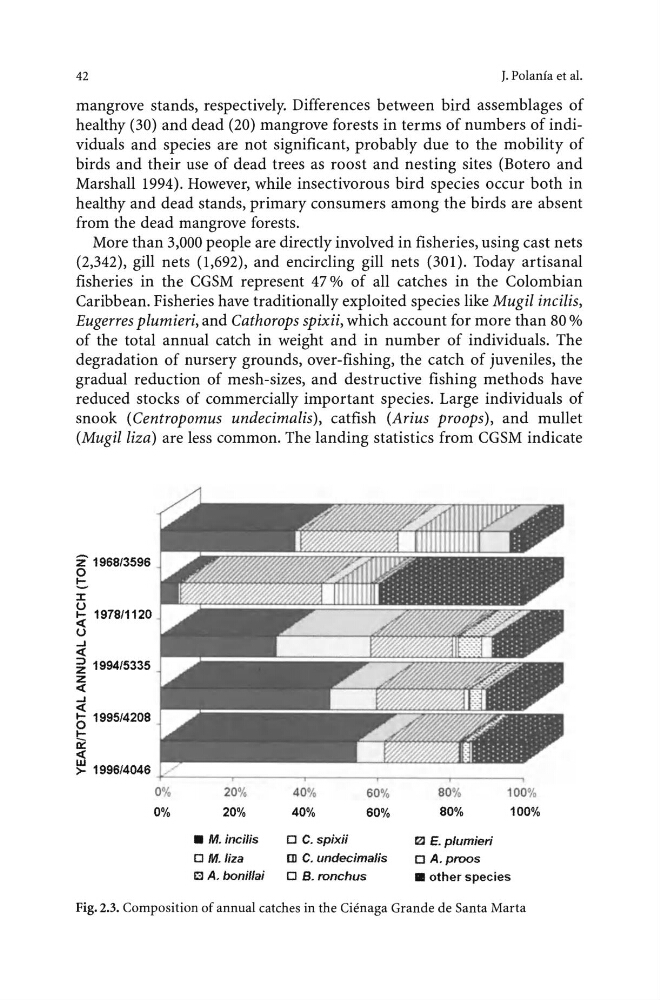
Caribbean. Fisheries have traditionally exploited species like Mugil incilis,
Eugerres plumieri, and Cathorops spixii, which account for more than 80%
of the total annual catch in weight and in number of individuals. The
degradation of nursery grounds, over-fishing, the catch of juveniles, the
gradual reduction of mesh-sizes, and destructive fishing methods have
reduced stocks of commercially important species. Large individuals of
snook (Centropomus undecimalis), catfish (Arius proops), and mullet
(Mugilliza) are less common. The landing statistics from CGSM indicate
0%
0%
20%
20%
40%
40%
• M. incilis
0 C. spixii
60%
60%
D M. liza
[D C. undecimalis
f:'l A. bonillai
0 B. ronchus
80%
80%
r2l E. plumieri
0 A.proos
100%
100%
• other species
Fig. 2.3. Composition of annual catches in the Cienaga Grande de Santa Marta
J. Polania eta!.
mangrove stands, respectively. Differences between bird assemblages of
healthy (30) and dead (20) mangrove forests in terms of numbers of individuals and species are not significant, probably due to the mobility of
birds and their use of dead trees as roost and nesting sites (Botero and
Marshall 1994). However, while insectivorous bird species occur both in
healthy and dead stands, primary consumers among the birds are absent
from the dead mangrove forests.
More than 3,000 people are directly involved in fisheries, using cast nets
(2,342), gill nets (1,692), and encircling gill nets (301). Today artisanal
fisheries in the CGSM represent 47% of all catches in the Colombian
Caribbean. Fisheries have traditionally exploited species like Mugil incilis,
Eugerres plumieri, and Cathorops spixii, which account for more than 80%
of the total annual catch in weight and in number of individuals. The
degradation of nursery grounds, over-fishing, the catch of juveniles, the
gradual reduction of mesh-sizes, and destructive fishing methods have
reduced stocks of commercially important species. Large individuals of
snook (Centropomus undecimalis), catfish (Arius proops), and mullet
(Mugilliza) are less common. The landing statistics from CGSM indicate
0%
0%
20%
20%
40%
40%
• M. incilis
0 C. spixii
60%
60%
D M. liza
[D C. undecimalis
f:'l A. bonillai
0 B. ronchus
80%
80%
r2l E. plumieri
0 A.proos
100%
100%
• other species
Fig. 2.3. Composition of annual catches in the Cienaga Grande de Santa Marta