

The Coastal Lagoon Cienaga Grande de Santa Marta, Colombia
41
50
Y:10.0125+0.052031*X
1970
1975
1980
1985
1990
1995
250
•
=a, 200
• • •
.§.
• •
z 150
••
•
0
•
... 100
Cl)
w
Cl)
50
Aug-1987 Dec-1988 May-1990 Sep-1991 Jan-1993 Jun-1994 Oct-1995
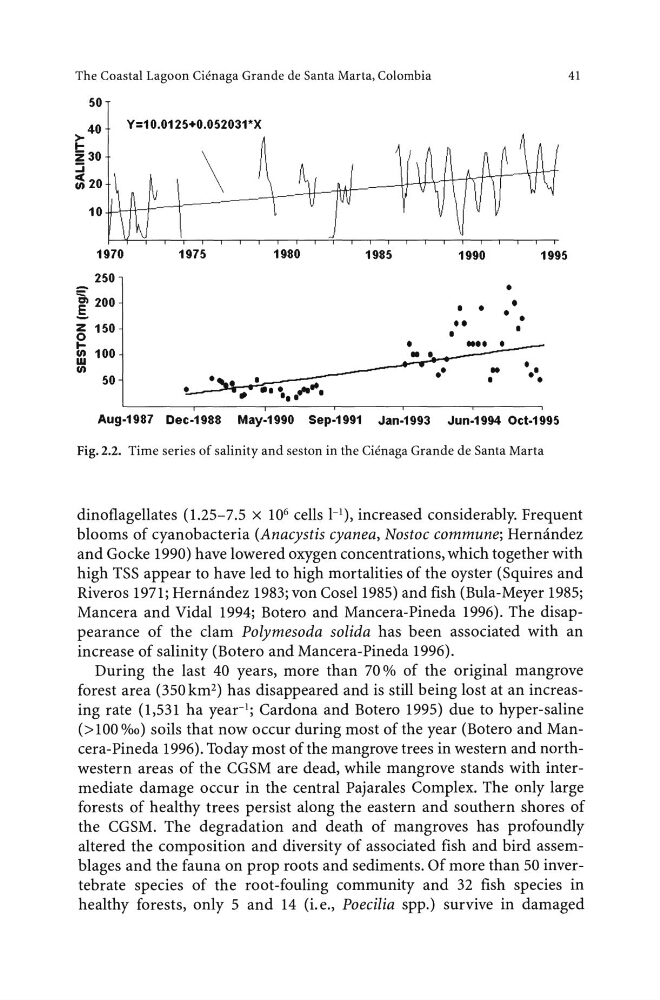
Fig. 2.2. Time series of salinity and seston in the Cienaga Grande de Santa Marta
dinoflagellates (1.25-7.5 x 10 6 cells l- 1 ), increased considerably. Frequent
blooms of cyanobacteria (Anacystis cyanea, Nostoc commune; Hernandez
and Gocke 1990) have lowered oxygen concentrations, which together with
high TSS appear to have led to high mortalities of the oyster (Squires and
Riveros 1971; Hernandez 1983; von Cosel1985) and fish (Bula-Meyer 1985;
Mancera and Vidal 1994; Botero and Mancera-Pineda 1996). The disappearance of the clam Polymesoda solida has been associated with an
increase of salinity (Botero and Mancera-Pineda 1996).
During the last 40 years, more than 70% of the original mangrove
forest area ( 350 km 2 ) has disappeared and is still being lost at an increasing rate (1,531 ha year- 1 ; Cardona and Botero 1995) due to hyper-saline
(> 100 o/oo) soils that now occur during most of the year (Botero and Mancera-Pineda 1996). Today most of the mangrove trees in western and northwestern areas of the CGSM are dead, while mangrove stands with intermediate damage occur in the central Pajarales Complex. The only large
forests of healthy trees persist along the eastern and southern shores of
the CGSM. The degradation and death of mangroves has profoundly
altered the composition and diversity of associated fish and bird assemblages and the fauna on prop roots and sediments. Of more than 50 invertebrate species of the root-fouling community and 32 fish species in
healthy forests, only 5 and 14 (i.e., Poecilia spp.) survive in damaged
41
50
Y:10.0125+0.052031*X
1970
1975
1980
1985
1990
1995
250
•
=a, 200
• • •
.§.
• •
z 150
••
•
0
•
... 100
Cl)
w
Cl)
50
Aug-1987 Dec-1988 May-1990 Sep-1991 Jan-1993 Jun-1994 Oct-1995
Fig. 2.2. Time series of salinity and seston in the Cienaga Grande de Santa Marta
dinoflagellates (1.25-7.5 x 10 6 cells l- 1 ), increased considerably. Frequent
blooms of cyanobacteria (Anacystis cyanea, Nostoc commune; Hernandez
and Gocke 1990) have lowered oxygen concentrations, which together with
high TSS appear to have led to high mortalities of the oyster (Squires and
Riveros 1971; Hernandez 1983; von Cosel1985) and fish (Bula-Meyer 1985;
Mancera and Vidal 1994; Botero and Mancera-Pineda 1996). The disappearance of the clam Polymesoda solida has been associated with an
increase of salinity (Botero and Mancera-Pineda 1996).
During the last 40 years, more than 70% of the original mangrove
forest area ( 350 km 2 ) has disappeared and is still being lost at an increasing rate (1,531 ha year- 1 ; Cardona and Botero 1995) due to hyper-saline
(> 100 o/oo) soils that now occur during most of the year (Botero and Mancera-Pineda 1996). Today most of the mangrove trees in western and northwestern areas of the CGSM are dead, while mangrove stands with intermediate damage occur in the central Pajarales Complex. The only large
forests of healthy trees persist along the eastern and southern shores of
the CGSM. The degradation and death of mangroves has profoundly
altered the composition and diversity of associated fish and bird assemblages and the fauna on prop roots and sediments. Of more than 50 invertebrate species of the root-fouling community and 32 fish species in
healthy forests, only 5 and 14 (i.e., Poecilia spp.) survive in damaged