

Upwelling and Lagoonal Ecosystems of the Dry Pacific Coast of Baja California
327
.....1
""
ct:
::::>
1"" z
rainfall, l evaporation j
=50
&50
roinf~l~ I
\1
~-evaporation i 1
= 46
seowo er
_ 1nflow =40
SAN QUINTIN VALLEY
surface oreo = 35,000 ho
potentially cultivated oreo
~3o,oooho
-1
-1
PPnoturoi=300kg C ho yr
groundwater
<0
(so line
intrusion)
runoff
-o
SAN QUINTIN BAY
surface oreo = 4,200 ho
cultivated oreo "' 300 ho
P P no~~wor = 9,ooo kg c ho·' yr'
exchonge
:2,300
DIN=I20
ON =300
pp
_, _,
ogr." 2,400 kg C ho yr
C,N,P flux
System resp.- prim. prod.
(C flux)"' 1,600 ;
JE-----;.t Oyster resp. +pseudo- feces prod.
DIP= 4Q
Groundwater Recharge "'37
~o
• fertiiize~ ., ••
N = 2,400
( C flux) "'700
•I ~•r"' •luna •~ • • • • • • • • • • • • •
t IW/.lll!Jilln ~
N = 6 P : I
.
p = 390
water demand
= 81 (crops)
+23 (export)
+ 2 (humans)
N= 1,400
p = 160
human waste.
N = 240
Crop (Corban)
= 24,000
p = 40
Crop (Cor bon)
= 33
OP = 4()
Net OC
. =;1~0
(!)
z
.....1
.....1
.....
:It
Q.
::::>
.
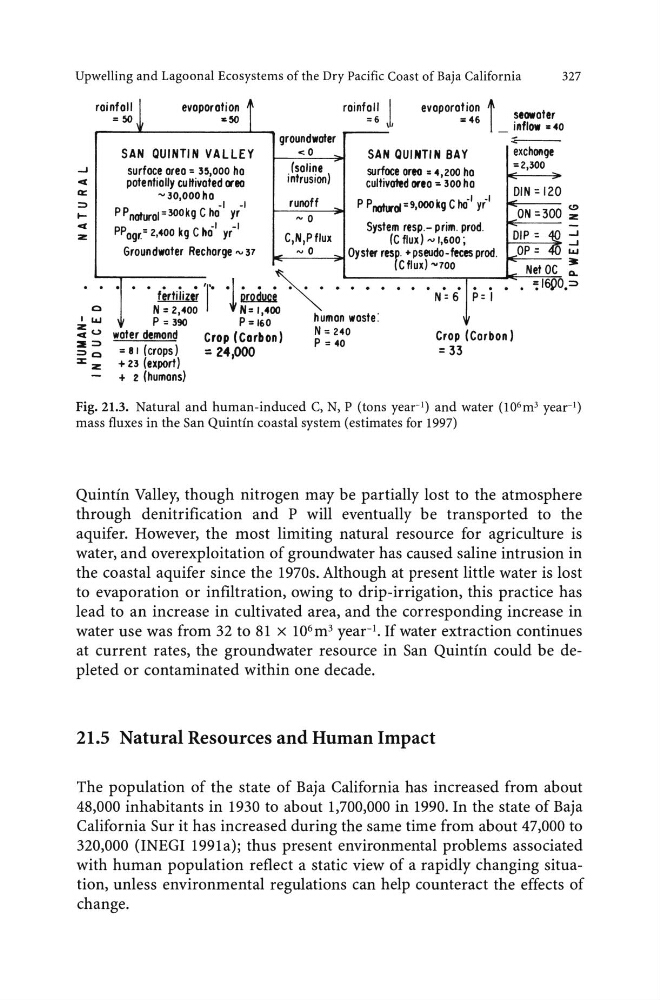
Fig. 21.3. Natural and human-induced C, N, P (tons year· ') and water (10 6 m 3 year- 1 )
mass fluxes in the San Quintin coastal system (estimates for 1997)
Quintin Valley, though nitrogen may be partially lost to the atmosphere
through denitrification and P will eventually be transported to the
aquifer. However, the most limiting natural resource for agriculture is
water, and overexploitation of groundwater has caused saline intrusion in
the coastal aquifer since the 1970s. Although at present little water is lost
to evaporation or infiltration, owing to drip-irrigation, this practice has
lead to an increase in cultivated area, and the corresponding increase in
water use was from 32 to 81 x 10 6 m 3 year- 1 • If water extraction continues
at current rates, the groundwater resource in San Quintin could be depleted or contaminated within one decade.
21.5 Natural Resources and Human Impact
The population of the state of Baja California has increased from about
48,000 inhabitants in 1930 to about 1,700,000 in 1990. In the state of Baja
California Sur it has increased during the same time from about 47,000 to
320,000 (INEGI 1991a); thus present environmental problems associated
with human population reflect a static view of a rapidly changing situation, unless environmental regulations can help counteract the effects of
change.
327
.....1
""
ct:
::::>
1"" z
rainfall, l evaporation j
=50
&50
roinf~l~ I
\1
~-evaporation i 1
= 46
seowo er
_ 1nflow =40
SAN QUINTIN VALLEY
surface oreo = 35,000 ho
potentially cultivated oreo
~3o,oooho
-1
-1
PPnoturoi=300kg C ho yr
groundwater
<0
(so line
intrusion)
runoff
-o
SAN QUINTIN BAY
surface oreo = 4,200 ho
cultivated oreo "' 300 ho
P P no~~wor = 9,ooo kg c ho·' yr'
exchonge
:2,300
DIN=I20
ON =300
pp
_, _,
ogr." 2,400 kg C ho yr
C,N,P flux
System resp.- prim. prod.
(C flux)"' 1,600 ;
JE-----;.t Oyster resp. +pseudo- feces prod.
DIP= 4Q
Groundwater Recharge "'37
~o
• fertiiize~ ., ••
N = 2,400
( C flux) "'700
•I ~•r"' •luna •~ • • • • • • • • • • • • •
t IW/.lll!Jilln ~
N = 6 P : I
.
p = 390
water demand
= 81 (crops)
+23 (export)
+ 2 (humans)
N= 1,400
p = 160
human waste.
N = 240
Crop (Corban)
= 24,000
p = 40
Crop (Cor bon)
= 33
OP = 4()
Net OC
. =;1~0
(!)
z
.....1
.....1
.....
:It
Q.
::::>
.
Fig. 21.3. Natural and human-induced C, N, P (tons year· ') and water (10 6 m 3 year- 1 )
mass fluxes in the San Quintin coastal system (estimates for 1997)
Quintin Valley, though nitrogen may be partially lost to the atmosphere
through denitrification and P will eventually be transported to the
aquifer. However, the most limiting natural resource for agriculture is
water, and overexploitation of groundwater has caused saline intrusion in
the coastal aquifer since the 1970s. Although at present little water is lost
to evaporation or infiltration, owing to drip-irrigation, this practice has
lead to an increase in cultivated area, and the corresponding increase in
water use was from 32 to 81 x 10 6 m 3 year- 1 • If water extraction continues
at current rates, the groundwater resource in San Quintin could be depleted or contaminated within one decade.
21.5 Natural Resources and Human Impact
The population of the state of Baja California has increased from about
48,000 inhabitants in 1930 to about 1,700,000 in 1990. In the state of Baja
California Sur it has increased during the same time from about 47,000 to
320,000 (INEGI 1991a); thus present environmental problems associated
with human population reflect a static view of a rapidly changing situation, unless environmental regulations can help counteract the effects of
change.