

326
S.E. Ibarra-Obando et al.
ever, residual flow is an order of magnitude lower than the exchange of
water volume (approx. 6 x 10 6 m 3 day- 1 in summer) between the bay and
ocean. Higher respiration of organic detritus than primary production
leads to excess dissolved inorganic phosphorus (DIP) inside the bay; thus,
especially in summer the bay is a net heterotrophic system. In contrast, an
overall net deficit of dissolved inorganic nitrogen (DIN) in the bay suggests a net denitrifying system. Bahia San Quintin is therefore a net source
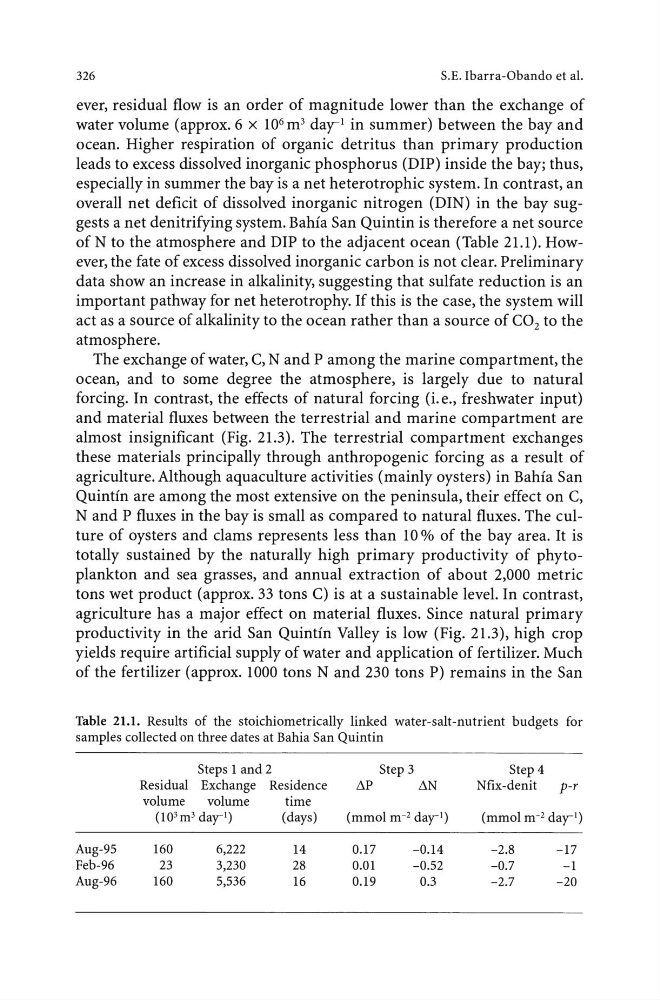
of N to the atmosphere and DIP to the adjacent ocean (Table 21.1). However, the fate of excess dissolved inorganic carbon is not clear. Preliminary
data show an increase in alkalinity, suggesting that sulfate reduction is an
important pathway for net heterotrophy. If this is the case, the system will
act as a source of alkalinity to the ocean rather than a source of C0 2 to the
atmosphere.
The exchange of water, C, N and P among the marine compartment, the
ocean, and to some degree the atmosphere, is largely due to natural
forcing. In contrast, the effects of natural forcing (i.e., freshwater input)
and material fluxes between the terrestrial and marine compartment are
almost insignificant (Fig. 21.3). The terrestrial compartment exchanges
these materials principally through anthropogenic forcing as a result of
agriculture. Although aquaculture activities (mainly oysters) in Bahia San
Quintin are among the most extensive on the peninsula, their effect on C,
Nand P fluxes in the bay is small as compared to natural fluxes. The culture of oysters and clams represents less than 10 o/o of the bay area. It is
totally sustained by the naturally high primary productivity of phytoplankton and sea grasses, and annual extraction of about 2,000 metric
tons wet product (approx. 33 tons C) is at a sustainable level. In contrast,
agriculture has a major effect on material fluxes. Since natural primary
productivity in the arid San Quintin Valley is low (Fig. 21.3), high crop
yields require artificial supply of water and application of fertilizer. Much
of the fertilizer (approx. 1000 tons Nand 230 tons P) remains in the San
Table 21.1. Results of the stoichiometrically linked water-salt-nutrient budgets for
samples collected on three dates at Bahia San Quintin
Steps 1 and 2
Step 3
Step 4
Residual Exchange Residence
ilP
ilN
Nfix-denit
p-r
volume
volume
time
(10 3 m 3 day- 1 )
(days)
(mmol m- 2 day- 1 )
(mmol m- 2 day- 1 )
Aug-95
160
6,222
14
0.17
-0.14
-2.8
-17
Feb-96
23
3,230
28
0.01
-0.52
-0.7
-1
Aug-96
160
5,536
16
0.19
0.3
-2.7
-20
S.E. Ibarra-Obando et al.
ever, residual flow is an order of magnitude lower than the exchange of
water volume (approx. 6 x 10 6 m 3 day- 1 in summer) between the bay and
ocean. Higher respiration of organic detritus than primary production
leads to excess dissolved inorganic phosphorus (DIP) inside the bay; thus,
especially in summer the bay is a net heterotrophic system. In contrast, an
overall net deficit of dissolved inorganic nitrogen (DIN) in the bay suggests a net denitrifying system. Bahia San Quintin is therefore a net source
of N to the atmosphere and DIP to the adjacent ocean (Table 21.1). However, the fate of excess dissolved inorganic carbon is not clear. Preliminary
data show an increase in alkalinity, suggesting that sulfate reduction is an
important pathway for net heterotrophy. If this is the case, the system will
act as a source of alkalinity to the ocean rather than a source of C0 2 to the
atmosphere.
The exchange of water, C, N and P among the marine compartment, the
ocean, and to some degree the atmosphere, is largely due to natural
forcing. In contrast, the effects of natural forcing (i.e., freshwater input)
and material fluxes between the terrestrial and marine compartment are
almost insignificant (Fig. 21.3). The terrestrial compartment exchanges
these materials principally through anthropogenic forcing as a result of
agriculture. Although aquaculture activities (mainly oysters) in Bahia San
Quintin are among the most extensive on the peninsula, their effect on C,
Nand P fluxes in the bay is small as compared to natural fluxes. The culture of oysters and clams represents less than 10 o/o of the bay area. It is
totally sustained by the naturally high primary productivity of phytoplankton and sea grasses, and annual extraction of about 2,000 metric
tons wet product (approx. 33 tons C) is at a sustainable level. In contrast,
agriculture has a major effect on material fluxes. Since natural primary
productivity in the arid San Quintin Valley is low (Fig. 21.3), high crop
yields require artificial supply of water and application of fertilizer. Much
of the fertilizer (approx. 1000 tons Nand 230 tons P) remains in the San
Table 21.1. Results of the stoichiometrically linked water-salt-nutrient budgets for
samples collected on three dates at Bahia San Quintin
Steps 1 and 2
Step 3
Step 4
Residual Exchange Residence
ilP
ilN
Nfix-denit
p-r
volume
volume
time
(10 3 m 3 day- 1 )
(days)
(mmol m- 2 day- 1 )
(mmol m- 2 day- 1 )
Aug-95
160
6,222
14
0.17
-0.14
-2.8
-17
Feb-96
23
3,230
28
0.01
-0.52
-0.7
-1
Aug-96
160
5,536
16
0.19
0.3
-2.7
-20