

The Gulf of Guayaquil and the Guayas River Estuary, Ecuador
257
·16 A
0 Shrimp Pond
~ - 18
. z~riM
a..
Cf)-20
-8-22
Mangrove Leaves/
~
-
Detritus
o-24
)It
-
~
7-o-26
-28
•
--30
14 8
~ 12
a..
((') 10
Marine
- ~J
0
8
~
- li
Mangrove Leaves/
z 6
Detritus
:!:!
4
c.o
•
2
0 Shrimp Pond
-20
0
20
40
60
80 100 120
(C:N)a
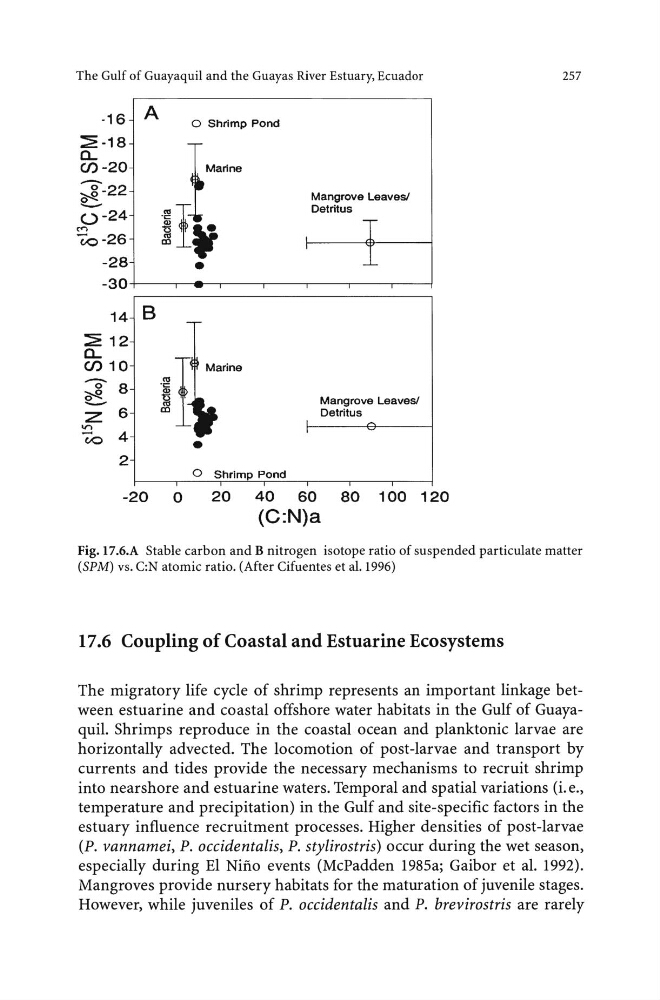
Fig. 17 .6.A Stable carbon and B nitrogen isotope ratio of suspended particulate matter
(SPM) vs. C:N atomic ratio. (After Cifuentes et al. 1996)
17.6 Coupling of Coastal and Estuarine Ecosystems
The migratory life cycle of shrimp represents an important linkage between estuarine and coastal offshore water habitats in the Gulf of Guayaquil. Shrimps reproduce in the coastal ocean and planktonic larvae are
horizontally advected. The locomotion of post-larvae and transport by
currents and tides provide the necessary mechanisms to recruit shrimp
into nearshore and estuarine waters. Temporal and spatial variations (i.e.,
temperature and precipitation) in the Gulf and site-specific factors in the
estuary influence recruitment processes. Higher densities of post-larvae
(P. vannamei, P. occidentalis, P. stylirostris) occur during the wet season,
especially during El Niiio events (McPadden 1985a; Gaibor et al. 1992).
Mangroves provide nursery habitats for the maturation of juvenile stages.
However, while juveniles of P. occidentalis and P. brevirostris are rarely
257
·16 A
0 Shrimp Pond
~ - 18
. z~riM
a..
Cf)-20
-8-22
Mangrove Leaves/
~
-
Detritus
o-24
)It
-
~
7-o-26
-28
•
--30
14 8
~ 12
a..
((') 10
Marine
- ~J
0
8
~
- li
Mangrove Leaves/
z 6
Detritus
:!:!
4
c.o
•
2
0 Shrimp Pond
-20
0
20
40
60
80 100 120
(C:N)a
Fig. 17 .6.A Stable carbon and B nitrogen isotope ratio of suspended particulate matter
(SPM) vs. C:N atomic ratio. (After Cifuentes et al. 1996)
17.6 Coupling of Coastal and Estuarine Ecosystems
The migratory life cycle of shrimp represents an important linkage between estuarine and coastal offshore water habitats in the Gulf of Guayaquil. Shrimps reproduce in the coastal ocean and planktonic larvae are
horizontally advected. The locomotion of post-larvae and transport by
currents and tides provide the necessary mechanisms to recruit shrimp
into nearshore and estuarine waters. Temporal and spatial variations (i.e.,
temperature and precipitation) in the Gulf and site-specific factors in the
estuary influence recruitment processes. Higher densities of post-larvae
(P. vannamei, P. occidentalis, P. stylirostris) occur during the wet season,
especially during El Niiio events (McPadden 1985a; Gaibor et al. 1992).
Mangroves provide nursery habitats for the maturation of juvenile stages.
However, while juveniles of P. occidentalis and P. brevirostris are rarely