

256
..J
..J
ct:
11.
11::
w
~
~
::::;
11.
ct:
w
..J
R.R. Twilley et a!.
1
2
3
4
5
LEAF LITTER STANDING CROP (tons/ha)
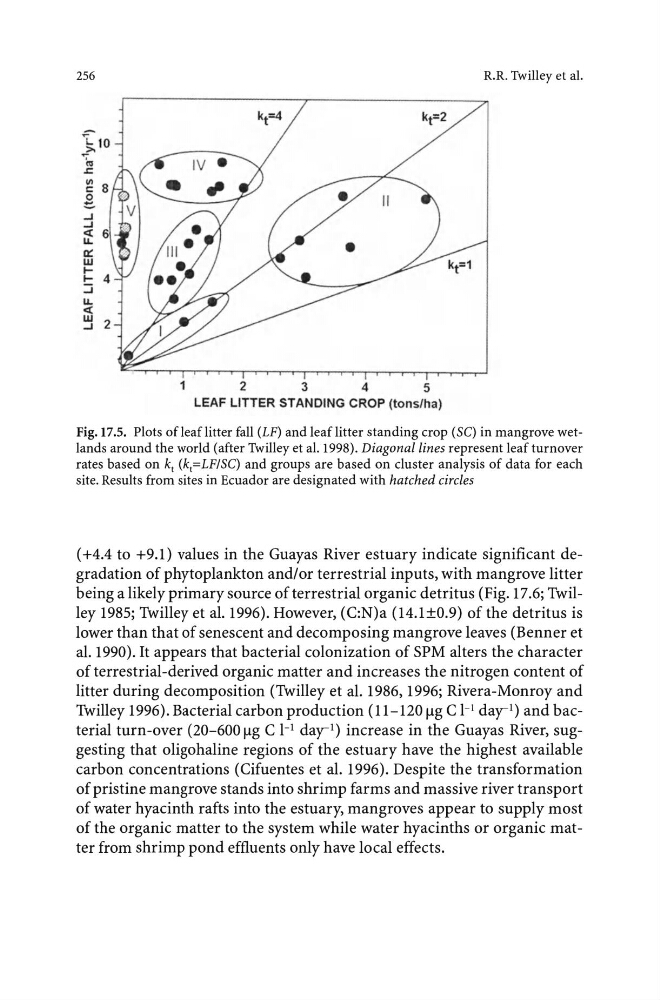
Fig.17.5. Plots of leaf litter fall (LF) and leaf litter standing crop (SC) in mangrove wetlands around the world (after Twilley eta!. 1998). Diagonal lines represent leaf turnover
rates based on k 1 (k 1 =LF/SC) and groups are based on cluster analysis of data for each
site. Results from sites in Ecuador are designated with hatched circles
( +4.4 to +9.1) values in the Guayas River estuary indicate significant degradation of phytoplankton and/or terrestrial inputs, with mangrove litter
being a likely primary source of terrestrial organic detritus (Fig. 17.6; Twilley 1985; Twilley et al. 1996). However, (C:N)a (14.1±0.9) of the detritus is
lower than that of senescent and decomposing mangrove leaves (Benner et
al. 1990). It appears that bacterial colonization of SPM alters the character
of terrestrial-derived organic matter and increases the nitrogen content of
litter during decomposition (Twilley et al. 1986, 1996; Rivera-Monroy and
Twilley 1996). Bacterial carbon production ( 11-120 jlg C 1- 1 day- 1 ) and bacterial turn-over (20-600 jlg C 1-' day- 1 ) increase in the Guayas River, suggesting that oligohaline regions of the estuary have the highest available
carbon concentrations (Cifuentes et al. 1996). Despite the transformation
of pristine mangrove stands into shrimp farms and massive river transport
of water hyacinth rafts into the estuary, mangroves appear to supply most
of the organic matter to the system while water hyacinths or organic matter from shrimp pond effluents only have local effects.
..J
..J
ct:
11.
11::
w
~
~
::::;
11.
ct:
w
..J
R.R. Twilley et a!.
1
2
3
4
5
LEAF LITTER STANDING CROP (tons/ha)
Fig.17.5. Plots of leaf litter fall (LF) and leaf litter standing crop (SC) in mangrove wetlands around the world (after Twilley eta!. 1998). Diagonal lines represent leaf turnover
rates based on k 1 (k 1 =LF/SC) and groups are based on cluster analysis of data for each
site. Results from sites in Ecuador are designated with hatched circles
( +4.4 to +9.1) values in the Guayas River estuary indicate significant degradation of phytoplankton and/or terrestrial inputs, with mangrove litter
being a likely primary source of terrestrial organic detritus (Fig. 17.6; Twilley 1985; Twilley et al. 1996). However, (C:N)a (14.1±0.9) of the detritus is
lower than that of senescent and decomposing mangrove leaves (Benner et
al. 1990). It appears that bacterial colonization of SPM alters the character
of terrestrial-derived organic matter and increases the nitrogen content of
litter during decomposition (Twilley et al. 1986, 1996; Rivera-Monroy and
Twilley 1996). Bacterial carbon production ( 11-120 jlg C 1- 1 day- 1 ) and bacterial turn-over (20-600 jlg C 1-' day- 1 ) increase in the Guayas River, suggesting that oligohaline regions of the estuary have the highest available
carbon concentrations (Cifuentes et al. 1996). Despite the transformation
of pristine mangrove stands into shrimp farms and massive river transport
of water hyacinth rafts into the estuary, mangroves appear to supply most
of the organic matter to the system while water hyacinths or organic matter from shrimp pond effluents only have local effects.