

The Gulf of Guayaquil and the Guayas River Estuary, Ecuador
251
90
80
70
~ 60
. so
z 40
5 30
20
10
GUAVAS
:P"' 15.5
•
0~--~~------r-•
90
80
;; 70
=>. 60
. so
~ -10
c 30
20
0
2 3 4
SRP, ~J.~\1
CHURUTE
s 6
I :P= 15.5
10
0 ~~--r-;-~--~~
90
80
70
~ 60
-:50
~ 40
0 30
20
10
0
0
0
2 3 4
SRP. ~I
SALADO
5 6
. :P = 15.5
400
z 300
:1
·- · 200
til
GUAVAS
100
o~~~r"~~~~~~~~~
400
z :1300
til 200
100
J 0 N D F M A M J J A S N D
CHUA UTE
0 ~~~~~~~~~~~~~
400
z 300
:1
u;' 200
J 0 N D F M A M J J A S N D
SALADO
100
0~~~~~~~~~~~~~
J 0 N D F M A M J J A S N D
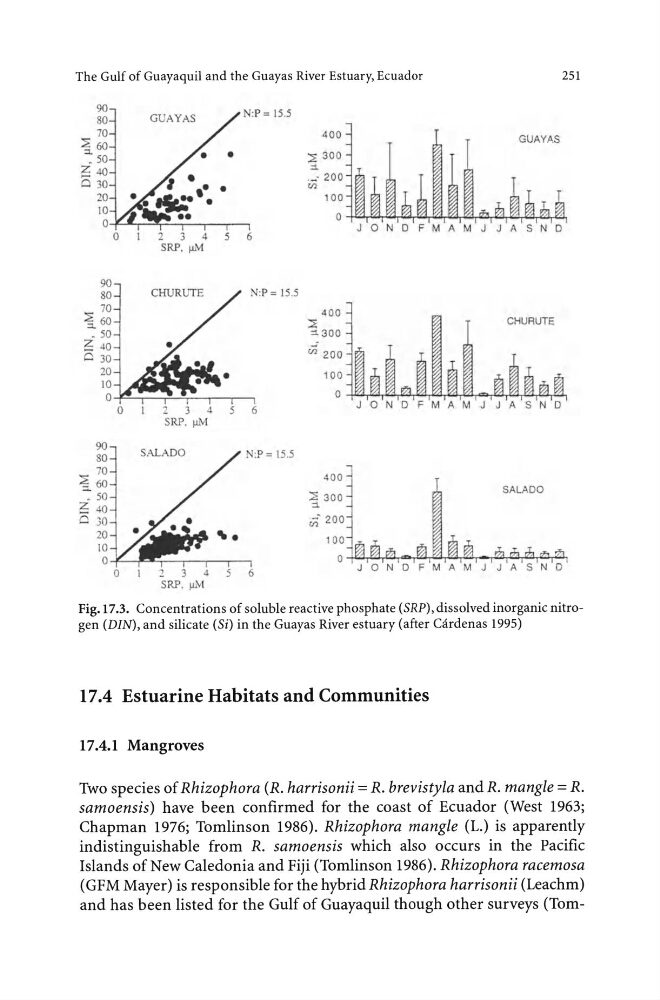
Fig. 17 .3. Concentrations of soluble reactive phosphate ( SRP), dissolved inorganic nitrogen (DIN), and silicate (Si) in the Guayas River estuary (after Cardenas 1995)
17.4 Estuarine Habitats and Communities
17 .4.1 Mangroves
Two species of Rhizophora (R. harrisonii = R. brevistyla and R. mangle = R.
samoensis) have been confirmed for the coast of Ecuador (West 1963;
Chapman 1976; Tomlinson 1986). Rhizophora mangle (L.) is apparently
indistinguishable from R. samoensis which also occurs in the Pacific
Islands of New Caledonia and Fiji (Tomlinson 1986). Rhizophora racemosa
(GFM Mayer) is responsible for the hybrid Rhizophora harrisonii (Leachm)
and has been listed for the Gulf of Guayaquil though other surveys (Tom-
251
90
80
70
~ 60
. so
z 40
5 30
20
10
GUAVAS
:P"' 15.5
•
0~--~~------r-•
90
80
;; 70
=>. 60
. so
~ -10
c 30
20
0
2 3 4
SRP, ~J.~\1
CHURUTE
s 6
I :P= 15.5
10
0 ~~--r-;-~--~~
90
80
70
~ 60
-:50
~ 40
0 30
20
10
0
0
0
2 3 4
SRP. ~I
SALADO
5 6
. :P = 15.5
400
z 300
:1
·- · 200
til
GUAVAS
100
o~~~r"~~~~~~~~~
400
z :1300
til 200
100
J 0 N D F M A M J J A S N D
CHUA UTE
0 ~~~~~~~~~~~~~
400
z 300
:1
u;' 200
J 0 N D F M A M J J A S N D
SALADO
100
0~~~~~~~~~~~~~
J 0 N D F M A M J J A S N D
Fig. 17 .3. Concentrations of soluble reactive phosphate ( SRP), dissolved inorganic nitrogen (DIN), and silicate (Si) in the Guayas River estuary (after Cardenas 1995)
17.4 Estuarine Habitats and Communities
17 .4.1 Mangroves
Two species of Rhizophora (R. harrisonii = R. brevistyla and R. mangle = R.
samoensis) have been confirmed for the coast of Ecuador (West 1963;
Chapman 1976; Tomlinson 1986). Rhizophora mangle (L.) is apparently
indistinguishable from R. samoensis which also occurs in the Pacific
Islands of New Caledonia and Fiji (Tomlinson 1986). Rhizophora racemosa
(GFM Mayer) is responsible for the hybrid Rhizophora harrisonii (Leachm)
and has been listed for the Gulf of Guayaquil though other surveys (Tom-