

The Subtropical Estuarine Complex of Paranagua Bay, Brazil
137
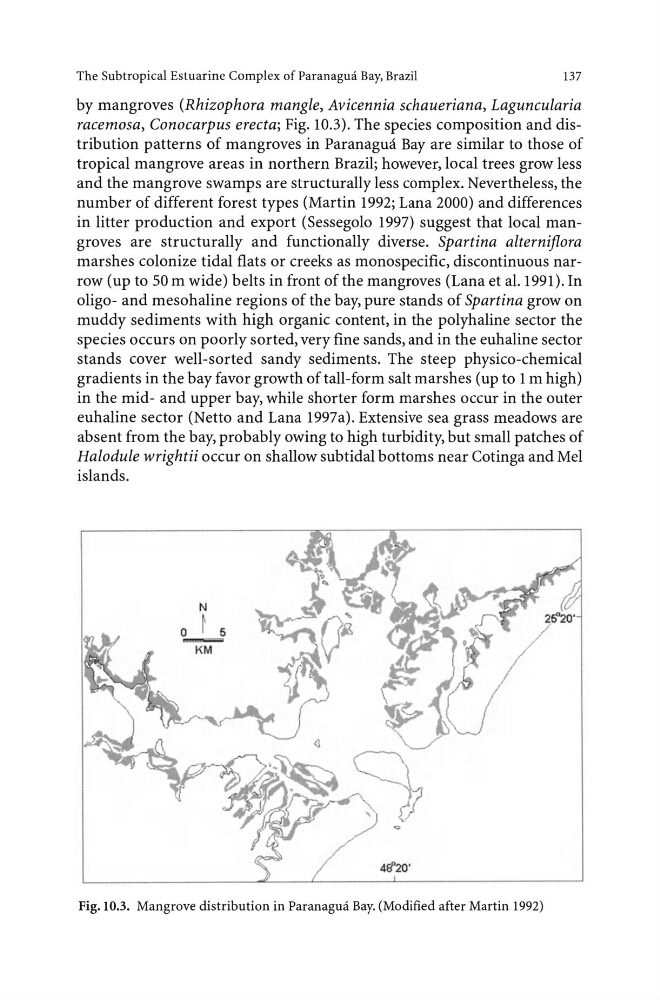
by mangroves (Rhizophora mangle, Avicennia schaueriana, Laguncularia
racemosa, Conocarpus erecta; Fig. 10.3). The species composition and distribution patterns of mangroves in Paranagua Bay are similar to those of
tropical mangrove areas in northern Brazil; however, local trees grow less
and the mangrove swamps are structurally less complex. Nevertheless, the
number of different forest types (Martin 1992; Lana 2000) and differences
in litter production and export (Sessegolo 1997) suggest that local mangroves are structurally and functionally diverse. Spartina alternijlora
marshes colonize tidal flats or creeks as monospecific, discontinuous narrow (up to 50 m wide) belts in front of the mangroves (Lana et al. 1991). In
oligo- and mesohaline regions of the bay, pure stands of Spartina grow on
muddy sediments with high organic content, in the polyhaline sector the
species occurs on poorly sorted, very fine sands, and in the euhaline sector
stands cover well-sorted sandy sediments. The steep physico-chemical
gradients in the bay favor growth of tall-form salt marshes (up to 1 m high)
in the mid- and upper bay, while shorter form marshes occur in the outer
euhaline sector (Netto and Lana 1997a). Extensive sea grass meadows are
absent from the bay, probably owing to high turbidity, but small patches of
Halodule wrightii occur on shallow subtidal bottoms near Cotinga and Mel
islands.
N
0 ~ 5
..............
KM
4&"20"
Fig. 10.3. Mangrove distribution in Paranagua Bay. (Modified after Martin 1992)
137
by mangroves (Rhizophora mangle, Avicennia schaueriana, Laguncularia
racemosa, Conocarpus erecta; Fig. 10.3). The species composition and distribution patterns of mangroves in Paranagua Bay are similar to those of
tropical mangrove areas in northern Brazil; however, local trees grow less
and the mangrove swamps are structurally less complex. Nevertheless, the
number of different forest types (Martin 1992; Lana 2000) and differences
in litter production and export (Sessegolo 1997) suggest that local mangroves are structurally and functionally diverse. Spartina alternijlora
marshes colonize tidal flats or creeks as monospecific, discontinuous narrow (up to 50 m wide) belts in front of the mangroves (Lana et al. 1991). In
oligo- and mesohaline regions of the bay, pure stands of Spartina grow on
muddy sediments with high organic content, in the polyhaline sector the
species occurs on poorly sorted, very fine sands, and in the euhaline sector
stands cover well-sorted sandy sediments. The steep physico-chemical
gradients in the bay favor growth of tall-form salt marshes (up to 1 m high)
in the mid- and upper bay, while shorter form marshes occur in the outer
euhaline sector (Netto and Lana 1997a). Extensive sea grass meadows are
absent from the bay, probably owing to high turbidity, but small patches of
Halodule wrightii occur on shallow subtidal bottoms near Cotinga and Mel
islands.
N
0 ~ 5
..............
KM
4&"20"
Fig. 10.3. Mangrove distribution in Paranagua Bay. (Modified after Martin 1992)