

136
P. Lana eta!.
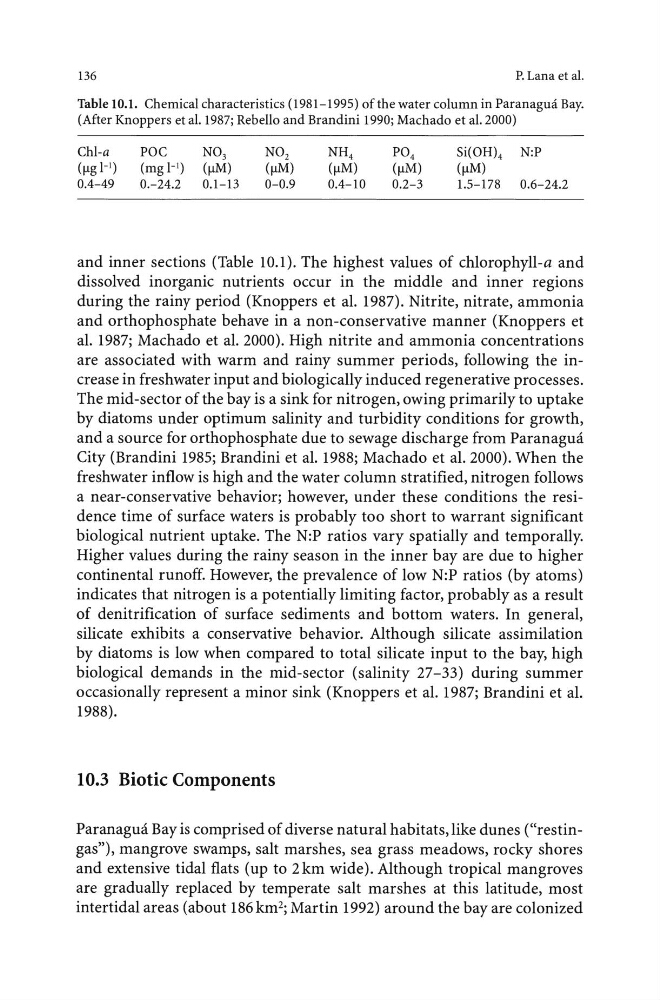
Table 10.1. Chemical characteristics (1981-1995) of the water column in Paranagua Bay.
(After Knoppers eta!. 1987; Rebello and Brandini 1990; Machado eta!. 2000)
Chi-a
(jlg J-1)
0.4-49
POC
(mg I- 1 )
0.-24.2
N0 3
(flM)
0.1-13
N0 2
(flM)
0-0.9
P0 4
(jlM)
0.2-3
Si(OH) 4 N:P
(flM)
1.5-178 0.6-24.2
and inner sections (Table 10.1). The highest values of chlorophyll-a and
dissolved inorganic nutrients occur in the middle and inner regions
during the rainy period (Knoppers et al. 1987). Nitrite, nitrate, ammonia
and orthophosphate behave in a non-conservative manner (Knoppers et
al. 1987; Machado et al. 2000). High nitrite and ammonia concentrations
are associated with warm and rainy summer periods, following the increase in freshwater input and biologically induced regenerative processes.
The mid-sector of the bay is a sink for nitrogen, owing primarily to uptake
by diatoms under optimum salinity and turbidity conditions for growth,
and a source for orthophosphate due to sewage discharge from Paranagua
City (Brandini 1985; Brandini et al. 1988; Machado et al. 2000). When the
freshwater inflow is high and the water column stratified, nitrogen follows
a near-conservative behavior; however, under these conditions the residence time of surface waters is probably too short to warrant significant
biological nutrient uptake. The N:P ratios vary spatially and temporally.
Higher values during the rainy season in the inner bay are due to higher
continental runoff. However, the prevalence of low N:P ratios (by atoms)
indicates that nitrogen is a potentially limiting factor, probably as a result
of denitrification of surface sediments and bottom waters. In general,
silicate exhibits a conservative behavior. Although silicate assimilation
by diatoms is low when compared to total silicate input to the bay, high
biological demands in the mid-sector (salinity 27-33) during summer
occasionally represent a minor sink (Knoppers et al. 1987; Brandini et al.
1988).
10.3 Biotic Components
Paranagua Bay is comprised of diverse natural habitats, like dunes ("restingas"), mangrove swamps, salt marshes, sea grass meadows, rocky shores
and extensive tidal flats (up to 2km wide) . Although tropical mangroves
are gradually replaced by temperate salt marshes at this latitude, most
intertidal areas (about 186 km 2 ; Martin 1992) around the bay are colonized
P. Lana eta!.
Table 10.1. Chemical characteristics (1981-1995) of the water column in Paranagua Bay.
(After Knoppers eta!. 1987; Rebello and Brandini 1990; Machado eta!. 2000)
Chi-a
(jlg J-1)
0.4-49
POC
(mg I- 1 )
0.-24.2
N0 3
(flM)
0.1-13
N0 2
(flM)
0-0.9
P0 4
(jlM)
0.2-3
Si(OH) 4 N:P
(flM)
1.5-178 0.6-24.2
and inner sections (Table 10.1). The highest values of chlorophyll-a and
dissolved inorganic nutrients occur in the middle and inner regions
during the rainy period (Knoppers et al. 1987). Nitrite, nitrate, ammonia
and orthophosphate behave in a non-conservative manner (Knoppers et
al. 1987; Machado et al. 2000). High nitrite and ammonia concentrations
are associated with warm and rainy summer periods, following the increase in freshwater input and biologically induced regenerative processes.
The mid-sector of the bay is a sink for nitrogen, owing primarily to uptake
by diatoms under optimum salinity and turbidity conditions for growth,
and a source for orthophosphate due to sewage discharge from Paranagua
City (Brandini 1985; Brandini et al. 1988; Machado et al. 2000). When the
freshwater inflow is high and the water column stratified, nitrogen follows
a near-conservative behavior; however, under these conditions the residence time of surface waters is probably too short to warrant significant
biological nutrient uptake. The N:P ratios vary spatially and temporally.
Higher values during the rainy season in the inner bay are due to higher
continental runoff. However, the prevalence of low N:P ratios (by atoms)
indicates that nitrogen is a potentially limiting factor, probably as a result
of denitrification of surface sediments and bottom waters. In general,
silicate exhibits a conservative behavior. Although silicate assimilation
by diatoms is low when compared to total silicate input to the bay, high
biological demands in the mid-sector (salinity 27-33) during summer
occasionally represent a minor sink (Knoppers et al. 1987; Brandini et al.
1988).
10.3 Biotic Components
Paranagua Bay is comprised of diverse natural habitats, like dunes ("restingas"), mangrove swamps, salt marshes, sea grass meadows, rocky shores
and extensive tidal flats (up to 2km wide) . Although tropical mangroves
are gradually replaced by temperate salt marshes at this latitude, most
intertidal areas (about 186 km 2 ; Martin 1992) around the bay are colonized